

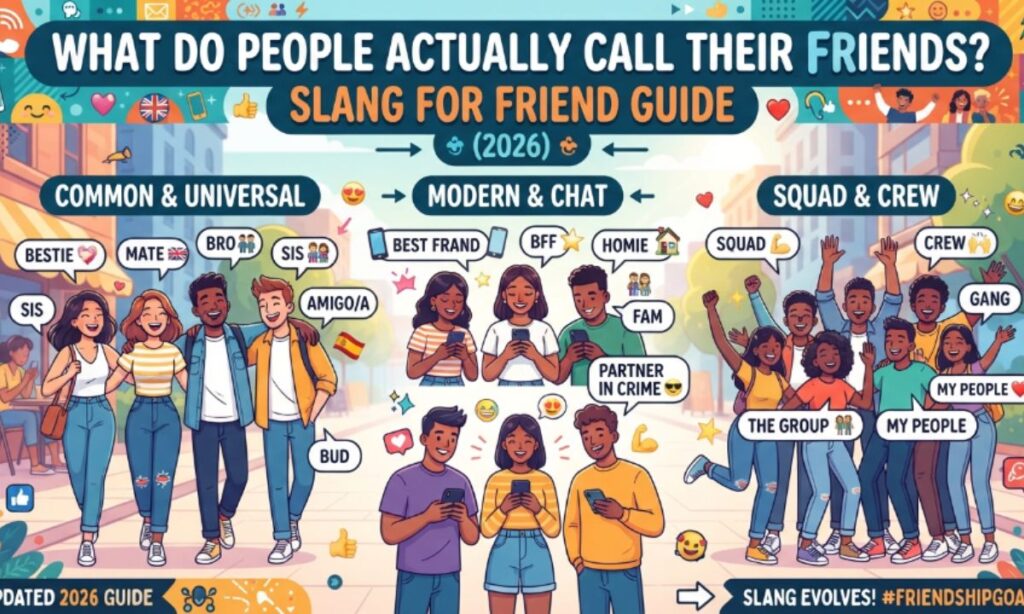
Ever called someone “bro” and wondered where that word actually came from? You use slang for friend every single day. But most people never learn its real meaning or origin.
Friend slang isn’t just casual talk it’s identity. Every slang word for friend, from bestie to mate, signals closeness. This guide breaks down every trending slang words for friend, so you never sound out of touch with real slang for friends again.
Quick Reference Table for Friend Slang
| Word | Meaning | Region/Origin |
| Bro | Close male friend | US |
| Bestie | Best friend | Global/Gen Z |
| Mate | Friend | UK/Australia |
| Homie | Loyal friend from your area | US urban |
| Fam | Trusted friend, family-like | US |
| Squad | Group of close friends | Global |
| Ride or Die | Extremely loyal friend | US |
| Pal | Casual friend | Global |
| Buddy | Friendly companion | US/Canada |
| Sis | Close female friend | Global |
This table alone shows how wide slang for friend really stretches from old-school casual words for friend like “pal” to modern, internet-driven terms like “bestie.”
Classic Slang Words for Friend

These are the informal words for friend that have stuck around for decades. They work almost anywhere and rarely sound outdated, unlike a lot of trending slang for friends that fades fast.
Mate
Mate is common British slang for friend, also widely used in Australia and New Zealand. It works as a greeting too you can say it to a stranger, not just a close friend.
Buddy
Buddy is a friendly, all-purpose word popular in the US and Canada. It’s neutral enough to use with kids, coworkers, or actual friends without sounding too casual.
Pal
Pal is one of the older casual words for friend, still used by all age groups. It has a light, easygoing tone not deep, just friendly.
Bro
Bro comes from “brother” and refers to a close male friend, though it’s used more broadly now. It’s one of the most recognizable slang terms for friend group culture in the US.
Dawg
Dawg is a playful, informal way to call someone a close friend. It leans casual and works best in relaxed conversations, not formal ones.
Chum
Chum is older British slang, less common today but still understood. It shows how language and slang evolution move some words toward “old-school” status over time.
Homie
Homie means a loyal friend, often from your neighborhood or crew. It has roots in hip-hop and urban culture and remains one of the most-used slang words for friends today.
Viral & Gen Z Slang for Friend

Internet slang and short-form videos have reshaped how younger people talk about friendship. This is where digital-era communication really shows in language.
Bestie
Bestie means best friend, but online it’s often used loosely even for strangers in comments, half-jokingly. It’s a strong example of Gen Z slang for friend spreading through social media influenced language.
Ride or Die
Ride or die describes a friend who’s loyal no matter what happens. It carries real emotional weight, so it’s usually reserved for a true slang for close friend, not casual acquaintances.
Bruh
Bruh started as a version of “bro” but now doubles as a reaction word (“bruh, seriously?”). It shows how informal vocabulary can shift meaning through memes and repeated online use.
OG
OG stands for “Original Gangster,” used to respect a long-time, trusted friend. It signals history and loyalty and trust built over years.
G
G is a short, cool way to refer to a trusted friend, common in urban and hip-hop-influenced speech. It’s casual, quick, and mostly used between close friends.
Twin
Twin describes a friend who feels just like you same taste, same energy. It’s a newer, playful term that spread mainly through gaming communities and short-form videos.
Slang Words for Friends Group

Not all friend slang is about one person a lot of it describes the whole crew.
Squad
Squad refers to your tight friend group, popularized heavily by social media captions and hashtags.
Fam
Fam is short for family but used for friends who feel just as close. It reflects a warm, trusted communication style.
The Crew
The crew is a casual term for your regular friend group, often used when talking about hanging out or group plans.
My People
My people points to your trusted circle the friends who just “get you.”
Mandem
Mandem is UK slang for a group of male friends, rooted in London street culture with Jamaican English influence.
Slang for Friend Girl

Female-specific friend slang has its own vocabulary, shaped by both US and UK culture.
British Slang for Friend Girl
In the UK, girls often use “babe,” “hun,” or regional terms alongside “mate” British slang for friend girl tends to be warmer and more affectionate than general UK slang.
Slang for Best Friend Girl
For a best friend specifically, “bestie” and “sis” dominate both signal closeness without needing extra explanation.
Sis
Sis is a warm, sisterly nickname for a close female friend, used across most English-speaking regions.
BFF
BFF means “Best Friends Forever,” a term that took off through texting and early internet culture and is now mostly used online or in captions.
Funny Slang for Friend
Some friend slang exists purely for humor and playful conversation style.
Also Read This Blog “Smut Book”
Funny Slang for Best Friend
Terms like “partner in crime” or exaggerated nicknames (“my ride or die trouble-maker”) add humor while still meaning best friend.
Partner in Crime
Partner in crime describes a friend who joins you for fun (harmless) mischief or shared adventures.
Day One
Day one refers to a friend who’s been there since the very beginning often said with pride and appreciation.
UK Slang for Friend
In the UK, people often use slang words like mate, pal, or buddy to refer to a friend. Among these, mate is the most common and can be used in both casual conversations and friendly greetings, such as “Alright, mate?” It reflects warmth, familiarity, and friendship in British culture.
Mate
Mate remains the single most common UK term used for actual friends and strangers alike, in almost any casual conversation.
Chum
Chum is a more old-fashioned British word, occasionally used today in a joking, retro way.
Urban Slang for Friend
Urban slang for friend draws heavily from hip-hop culture and AAVE (African American Vernacular English), and understanding its roots matters.
Homie
Homie signals loyalty and closeness, especially to someone from your neighborhood or background.
Dawg
Dawg is a playful, informal nickname for a trusted friend, common in casual urban speech.
Bro
Bro also fits here it crosses over between general slang and urban slang for friend depending on tone and context.
Timeline: How Friend Slang Evolved
Friend slang didn’t appear overnight it moved through clear phases:
- Pre-2000s: Pal, buddy, mate, chum mostly regional, spread through speech and print
- 2000s–2010s: Homie, bro, dawg pushed mainstream by music culture and hip-hop
- 2010s: BFF, squad driven by early social media and texting
- 2020s–2026: Bestie, ride or die, twin, bruh spread instantly through short-form videos and memes
This timeline shows slang evolution isn’t random it tracks whatever communication platform is dominant at the time.
Slang for Friend by Generation
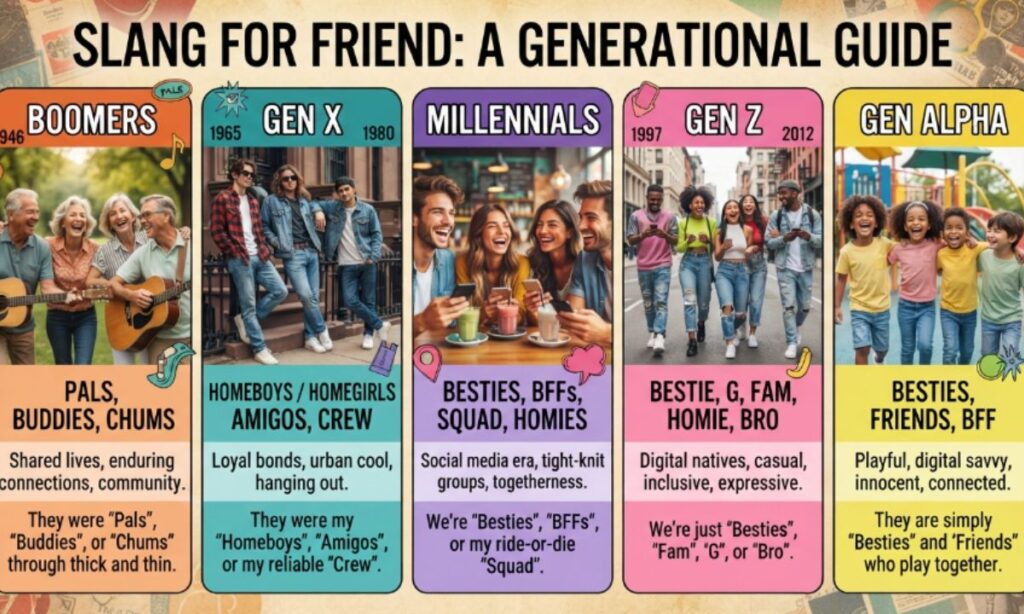
Generational slang comparison shows a clear pattern: each generation picks words that match its dominant communication style.
Gen Z
Gen Z leans toward bestie, twin, and bruh internet-born terms shaped by memes and short-form video slang.
Millennials
Millennials grew up with bro, homie, and squad, tied to early social media and music culture.
Older Generations
Older speakers stick with buddy, pal, and mate steady, still-understood, rarely “trending” but never fully outdated.
How to Use Friend Slang Naturally
Using slang well isn’t about knowing more words it’s about knowing when to use them.
Reading the Room Before Using Slang
Don’t jump into slang with someone you just met. Let context and comfort build first this is basic context awareness.
Matching Slang to Social Setting
A slang term for friend that works in a group chat may feel off in a formal email. Social setting awareness prevents that kind of mismatch.
Is Friend Slang Ever Controversial?
Yes and it’s worth knowing why. Many popular terms, including homie, fam, and bruh, come from Black American culture and AAVE. Using them casually is common, but understanding their origin matters, especially in professional communication or when speaking with people outside that culture.
Social Media Buzz Around Friend Slang

Social media influenced language faster than any previous era. Messaging apps, short-form videos, memes, and gaming communities now decide which slang words for friends go viral within days.
A term like “bestie” can shift from sincere to sarcastic online just through repeated meme use showing how fast internet slang meaning can change.
Common SlangMistakes for Friend
Friends often use slang words in casual conversations, but using them incorrectly can cause confusion or misunderstandings. Learning the correct meaning and context of common slang helps improve communication and makes conversations sound more natural and friendly.
Using Outdated Slang
Some words age fast. Using outdated slang confidently can come across as trying too hard.
Using Slang in Formal Writing
Formal vs informal language matters professional communication rarely welcomes casual friend slang.
Overusing Slang
Repeating the same term for every person you know weakens its meaning especially heavier words like “ride or die.”
Real Reactions When Slang Misfires
Calling a coworker “homie” in a meeting, or a stranger “bestie” too soon, often gets an awkward laugh or a confused look proof that context still rules.
Common Misconceptions About Friend Slang
- “Slang means disrespect” Actually, most friend slang signals closeness, not rudeness.
- “All slang is Gen Z” Many terms like mate and pal predate current generations by decades.
- “Regional slang works everywhere” Mate lands naturally in the UK but can sound forced elsewhere.
Fun Facts About Friend Slang
- “Mate” traces back to Middle Low German, meaning “comrade.”
- “Chum” likely comes from “chamber-fellow,” an old word for roommate.
- “BFF” started in early internet chatrooms, not texting.
- “Bestie” is now sometimes used sarcastically for strangers online.
Best Tools to Track New Slang
| Tool | Best For | Limitation |
| Urban Dictionary | Quick definitions | Not always accurate |
| TikTok | Real, live slang usage | Trends change fast |
| Genius | Slang in song lyrics/context | Music-focused only |
Frequently Asked Questions
What to call a friend in slang?
Common slang for friend includes bro, bestie, homie, mate, pal, and buddy. Each term varies by region, tone, and generation but all mean a close, trusted companion.
What is the Gen Z word for friends?
Gen Z’s favorite slang for friend is “bestie,” alongside “twin” and “bruh.” These terms spread through TikTok and short-form videos, replacing older words like buddy or pal.
How do you say friend in a cool way?
Cool slang for friend includes bestie, ride or die, OG, and G. These words sound casual and modern, fitting texts, group chats, and everyday informal conversation naturally.
What is Gen Z’s favorite slang?
Gen Z’s most popular slang for friend is “bestie,” used both sincerely and jokingly online. “Twin” and “bruh” also rank high in casual, internet-driven conversation today.
Below are relevant replacement questions added to strengthen this FAQ section:
What is British slang for friend?
British slang for friend mainly uses “mate,” a casual term for close friends and even strangers. “Chum” is an older, less common British slang for friend.
What is urban slang for friend?
Urban slang for friend includes homie, dawg, and bro, rooted in hip-hop and AAVE culture. These terms signal loyalty, closeness, and shared background between trusted friends.
Is “bestie” only used for girls?
No, bestie isn’t gender-specific slang for friend. Anyone can call their closest friend “bestie,” though it’s more commonly used among younger, female, and Gen Z speakers.
What is the most popular slang for friend?
“Bro” and “bestie” remain the most widely used slang for friend today, spanning generations. Mate, homie, and pal also stay popular across different regions and age groups.
What is slang for a group of friends?
Popular slang for a friend group includes squad, fam, the crew, and mandem. Each term reflects closeness and belonging within a trusted circle of friends.
Conclusion
Slang for friend reflects how language grows with culture, region, and generation. From classic friend slang like mate, buddy, and pal to viral terms like bestie and ride or die, each slang word for friend carries its own tone and history.
Slang words for friend aren’t random they show trust, loyalty, and belonging between people. UK speakers lean on mate, US culture favors bro and homie, and Gen Z keeps pushing new slang for friends through social media and short-form videos.
