

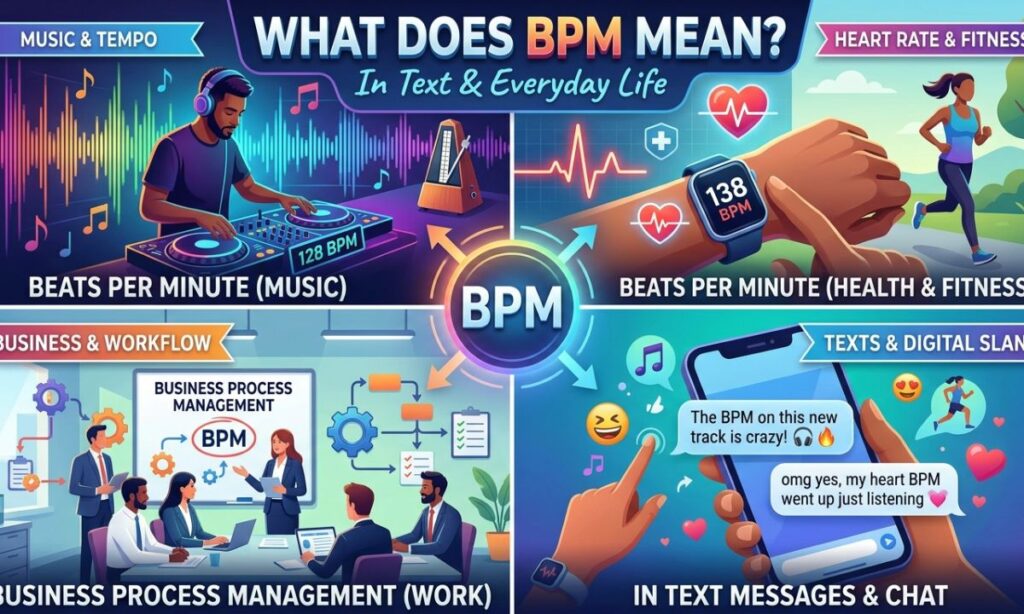
The BPM meaning is simple: it stands for beats per minute. It counts how many beats happen in sixty seconds, whether that is the tempo of a song or the number of times your heart beats. You will see it in music apps, fitness trackers, medical charts, and group chats.
This guide explains the BPM meaning in every common setting. You will learn where the term came from, how people use it in texts, what the numbers mean for your heart, and how to reply when someone sends it to you.
BPM Meaning: Quick Definition
BPM means beats per minute, a unit that measures how fast a rhythm or a heartbeat moves. A higher number means a faster pace. A lower number means a slower one.
Most Common Definitions
The BPM meaning changes slightly depending on where you see it. Here are the four you will meet most often.
| Setting | What BPM stands for | What it measures |
|---|---|---|
| Music | Beats per minute | The tempo or speed of a song |
| Health and fitness | Beats per minute | Your heart rate or pulse |
| Business | Business Process Management | How a company designs and improves workflows |
| Chat and social media | Beats per minute (often used as a joke) | Excitement, nerves, or a racing heart |
Simple Definition
BPM is the count of beats in one minute. If a song is 120 BPM, it has 120 beats every minute, or two beats every second. If your pulse is 72 BPM, your heart beats 72 times in one minute.
Example Quotes
These short lines show how people use the BPM meaning in daily talk.
“This track is 128 BPM, perfect for the gym.”
“Her smile just sent my BPM through the roof.”
“My resting BPM is 62 on my watch.”
“We are moving our approvals to a new BPM platform.”
Origin & Background
The BPM meaning grew from music, then moved into medicine, technology, and business. Each field borrowed the same idea of counting beats, and each gave it a slightly different job.
Musical Roots
The idea of measuring tempo in beats per minute became popular with the metronome in the early 1800s. Musicians could finally set an exact speed instead of writing words like “slow” or “lively.” Composers soon printed numbers on their sheet music, and the habit stuck.
Today, tempo markings like 60 BPM (slow) or 140 BPM (fast) are standard across every genre.
Medical Adoption
Doctors have counted pulse for centuries by pressing a finger to the wrist and watching the clock. Using BPM for heart rate made that count easy to record and compare. It gave nurses and doctors one shared unit.
Now monitors, pulse oximeters, and ECG machines show BPM instantly.
Digital & Internet Expansion
Smartwatches, fitness bands, DJ software, and music apps all display BPM on screen. This put the term in front of millions of people who never studied music or medicine. Social media then picked it up as playful slang for feelings.
A racing heart in a text or caption often shows up as “BPM rising.”
Business & Corporate Use
In offices, BPM often means Business Process Management. It is a method for mapping, automating, and improving how work gets done, such as invoice approvals or customer onboarding. Software tools built around it are called BPM suites.
If you see BPM in a work email about workflows or software, this is almost always the meaning.
Real-Life Conversations
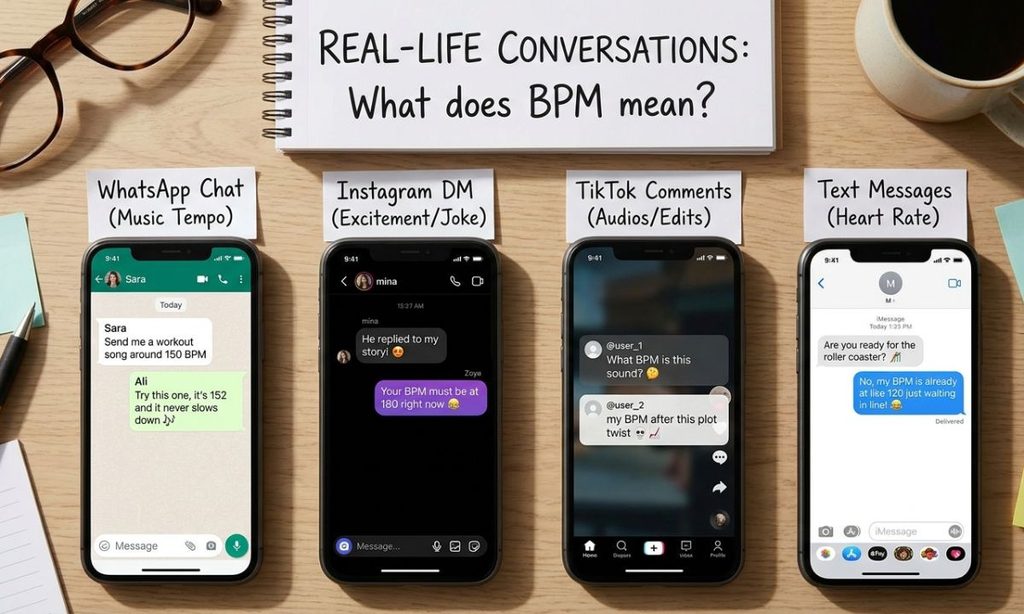
In chats, the BPM meaning is usually either a music tempo or a joke about someone’s heartbeat. Context tells you which one. These examples show the pattern.
WhatsApp Chat
Friends often use BPM when sharing playlists or talking about feelings.
Sara: Send me a workout song around 150 BPM Ali: Try this one, it’s 152 and it never slows down
Instagram DM
On Instagram, BPM often appears as a reaction to a crush or a surprise.
Mina: He replied to my story! Zoya: Your BPM must be at 180 right now
TikTok Comments
Creators and fans use BPM to talk about audio and edits. A comment like “What BPM is this sound?” usually comes from someone who wants to time a video cut to the beat. Others write “my BPM after this plot twist” as a joke.
Text Messages
In plain text messages, BPM is short and quick to type. A message like “Walking pace playlist, 110 BPM” is a music request. A message like “That call spiked my BPM” means the person felt nervous or excited.
Read Also This Blog BFF Meaning
Emotional & Psychological Meaning
The emotional BPM meaning links speed with feeling. Faster beats and faster heartbeats are tied to energy and excitement, while slower ones are tied to calm. That is why people use BPM to describe moods.
Music & Mood Connection
Fast music tends to raise energy, and slow music tends to relax the body. Songs around 120 to 140 BPM often feel upbeat and driving. Songs under 80 BPM often feel soft, sad, or soothing.
Many people pick playlists by BPM without even noticing.
Heartbeat & Emotion
Your heart speeds up when you feel fear, joy, anger, or attraction. This is why “my BPM went up” became a popular way to say someone made you nervous or excited. It is a light way to describe a real body reaction.
Psychological Identity
Some people describe themselves as “high BPM” or “low BPM” people. A high BPM person is energetic, fast-talking, and always moving. A low BPM person is calm, slow-paced, and steady.
This is not a medical label. It is a playful way to describe personality and pace.
Usage in Different Contexts
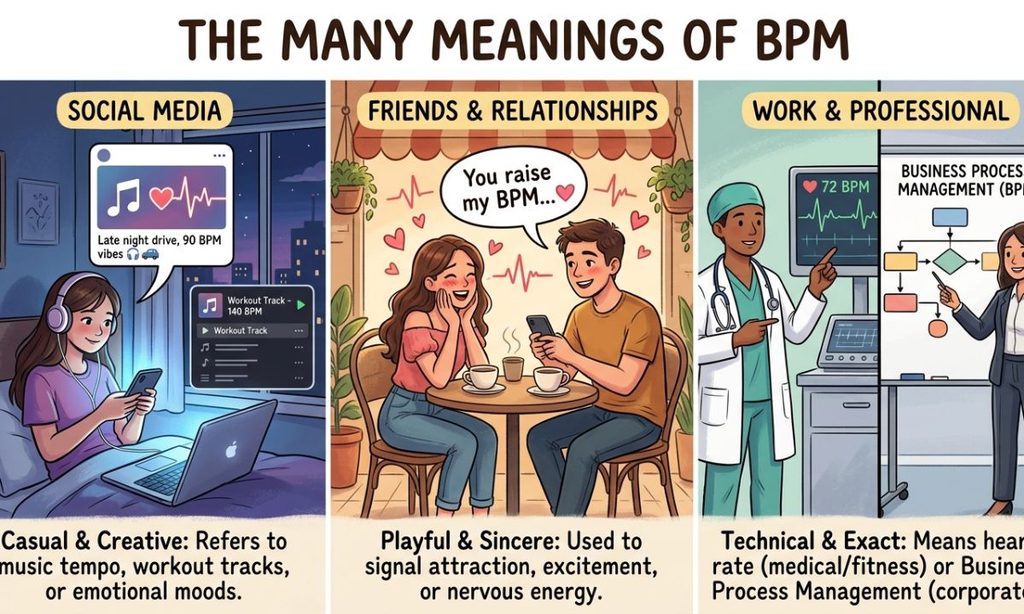
The BPM meaning depends on who is talking and where. A teenager on social media, a doctor, and a manager can use the same three letters for very different things.
Social Media
On social platforms, BPM is used for music tempo, workout tracks, and emotional jokes. Captions like “Late night drive, 90 BPM vibes” set a mood. It is casual and creative.
Friends & Relationships
With friends or partners, BPM often signals attraction or nerves. Saying “you raise my BPM” is a flirty line. It is playful, but it can also sound sincere when said gently.
Work & Professional Settings
At work, BPM usually means Business Process Management, or sometimes a heart rate figure in health and fitness jobs. Doctors, nurses, trainers, and music producers also use BPM as a plain technical term. In these settings, it is always serious and exact.
Casual vs Serious Tone
A casual BPM sounds like a joke or a mood. A serious BPM is a number with a purpose, such as 58 BPM on a patient chart.
Quick tip: If a number follows BPM (like 72 BPM), it is a measurement. If there is no number, it is probably slang for a feeling.
Read Also This Blog LYT Meaning in Text
Common Misunderstandings
Most mistakes about the BPM meaning come from assuming it only has one use. These are the four errors people make most often.
Thinking BPM Only Means Music
BPM is also a heart rate unit and a business term. If you only think of songs, you may misread a medical report or a work message. Always check the context first.
Confusing High BPM as Always Bad
A high BPM is not always a problem. Your heart rate rises during exercise, stress, caffeine, fever, or excitement, and that can be normal. It becomes a concern when it stays high at rest or comes with chest pain, dizziness, or breathlessness.
Assuming All Songs Need High BPM
A good song does not need a fast tempo. Slow ballads, lo-fi tracks, and ambient music work perfectly at 60 to 80 BPM. The right BPM depends on the mood and the purpose.
Using BPM in Wrong Context
Sending “BPM” in a formal email without explaining it can confuse the reader. In mixed groups, write “beats per minute” or “Business Process Management” once, then use the short form. This keeps your message clear.
Comparison Table
This table gives a fast side-by-side view of the BPM meaning across everyday uses.
BPM Meaning in Heart Rate
For heart rate, BPM is the number of times your heart beats per minute. Here is how common ranges compare for a healthy adult.
| Situation | Typical BPM range | What it usually means |
|---|---|---|
| Deep rest or sleep | 40 to 60 | Very relaxed, common in fit people |
| Normal resting rate | 60 to 100 | Healthy range for most adults |
| Light activity | 90 to 120 | Walking or daily movement |
| Moderate exercise | 100 to 150 | Brisk workout |
| Intense exercise | 150 to 190 | Hard training, depends on age |
| Resting above 100 | Over 100 | Called tachycardia, worth checking |
| Resting below 60 | Under 60 | Called bradycardia, can be normal or not |
Variations / Types of BPM
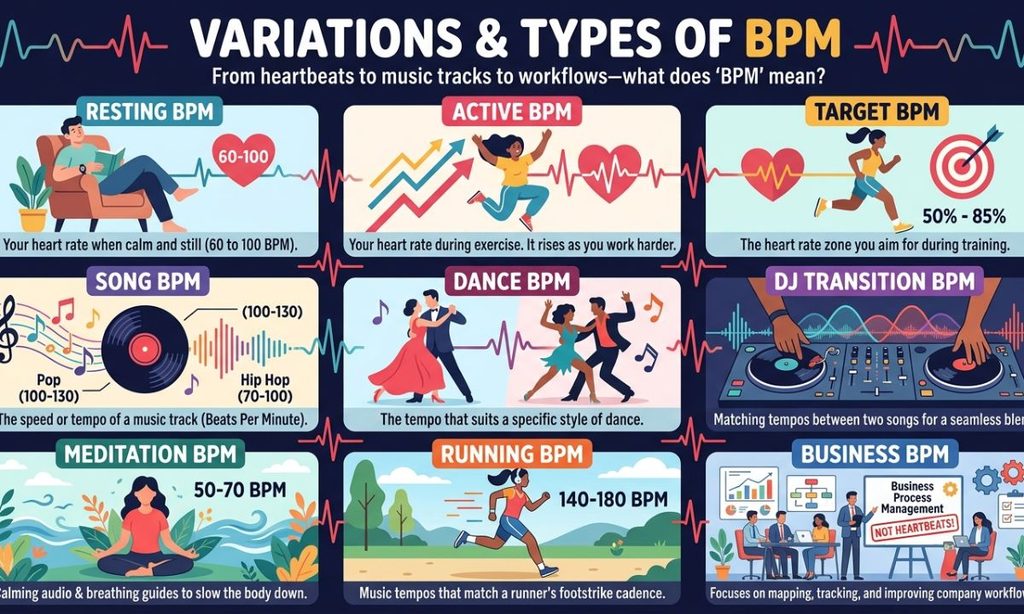
There are many types of BPM, and each one describes a different kind of beat count. The main idea stays the same, but the target number changes with the activity.
Resting BPM
Resting BPM is your heart rate when you are calm and still. For most adults it falls between 60 and 100. Fit people often sit lower, sometimes in the 50s.
Active BPM
Active BPM is your heart rate during movement or exercise. It rises as your body asks for more oxygen. It drops back toward your resting rate as you recover.
Target BPM
Target BPM is the heart rate zone you aim for during training. A common rule sets it at 50 to 85 percent of your maximum heart rate. A rough estimate of maximum heart rate is 220 minus your age.
Song BPM
Song BPM is the tempo of a track. Pop often sits around 100 to 130 BPM, hip hop around 70 to 100, and house music around 120 to 130. Drum and bass can reach 160 to 180.
Dance BPM
Dance BPM is the tempo that suits a dance style. Slow dances like the waltz move at a gentler pace, while latin and club styles run faster. Instructors choose music by BPM so steps feel natural.
DJ Transition BPM
DJs match the BPM of two songs so the mix sounds smooth. Tracks within a few BPM of each other blend easily. DJ software can also shift tempo slightly to line them up.
Meditation BPM
Meditation BPM usually refers to calm music or breathing guides at around 50 to 70 BPM. This is close to a relaxed resting heartbeat. Many people find it helps the body slow down.
Running BPM
Running BPM is the tempo of music that matches your stride. Many runners enjoy songs between 140 and 180 BPM because they match a common running cadence. Easy jogs can feel better at the lower end.
Business BPM
Business BPM means Business Process Management. It has nothing to do with beats. It focuses on mapping, tracking, and improving company workflows.
Gaming BPM
In rhythm games, gaming BPM is the speed of a song’s beat. Higher BPM songs ask for faster reactions and are usually rated harder. Some games also use a fast BPM soundtrack to build tension.
BPM Meaning in Medical
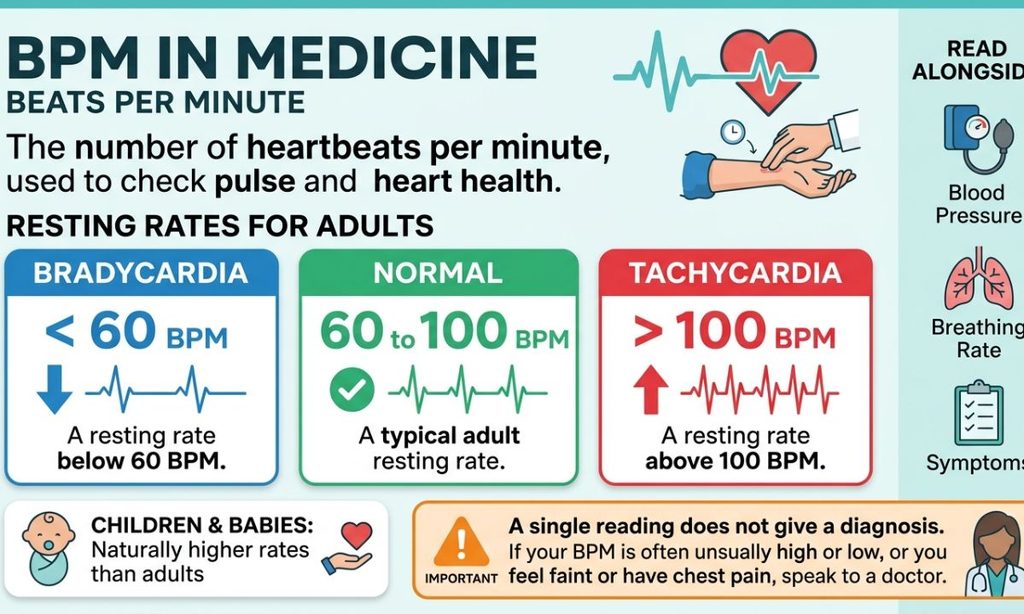
In medicine, BPM means the number of heartbeats per minute, used to check pulse and heart health. Doctors read it alongside blood pressure, breathing rate, and symptoms.
- Normal adult resting rate: 60 to 100 BPM
- Tachycardia: a resting rate above 100 BPM
- Bradycardia: a resting rate below 60 BPM
- Children and babies: naturally higher rates than adults
Important: A single reading does not give a diagnosis. If your BPM is often unusually high or low, or you feel faint or have chest pain, speak to a doctor.
How to Respond When Someone Uses “BPM”
The best reply depends on the person and the mood. First check whether they mean music, heartbeat, or a flirty joke. Then match their tone.
Read Also This Blog SNM Meaning
Casual Replies
Keep it light and short.
- “Haha, same here, mine is racing too.”
- “Which song is that? I need it.”
- “Nice, what’s the BPM of that track?”
Funny Replies
Humor works well when the message is playful.
- “Careful, my smartwatch is about to call an ambulance.”
- “I’m at 200 BPM and I’m only sitting down.”
- “Someone check my pulse, I think I’m a drum machine.”
Mature / Confident Replies
If the message is flirty, stay warm and calm.
- “That’s sweet. You do the same to me.”
- “Glad I can have that effect.”
- “Good to know. Let’s keep it going.”
Private / Respectful Replies
If you are unsure or want to keep things polite, stay neutral.
- “Thanks for sharing that.”
- “I appreciate you telling me.”
- “Let’s talk more about it later.”
BPM Meaning in Watch
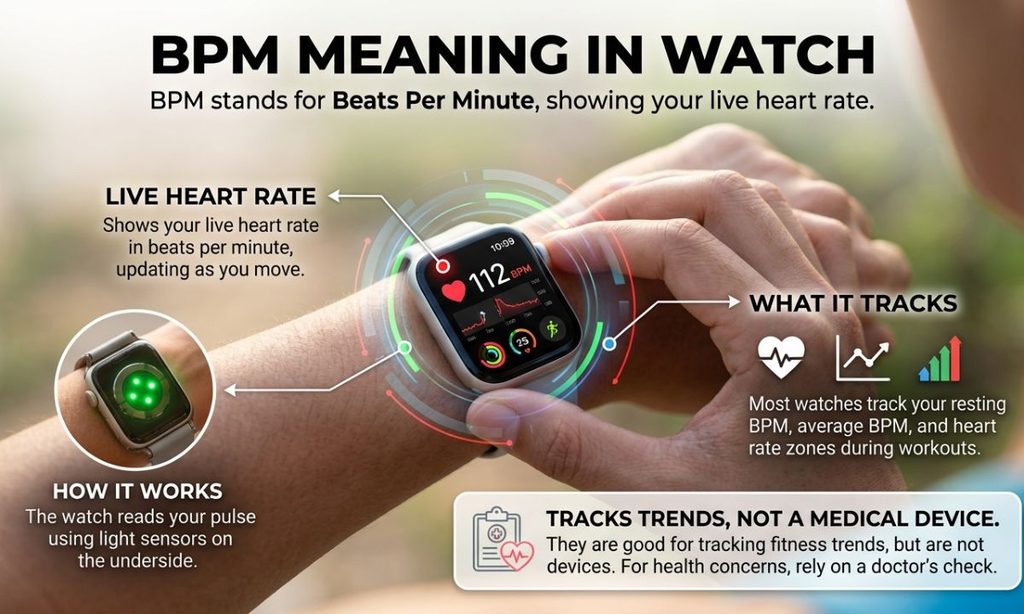
On a smartwatch or fitness band, BPM shows your live heart rate in beats per minute. The watch reads your pulse using light sensors on the underside, then updates the number as you move.
Most watches also show your resting BPM, average BPM, and heart rate zones during workouts. They are good for tracking trends, but they are not medical devices. For health concerns, rely on a doctor’s check.
BPM Meaning Music
In music, BPM tells you how fast a song is, counting the main beats in one minute. A 60 BPM song has one beat every second. A 120 BPM song has two.
Producers use it to build tracks, DJs use it to mix, and runners use it to pick playlists. Knowing a song’s BPM helps you choose music for the right mood or activity.
| Genre | Common BPM range |
|---|---|
| Ballad | 60 to 80 |
| Hip hop | 70 to 100 |
| Pop | 100 to 130 |
| House | 120 to 130 |
| Techno | 125 to 150 |
| Drum and bass | 160 to 180 |
BPM Meaning Normal
A normal BPM for a healthy adult at rest is 60 to 100 beats per minute. Many fit people have a lower resting rate, and that can be perfectly healthy.
Normal BPM also depends on age, fitness, stress, sleep, medication, and caffeine. Babies and children have faster normal rates than adults. A rate that stays outside your usual range, or comes with symptoms, is worth discussing with a doctor.
Read Also This Blog WTV Meaning in Text
Regional & Cultural Usage
The BPM meaning stays the same around the world, but the way people use it in conversation differs by culture. Music and health apps spread it everywhere, so most young people know it.
Western Culture
In Western countries, BPM is common in fitness, music production, and casual slang. People use it for gym playlists and for jokes about crushes. Business Process Management is also widely used in corporate settings.
Asian Culture
In many Asian countries, BPM is popular in K-pop, J-pop, and dance communities. Fans often share song BPM when learning choreography. In Pakistan and India, it is also familiar through fitness apps, smartwatches, and Bollywood or pop dance practice.
Middle Eastern Culture
In the Middle East, BPM is mostly used for music, fitness, and medical readings. In texts, many people prefer to describe feelings in their own language, so the slang use is less common. Younger users on global platforms still use it freely.
Global Internet Usage
Online, BPM works as a shared shorthand. Gamers, DJs, runners, doctors, and office teams all understand its core idea of beats per minute. The meaning shifts only with context.
FAQs
What does BPM mean in music?
In music, BPM means beats per minute, the tempo of a song. A higher BPM means a faster song, and a lower BPM means a slower one. For example, 60 BPM is one beat per second, and 120 BPM is two beats per second.
What is a normal heart BPM?
A normal resting heart rate for most adults is 60 to 100 BPM. Athletes can be lower, sometimes between 40 and 60 BPM. If your resting rate stays above 100 or below 60 with symptoms, check with a doctor.
Is higher BPM better for workouts?
Not always. A higher BPM means harder effort, but the best workout rate depends on your goal and age. Moderate exercise usually sits at 50 to 70 percent of your maximum heart rate, while hard training goes up to about 85 percent.
What does BPM mean in business?
In business, BPM means Business Process Management. It is the practice of mapping, automating, and improving workflows so tasks run faster and with fewer errors. It has no link to heartbeats or music.
Can BPM measure stress?
BPM can hint at stress, but it cannot measure it alone. Stress often raises heart rate, and many watches use BPM changes to estimate stress levels. Exercise, caffeine, illness, and poor sleep also raise BPM, so it is only one clue.
What BPM is best for running?
Most runners enjoy music between 140 and 180 BPM, which matches a common running cadence. Slower jogs may feel better at 120 to 140 BPM. Pick a tempo that matches your steps and keeps you comfortable.
Is low resting BPM good?
A low resting BPM is often a sign of good fitness and a strong heart. Many athletes sit in the 40s or 50s without any problem. If a low rate comes with dizziness, fainting, or tiredness, see a doctor.
Conclusion
The BPM meaning is beats per minute, a simple unit that counts how fast a rhythm or heart is moving. Depending on where you see it, it can describe a song’s tempo, your pulse, a joke about nerves, or Business Process Management at work.
Once you check the context, the meaning becomes clear. Use the numbers in this guide as a quick reference, and treat any worrying heart rate as a reason to talk to a doctor. Now you can read, use, and reply to BPM with confidence.
