

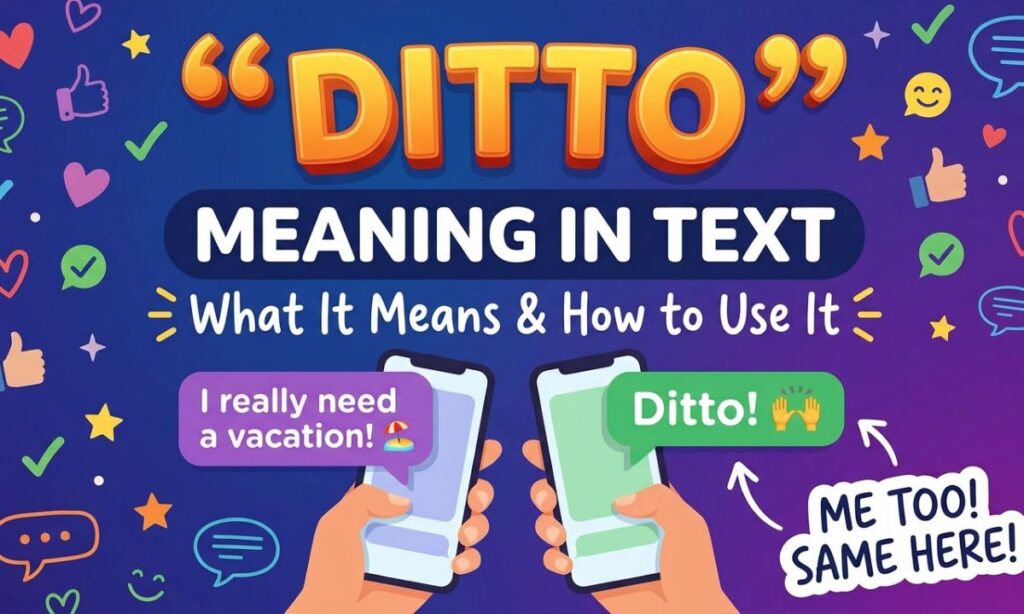
The ditto meaning is simple: “the same” or “me too.” When someone says “ditto” in a text, chat, or conversation, they are agreeing with what was just said without repeating it. It is a quick, friendly shortcut.
But the ditto meaning changes a little depending on where you see it. In a love text it can mean “I love you too.” In a construction document it means “same as the line above.” In this guide, you will learn every common ditto meaning, where the word came from, and how to use it without sounding awkward.
What Does Ditto Mean? Quick Definition
Ditto means “the same as before” or “the same goes for me.” It lets you agree with a statement or repeat an item without writing it out again. The word works as an adverb, a noun, a verb, and an interjection.
Quick answer: If a friend says “I’m so tired today” and you reply “ditto,” you are saying “I’m tired too.”
Simple Ditto Examples
The easiest way to learn the ditto meaning is to see it in short exchanges. Each example below shows ditto standing in for a full sentence.
- Agreement: “I can’t wait for the weekend.” “Ditto!”
- Feelings: “I really missed you.” “Ditto.”
- Orders: “I’ll have the iced coffee.” “Ditto for me.”
- Lists: Item 1 is a blue pen. Item 2 is ditto (another blue pen).
In every case, ditto points back to something already said. It saves time and keeps the chat light.
Ditto as Adverb, Verb, Noun
Most people only know ditto as a casual reply. Dictionaries list it in more than one role.
| Part of speech | Ditto meaning | Example |
| Adverb | In the same way, likewise | “She loves pasta, and he does ditto.” |
| Noun | A duplicate, or the mark showing repetition | “The second entry is a ditto of the first.” |
| Verb | To repeat or copy | “He dittoed the last report for the new client.” |
| Interjection | “Same here” | “Ditto!” |
The verb use is rare today. The interjection is the one you will meet most often in texts and speech.
Ditto Synonyms: Also, Likewise, Same
If you want a different word with the same ditto meaning, you have plenty of options. Pick based on how casual you want to sound.
- Casual: same, me too, same here, ditto
- Neutral: likewise, as do I, so do I
- Formal: the same applies, I concur, I agree
To repeat a list item, use “same as above,” “idem,” or “do.” These are common in paperwork.
Ditto Meaning in Chat
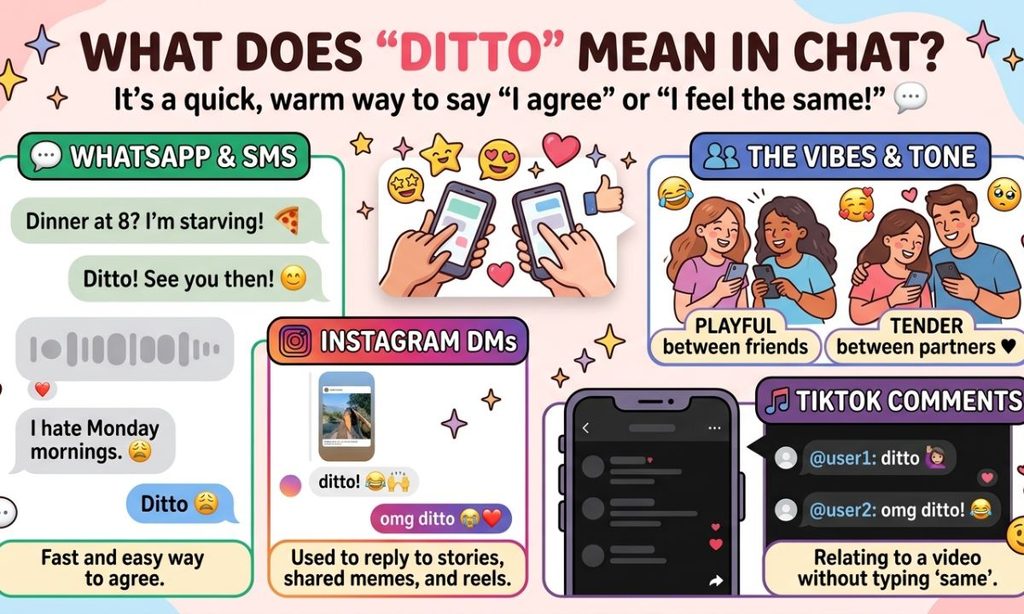
In chat, ditto meaning is “I feel the same” or “I agree.” People use it in messaging apps because it is short and warm. It works in one-on-one chats and group threads alike.
The tone depends on the person and the platform. Between friends it feels playful. Between partners it can feel tender.
WhatsApp and Text Messages
On WhatsApp and SMS, ditto is a fast way to agree. You can use it alone or add an emoji to soften it.
Examples:
- “Dinner at 8?” “Ditto, I’m starving.”
- “I hate Monday mornings.” “Ditto 😩”
In group chats, ditto saves you from repeating what three people already said. Just keep it tied to the message above so nobody gets confused about what you agree with.
Instagram DMs
On Instagram DMs, ditto often replies to a message, a story reaction, or a shared reel. It can be sweet or funny depending on the post.
If someone shares a meme and writes “this is literally me,” a reply of “ditto” shows you relate. If you reply to a story with “ditto,” the person knows you feel the same about what they posted.
TikTok Comments
On TikTok, ditto shows up in comments when someone relates to the video. It is shorter than “same,” and it often gets likes from other viewers who feel the same way.
A creator posts about being unable to wake up early. A comment saying “ditto” tells them, and everyone reading, that the feeling is shared. Comments like this are common in trend videos and song-based posts.
Tip: On public comments, ditto works best as a quick reaction. If you want to add a thought, write one more line after it.
Ditto Meaning Same
Ditto meaning same is the core definition. Ditto tells the listener that the thing you are talking about matches what came before. It can describe a feeling, a choice, an action, or an item.
If your friend says “I’m going home early,” and you say “ditto,” you also plan to go home early. The word replaces the whole repeated idea in one beat.
Read Also This Blog What Does WTW Mean
Ditto vs “Me Too” and “Same”
These three phrases overlap, but they do not feel identical.
| Phrase | Feel | Best use |
| Ditto | Light, slightly retro, a bit playful | Agreeing with a feeling or statement |
| Me too | Warm and direct | Sharing a personal feeling or experience |
| Same | Very casual, modern | Quick chat replies |
If someone says “I love this song,” “me too” and “ditto” both work. “Same” works too, but it can sound a bit flat. Ditto adds a small touch of personality.
Ditto Meaning Love
Ditto meaning love shows up when the word replaces “I love you too.” It is a short, gentle way to return affection, especially in a relationship where both people already know how they feel.
It can sound sweet or a bit guarded, depending on tone and timing. Context decides which one you are getting.
When Ditto Shows Affection
Ditto shows affection when it follows a loving message. A partner texts “I miss you,” and you reply “ditto.” You are saying “I miss you too” without making a big moment of it.
It also works between close friends and family. A parent signing off a call with “love you” and a teen answering “ditto” is a very common pattern.
Why People Say Ditto
People say ditto for a few honest reasons.
- Shyness: Saying the full words feels like too much.
- Habit: Couples and families build shorthand over time.
- Playfulness: It feels lighter than a serious declaration.
- Speed: Texting rewards short replies.
Sometimes it also hides discomfort. If you want to be clear about your feelings, the full sentence is stronger.
Takeaway: Ditto can be sweet and sincere. If someone clearly needs to hear the full words, say them.
Ditto Meaning I Love You

In romance, ditto meaning I love you is “I love you too.” It is a soft reply to a declaration of love, and it became famous through a classic movie scene.
Most people who say it in this way mean it warmly. It is just a different style from saying the words directly.
Ghost Movie Scene Origin
The romantic ditto meaning grew popular after the 1990 film Ghost. In the movie, Molly (played by Demi Moore) tells Sam (played by Patrick Swayze) “I love you,” and Sam answers “ditto.” The line becomes an emotional payoff later in the story.
The scene made ditto a recognizable stand-in for “I love you too.” Many people still reference it when they use the word in a romantic way.
Is Ditto Always Romantic?
No. Ditto is not always romantic. It is a general agreement word, and love is only one of its uses.
You can say ditto to a friend about pizza, to a coworker about Mondays, or to a partner about love. The surrounding message tells you which meaning applies.
Ditto Meaning NewJeans
Ditto meaning NewJeans refers to “Ditto,” a hit song by the K-pop girl group NewJeans. The title uses the word in its everyday sense of “same” or “me too,” matching the song’s theme of shared, unspoken feelings.
For many younger fans, this song is the first place they met the word. That is one reason ditto is trending again in chats and comments.
Read Also This Blog BFF Meaning
NewJeans Ditto Release Timeline
Here is a simple timeline of the song’s release.
| Date | Event |
| July 2022 | NewJeans debuts under ADOR, a HYBE label |
| December 19, 2022 | “Ditto” is released digitally |
| January 2023 | “Ditto” is included on the single album OMG |
The music video came in two parts, often called Side A and Side B. Fans enjoyed picking apart the story across both versions.
Fan Reactions and Social Media Buzz
Fans responded warmly to the song’s soft, nostalgic sound and its emotional video. Clips, dance covers, and edits spread widely on TikTok, Instagram, and YouTube.
Many fans, who call themselves Bunnies, started replying “ditto” in comments as a nod to the song. This helped bring the word back into everyday online talk.
Song Title vs Word Meaning
The song title and the word share the same spelling, but they play slightly different roles. The word means “same.” The song uses it to express a feeling that is mutual but hard to say aloud.
Key point: If someone says “ditto” and links it to NewJeans, they may be quoting the song, not only agreeing. Context tells you which.
Ditto Meaning Korean
Ditto meaning Korean can point to two things: how the word appears in Korean pop culture, and which Korean words carry a similar meaning. The English word is written as 디토 (dito) in Korean, mostly because of the NewJeans song.
In everyday Korean speech, people usually use native phrases rather than the English word.
Ditto in Korean Fan Culture
In Korean fan spaces, ditto has become a trendy reply on social media, fan communities, and comment sections. It is tied closely to the song and to the group’s image.
Fans use it to say “I feel that too” about a song, a stage, or a member’s moment. It carries a youthful, slightly sentimental tone.
Korean Words Similar to Ditto
Korean has several natural ways to say what ditto says in English.
| Korean | Romanization | Meaning |
| 나도 | nado | Me too |
| 똑같아 | ttokgata | It’s the same |
| 마찬가지야 | machangajiya | Likewise |
| 동감이야 | donggamiya | I agree, I feel the same |
In written lists and tables, East Asian documents also use a ditto mark (〃) to repeat the item above.
Ditto Meaning in Construction
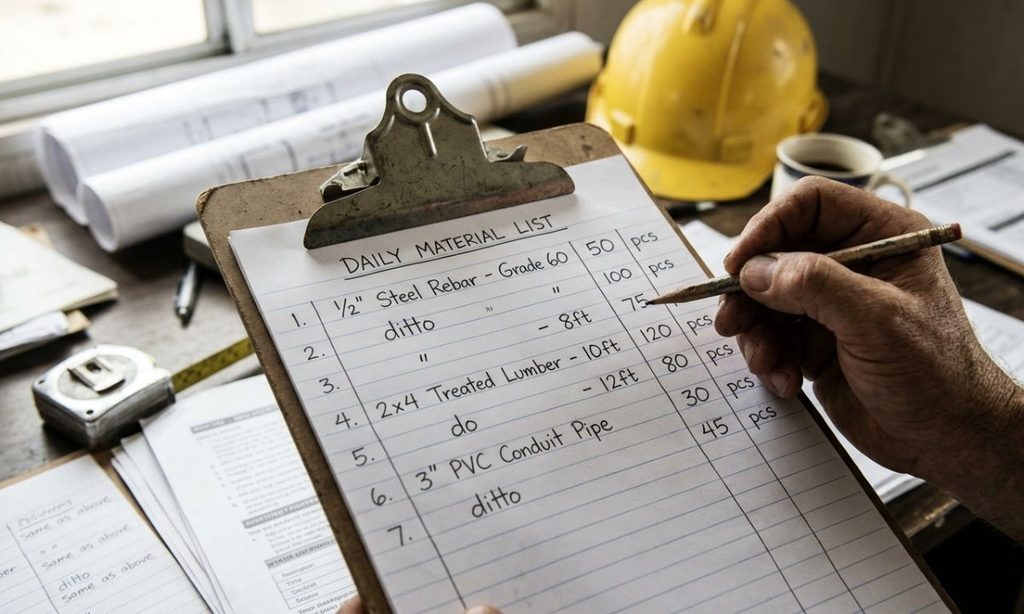
Ditto meaning in construction is “same as the item above.” Builders, engineers, and estimators use ditto to avoid rewriting the same description or value again and again in documents.
It appears as the word “ditto,” the short form “do,” or the ditto mark (″). All three say the same thing.
Ditto in Site Documents
On site, ditto saves time in schedules, material lists, drawings notes, and inspection sheets. If three rows all need the same finish, the second and third rows may simply say “ditto.”
This keeps documents shorter and easier to scan. It only works if the row above is clear and unchanged.
Ditto in Invoices and Lists
In invoices and price lists, ditto repeats a description when only the quantity or size changes. A supplier might write “Steel bar 12 mm” in the first row and “ditto 16 mm” in the next.
Tip: Use ditto only when the repeated part is identical. If anything important changes, write it out in full.
Ditto Meaning in BOQ
Ditto meaning in BOQ (Bill of Quantities) is “repeat the description from the line above.” It is a shorthand that keeps long item descriptions from being typed again and again.
A BOQ lists work items, quantities, units, and rates for a building or civil project. Ditto helps keep it compact.
Read Also This Blog KMT Meaning
How Ditto Works in BOQ
In a BOQ, the first row holds the full description. Later rows that share most of that description use ditto and then add only what is different, such as the size, thickness, or grade.
The reader reads the ditto row by pulling the text from the row above and swapping in the new detail. This works well when rows stay in order.
BOQ Ditto Example Table
Here is a simple example.
| Item | Description | Quantity | Unit |
| 1 | Concrete grade C25, poured in foundations | 40 | cubic meters |
| 2 | Ditto, in columns | 18 | cubic meters |
| 3 | Ditto, in beams | 22 | cubic meters |
| 4 | Ditto, in slabs | 60 | cubic meters |
Each ditto row means “Concrete grade C25, poured” followed by the new location.
Common Ditto Mistakes in BOQ
Ditto saves space, but it causes real problems when used carelessly.
- Re-sorting rows: If the list is sorted or filtered, ditto may point to the wrong row.
- Page breaks: The row above may land on the previous page.
- Hidden changes: A different unit or grade is missed because the row says ditto.
- Copy and paste errors: Ditto rows pasted elsewhere lose their meaning.
Tip: For contracts and pricing, write full descriptions where cost or quality could be disputed.
Ditto Origin and Word History
The ditto meaning we use today grew from an Italian word that simply meant “said.” Over a few centuries, it moved from business records into everyday speech and then into texts and comments.
Understanding this history explains why ditto still means “as stated above” in paperwork and “same here” in chat.
Italian and Latin Roots
Ditto comes from the Italian word detto, which means “said” or “aforesaid.” Italian took it from the Latin dictus, the past participle of dicere, meaning “to say.”
Merchants first used it in account books to avoid rewriting a month or an item already named. Writing “ditto” meant “the one I just said.”
Ditto Timeline: 1668 to Today
Exact first-use dates vary a little between dictionaries, so treat these as approximate markers of how the ditto meaning developed.
| Period | Use | Meaning |
| 1600s | Entered English through trade and bookkeeping | “The same thing already mentioned” |
| Around 1668 | Early recorded adverb and noun use | “In the same way” or “a duplicate” |
| 1800s | Verb use appears | “To repeat or copy” |
| Early 1900s | Ditto mark common in tables and ledgers | “Same as the line above” |
| 1950s to 1980s | Ditto machines in schools and offices | “A copy made by duplicator” |
| 1990 | Ghost film | “I love you too” |
| Today | Texting, comments, K-pop references | “Me too, same here” |
Ditto Machine and Duplicators
The ditto machine (also called a spirit duplicator) was a classic office and school copier. It pressed a master sheet against paper using a liquid, and it produced copies with faint purple ink.
Teachers used it for worksheets, and many people still remember the smell of fresh “dittoed” pages. The name stuck because the machine made “the same” page again and again.
Ditto Mark (″) and How to Type It
The ditto mark (″) is a small symbol that means “same as above.” It is written under the item you want to repeat, and it appears in old ledgers, tables, and lists.
Here are simple ways to type it:
- Copy and paste: Use the symbol ″ (double prime) or 〃 (the ditto mark used in East Asian writing).
- Word or Google Docs: Type 2033, then press Alt and X to turn it into ″.
- Quick shortcut: Straight double quotation marks (“) are often used as a stand-in.
Tip: In formal documents, the word “ditto” or “same as above” is clearer than a mark that can be misread.
How to Use Ditto Correctly
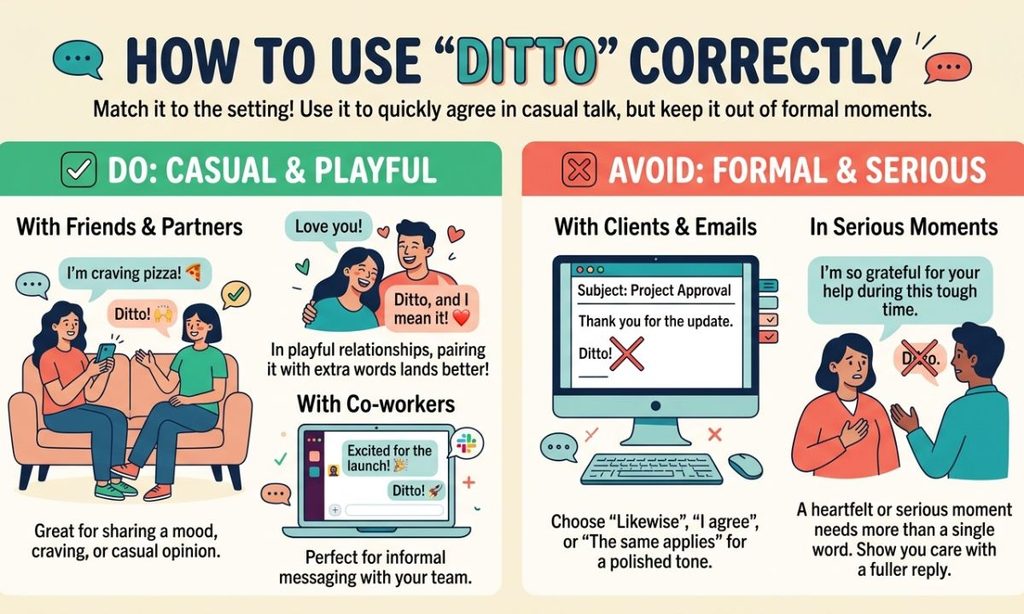
To use ditto meaning correctly, match it to the setting. Say it to agree with a feeling or a statement, keep it short, and make sure the other person knows what you are agreeing with.
Ditto works best in casual talk, light chats, and informal lists. It is weaker in serious or formal moments.
Friends and Relationships
With friends, ditto is easy and fun. Use it when you share a mood, a craving, or an opinion.
In relationships, ditto can be sweet when the mood is playful. If your partner has said something heartfelt, a fuller reply shows more care. Ditto plus a few words, like “ditto, and I mean it,” often lands better.
Work and Professional Settings
At work, ditto fits friendly chats with teammates in Slack or a group thread. A coworker writes “Excited for the launch,” and you answer “Ditto!” That is fine.
In client emails, reports, and formal messages, choose “likewise,” “I agree,” or “the same applies.” These sound more polished.
Casual vs Serious Tone
Tone is the key. Ditto sounds relaxed, so it fits casual talk and can seem too light for heavy topics.
| Situation | Is ditto a good fit? |
| Friends joking about a long week | Yes |
| Partner saying “I love you” | Yes, with warmth |
| Someone sharing bad news | Better to write a fuller reply |
| Formal complaint or legal message | No |
Ditto in Formal Writing
In formal writing, avoid ditto as a casual agreement. Use “likewise,” “the same,” or “as above” instead.
There is one exception. In tables, ledgers, schedules, and BOQs, ditto (or the ditto mark) is still accepted as long as the line above is clear.
Read Also This Blog What Does SU Mean
Common Ditto Misconceptions
The most common ditto meaning mistakes come from mixing ditto up with copying, a Pokémon, or a spelling error. Each misconception below gets a short, clear correction.
Ditto Doesn’t Mean Copying
Ditto does not mean you copy someone else’s idea. It means you share the same feeling, choice, or fact. If a friend says “I’m hungry” and you say “ditto,” you are not stealing the hunger. You are matching it.
The only time ditto links to copying is in documents, where it repeats a line from above.
Pokémon Ditto vs Word Ditto
The Pokémon Ditto is a pink, blob-like creature that can transform into other Pokémon. It was named for the word because it “duplicates” what it sees.
The word ditto is not tied to Pokémon at all. If you see “ditto” in a Pokémon forum, it likely means the creature. In a chat, it means “same.”
Ditto vs Dittography
Dittography is a writing error where a letter, word, or phrase gets repeated by accident. A typist who writes “the the” has made a dittography error. Scholars of old manuscripts use the term often.
The two words share a root, but they are not the same. Ditto is the agreement or repetition on purpose. Dittography is the repetition by mistake.
Overusing Ditto in Chats
Saying ditto to everything can make you sound distracted or distant. If every reply is “ditto,” the other person may feel you are not really listening.
Tip: Mix it up. Use ditto for quick agreement, and add a sentence when the topic matters.
Ditto vs Similar Phrases Compared
Ditto meaning overlaps with “same,” “likewise,” and “me too,” but each phrase has its own tone and best use. Ditto is playful and a bit classic. Likewise is polite. Same is quick and modern.
Comparison Table: Ditto, Same, Likewise
| Phrase | Tone | Best use | Example |
| Ditto | Playful, slightly retro | Agreeing with a feeling or a love message | “Love you.” “Ditto.” |
| Same | Casual, modern | Fast chat replies | “I’m so tired.” “Same.” |
| Likewise | Polite, neutral | Work messages and greetings | “Nice to meet you.” “Likewise.” |
| Me too | Warm, direct | Personal feelings | “I loved that film.” “Me too.” |
Which Phrase Fits Best
Pick the phrase by audience. For friends and partners, ditto or same works. For coworkers and clients, likewise is safer.
If the message is emotional, “me too” or a full sentence feels more sincere. If the message is a quick joke or a shared mood, ditto fits well.
Takeaway: Choose ditto when you want to agree quickly with a bit of personality.
Modern Ditto Variations and Slang
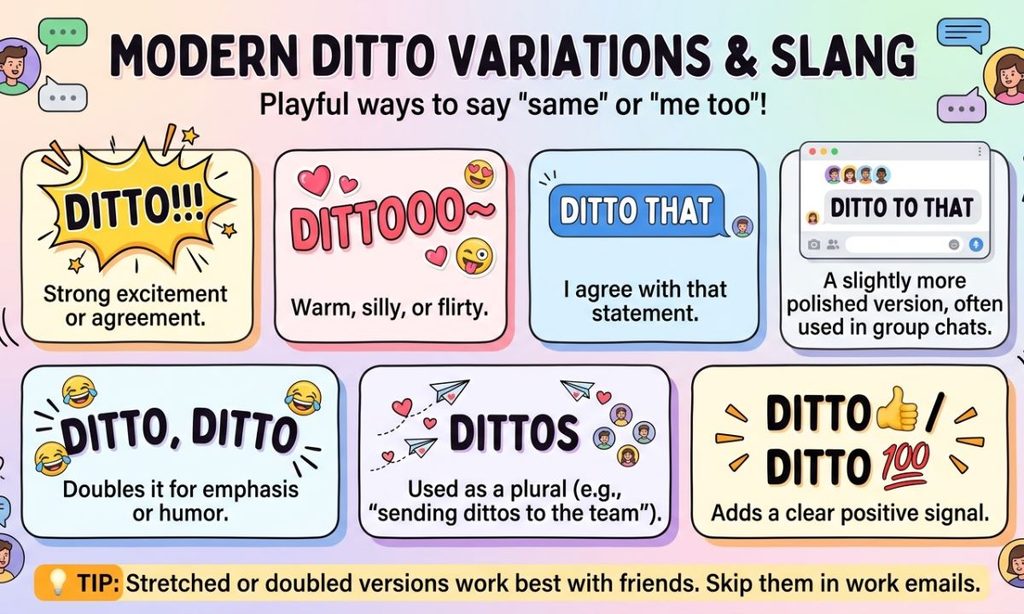
Modern ditto meaning shows up in a few playful variations online. These spin-offs all keep the idea of “same” or “me too” but change the tone or the length.
- Ditto!!! with extra exclamation marks shows strong excitement or agreement.
- Dittooo with stretched letters feels warm, silly, or flirty.
- Ditto that means “I agree with that statement.”
- Ditto to that is a slightly more polished version, often used in group chats.
- Ditto, ditto doubles it for emphasis or humor.
- Dittos is sometimes used as a plural noun, as in “I’m sending dittos to the whole team.”
- 👍 or 💯 after ditto adds a clear positive signal.
Tip: Stretched or doubled versions work best with friends. Skip them in work emails.
How to Reply to Ditto
To reply to ditto meaning “me too,” match the mood. If it was sweet, answer warmly. If it was a joke, answer with humor. If you want to keep things private, reply with a short and kind line.
The right reply depends on who sent the message and what you want to say next.
Casual Replies
Casual replies keep the chat easy and friendly.
- “Haha, great minds think alike.”
- “Glad it’s not just me.”
- “Good to know we’re on the same page.”
- “Always.”
Funny Replies
Humor works well when the person’s ditto was playful.
- “Ditto to your ditto.”
- “Did you just copy me? Kidding.”
- “Ditto, but louder.”
- “Ditto squared.”
Confident Replies
If the ditto came after a romantic message, you can answer with confidence and clarity.
- “I meant what I said.”
- “I’m glad you feel the same.”
- “I love hearing that from you.”
- “That made my day.”
Private and Respectful Replies
If the message is personal or the setting is public, keep your reply gentle and short.
- “Thank you, that means a lot. Let’s talk later.”
- “I appreciate that. Can I call you tonight?”
- “I feel respected hearing that.”
These replies protect the other person’s privacy and keep the tone kind.
Read Also This Blog LYT Meaning in Text
Ditto Meaning Across Cultures
Ditto meaning is understood in many places because English is widely used online. Still, comfort with the word differs from region to region, and local phrases often replace it in daily speech.
Western Usage
In the United States, the United Kingdom, Canada, and Australia, ditto is a familiar, casual word. It feels slightly retro, which many people find charming.
Parents, partners, and friends use it for “me too,” and the Ghost scene keeps the romantic meaning alive.
Middle Eastern Usage
In Middle Eastern countries, people who chat in English often use ditto the same way, as a quick “me too.” In Arabic, people usually say something like “وأنا كمان” (wana kaman), meaning “me too.”
Because chat in this region often mixes English and Arabic, ditto can appear inside a bilingual message. Tone and closeness matter, so people tend to use it with friends and peers rather than elders or in formal settings.
Global Internet Usage
Online, ditto has become a shared piece of internet language. K-pop fans, gamers, and meme communities use it across languages.
It is short, easy to read, and friendly. That is why it keeps surviving in comment sections and group chats around the world.
Quick Facts About Ditto
Here is a fast summary of the ditto meaning, with approximate timing of its first recorded uses by part of speech. Dictionaries disagree by a few decades, so use the dates as a rough guide.
| Part of speech | Approximate first use | Core meaning |
| Noun | 1600s | The same thing, a duplicate |
| Adverb | 1600s | In the same way |
| Verb | 1800s | To repeat or copy |
| Interjection | 1900s | “Same here,” “me too” |
- Origin: Italian detto, from Latin dictus, meaning “said.”
- Famous use: The 1990 film Ghost.
- Musical use: “Ditto” by NewJeans, released December 2022.
- Document use: “Same as above” in BOQs, invoices, and ledgers.
- Symbol: The ditto mark (″).
Frequently Asked Questions
What does “ditto” mean in texting?
In texting, ditto means “me too” or “same here.” It is a short reply that agrees with what the other person just said. Friends, family, and partners all use it.
Is “ditto” rude or polite?
Ditto is neither rude nor especially polite. It is casual and friendly. It can feel too short if someone shares something serious, so add a few words when the topic matters.
Can “ditto” be used romantically?
Yes. Ditto often means “I love you too,” especially after a loving message. The 1990 film Ghost made this use famous. If you want your feelings to be clear, you can pair it with a sentence of your own.
Is “ditto” the same as “me too”?
They mean almost the same thing. “Me too” sounds more direct and personal. Ditto sounds lighter and a little more playful, and it can also repeat a list item, which “me too” cannot do.
Can I use “ditto” in professional emails?
It is better to avoid it in formal emails. Use “likewise,” “I agree,” or “the same applies.” In internal chats with friendly coworkers, ditto is usually fine.
Why do people use “ditto” instead of typing full sentences?
People use ditto because it is quick and clear. It saves effort, avoids repeating long statements, and adds a small touch of warmth. In romantic or shy moments, it also feels gentler than a full declaration.
Is “ditto” outdated?
Not really. Ditto sounds a bit classic, but it has come back through K-pop, social media, and film references. It is still widely understood, and many younger people use it on purpose for its retro charm.
Conclusion
The ditto meaning comes down to one idea: “the same.” In a text, it is a friendly way to say “me too.” In a love message, it can quietly mean “I love you too.” In a BOQ or invoice, it points back to the line above.
The word has traveled a long way, from Italian account books to ditto machines, a famous movie scene, and a hit NewJeans song. Use it with friends and partners, choose “likewise” for formal moments, and add a few words whenever the feeling deserves more than a shortcut.
