

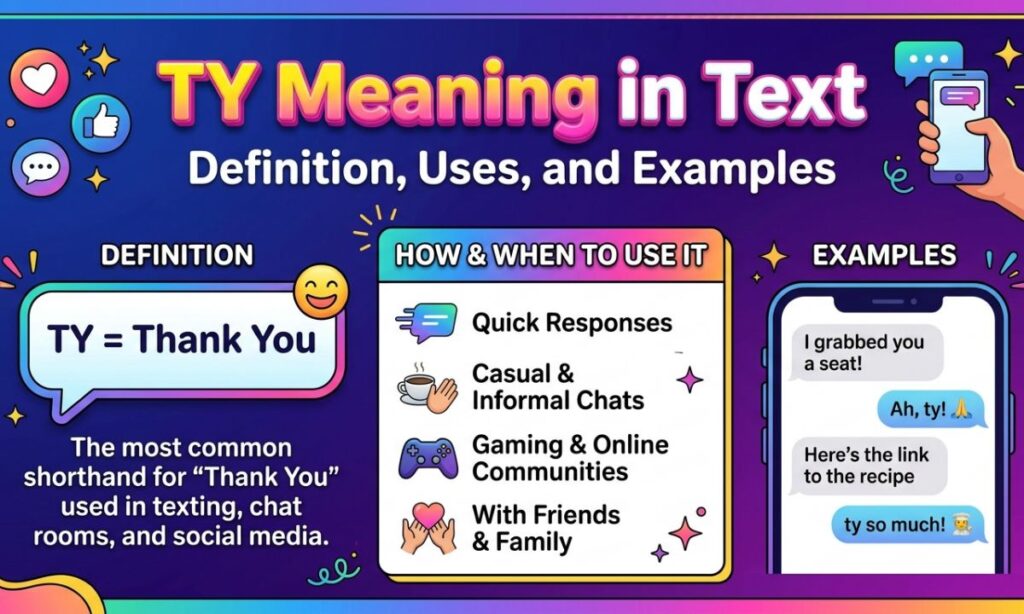
TY meaning in text is simple: it stands for “thank you.” People type it to save time and keep a message friendly. But the tone can change with the sender, the platform, and even the letter case.
This guide explains the TY meaning in text, how it differs from a guy or a girl, what it means on WhatsApp and Instagram, and when it has a totally different meaning. You will also find replies, examples, and a quick comparison with similar abbreviations.
What Does TY Mean in Text?
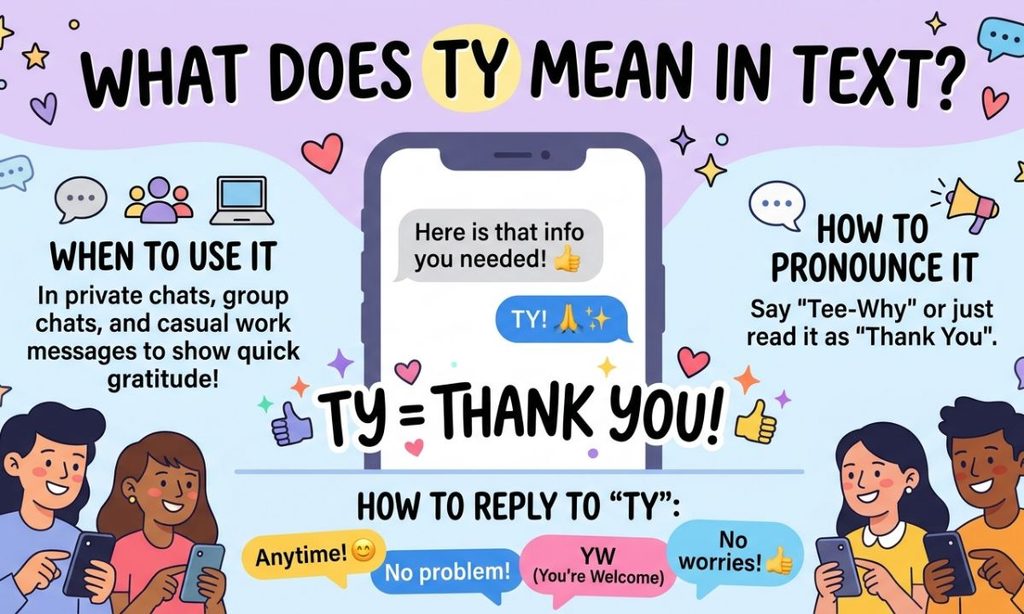
In text messages and online chats, TY means “thank you.” It is one of the most common thank-you abbreviations in everyday texting. You will see it in private chats, group chats, comments, and work messages.
Quick Answer: TY Means Thank You
The TY meaning in text is thank you. It shows gratitude in two letters. Someone sends it after a favor, a compliment, a gift, or a helpful answer.
Key takeaway: If someone texts you TY, they are thanking you. Reply with something like “anytime” or “no problem.”
TY Full Form and Pronunciation
The full form of TY is thank you. People usually say the letters out loud as “tee-why,” or they just say “thank you” in full. In speech, nobody says TY as a single word, because it is a texting shortcut.
TY Meaning in Text From a Guy
When a guy texts TY, it almost always means thank you, said in a quick and relaxed way. Many men keep messages short, so TY is a normal part of how they chat. It does not usually hide a deeper message.
When a Guy Texts TY
A guy might send TY after you share a link, send directions, or help with a plan. It can also be a polite way to close a conversation. Treat it as a friendly nod, not a cold reply.
If he usually writes long messages and suddenly sends only TY, pay attention to the change. A shorter reply can mean he is busy or done talking.
Sincere or Sarcastic TY?
TY is sincere by default. It turns sarcastic only when the situation points that way, such as after an argument or a late reply. Look for clues like a period at the end (“TY.”), no emoji, or a sharp change in tone.
Read Also This Blog DNI Meaning in Text
What Does TY Mean From a Girl
From a girl, TY also means thank you, and it is usually warm. Many women add emojis, extra letters, or exclamation marks to make it feel kind. So a plain TY with nothing extra is still a normal, polite reply.
As with a guy, the real message comes from context. The word is the same, but the mood can change.
Reading Tone and Context
Check three things: what was said before, how fast the reply came, and how the person normally texts. If she writes “TY!! 😊” she is happy. If she writes “ty.” after a disagreement, she may be upset or ending the chat.
| Sender | Situation | Likely Meaning |
| Friend | After you help with something | Genuine thanks |
| Crush or partner | After a compliment | Shy or happy thanks |
| Anyone | After a disagreement, with a period | Cold or dismissive |
| Coworker | After you send a file | Polite and professional |
| Family member | After a favor | Casual gratitude |
TY Meaning in Chat
In chat apps, TY means thank you and is used to keep the conversation moving fast. It works well when you are replying quickly and do not need a long message. It fits live chats, comment threads, and messaging apps.
TY TY Meaning in Chat
When someone writes “TY TY,” they are saying thank you twice for extra emphasis. It sounds more grateful than a single TY. People use it when someone went out of their way to help.
TY, TYY, TYTY, and TYSM
These forms all stretch the same idea. Here is how they compare.
- TY: thank you, the basic version.
- TYY: a friendly, softer thank you with a stretched letter.
- TYTY: thank you thank you, very grateful.
- TYSM: thank you so much, the strongest of the group.
TY Meaning in WhatsApp

On WhatsApp, TY means thank you, just like in any other chat. It is common in personal chats and family groups because it is quick on a phone keyboard. WhatsApp users often pair it with a thumbs-up or a heart.
TY on Instagram and Snapchat
On Instagram and Snapchat, TY is a fast, casual thank you. People use it in DMs, story replies, and comments. A reply like “ty 🙌” after someone reacts to a story is very typical.
TY in Gaming and Discord
In games and on Discord, TY is often used right after a teammate helps, heals, or shares loot. It is quick because players are busy. It also works as a polite way to show good sportsmanship.
TY in Workplace Chats
In Slack, Teams, or work texts, TY is acceptable between close colleagues but can feel too casual with managers or clients. If the message matters, write “thank you” in full. That small change shows respect.
| Platform | What TY Means | Typical Tone |
| Thank you | Friendly and quick | |
| Thank you | Casual | |
| Snapchat | Thank you | Casual |
| Discord and gaming | Thank you | Fast and playful |
| Slack or Teams | Thank you | Casual, use with care |
| Better to write in full | Formal |
TY Meaning as a Name
TY can also be a name or a nickname, usually short for names like Tyler. In that case it has nothing to do with “thank you.” The only way to tell is the context.
Popular Names Shortened to Ty
Ty is a common short form of names such as Tyler, Tyrone, Tyson, Tyrell, Tyrese, and Tyrus. Some people also have Ty as their full given name. You will often see it capitalized as “Ty” when it is a name.
Name or Abbreviation? How to Tell
Look at the sentence. If the word is a person (“Ty is coming over”), it is a name. If it closes a message after a favor (“Ty for the ride”), it is the abbreviation for thank you.
Tip: A name usually starts with a capital T and a lowercase y. The abbreviation shows up as “TY” or “ty.”
TY Meaning in Russian
In Russian, “ты” (written ty in Latin letters) means “you,” specifically the informal, singular form. It is a real word, not a texting abbreviation. So the same two letters can have a very different meaning in Russian.
Russian “ты” Means “You”
Russians use “ты” with friends, family, children, and people they know well. With strangers or in formal settings, they use “вы” instead. Using the wrong one can sound rude or too familiar.
Same Word in Czech and Polish
The word looks the same in other Slavic languages. In Czech and Polish, “ty” also means “you” (informal singular). If a Czech or Polish speaker writes ty, they are most likely talking about you, not thanking anyone.
TY Meaning in Year
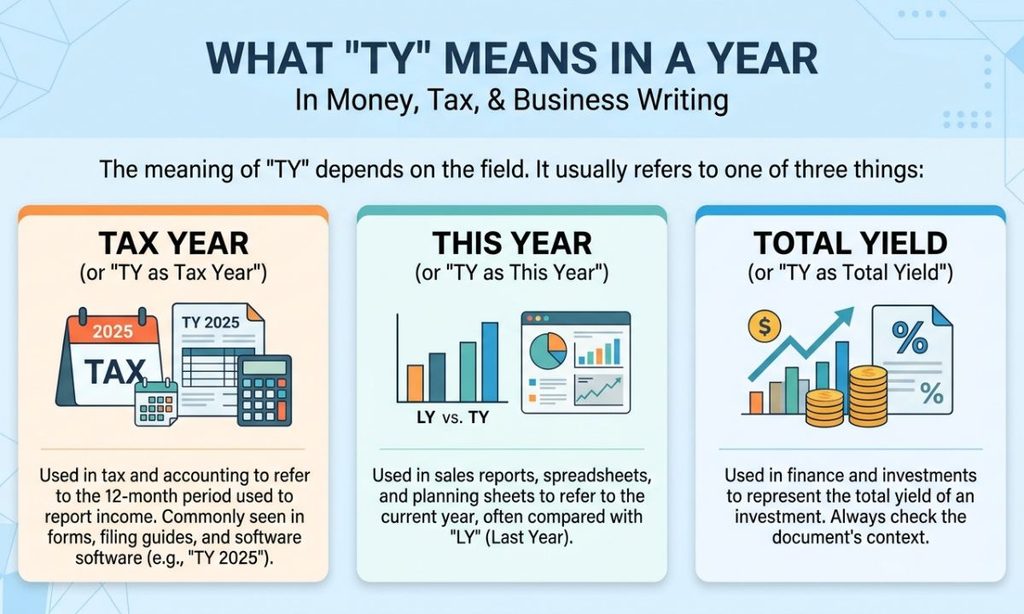
In money, tax, and business writing, TY often points to a year. It can stand for tax year, this year, or a similar term. The meaning depends on the field.
TY as Tax Year
In tax and accounting, TY means tax year, the 12-month period used to report income. For example, “TY 2025” refers to the tax year 2025. You will see it in forms, filing guides, and tax software.
TY as This Year or Total Yield
In sales reports or planning sheets, TY can mean “this year,” often compared with LY, which means “last year.” In finance, it can also stand for total yield. Always check the document to be sure.
| Context | What TY Means | Example |
| Texting | Thank you | “ty for the help” |
| Tax and accounting | Tax year | TY 2025 return |
| Sales or reports | This year | TY vs LY sales |
| Finance | Total yield | TY on a bond |
| Name | Short for Tyler and similar | “Ty is here” |
| Russian, Czech, Polish | You (informal) | “ты” |
TY Origin and History Timeline
TY comes from the early days of online chat and short messages, when people needed to type less. It is part of the same family as LOL, BRB, and TTYL. There is no single known inventor, so its exact start date is unclear.
Chat Rooms and Early SMS
In the 1990s and early 2000s, chat rooms and instant messengers pushed people to type fast. Early text messages also had a 160-character limit and cost money, so short forms made sense. TY was a natural shortcut for “thank you.”
How T9 Phones Spread TY
Phones with T9 predictive text and number keypads made every letter slower to type. Short words and abbreviations were easier. That helped TY spread to millions of people before smartphones arrived.
Why Do People Use TY?
People use TY because it is fast, easy, and friendly. It saves effort, keeps the chat light, and still shows gratitude. It also fits the way most of us text today.
Speed and Convenience
Typing two letters is quicker than typing nine. This matters when you reply one-handed, in a hurry, or in a fast group chat. On a phone, it also means fewer typos.
Casual, Friendly Tone
TY feels relaxed, like a quick “cheers” between friends. It works across apps, ages, and countries where people read English. It tells the other person you appreciate them without making the moment heavy.
Read Also This Blog What Does YH Mean
Ty vs TY: How Case Changes Tone
The letter case can change how TY feels. Lowercase is relaxed, all caps is louder. The words stay the same, but the vibe shifts.
Lowercase ty
Lowercase “ty” is the most common version. It feels calm, casual, and natural, like a quiet thanks. Most people use it in everyday chats.
All-Caps TY
All-caps “TY” can feel more excited or emphatic, as in “TY SO MUCH.” It can also feel stiff or even sharp if the rest of the message is cold. Check the other words around it.
Real-Life Examples of TY in Text
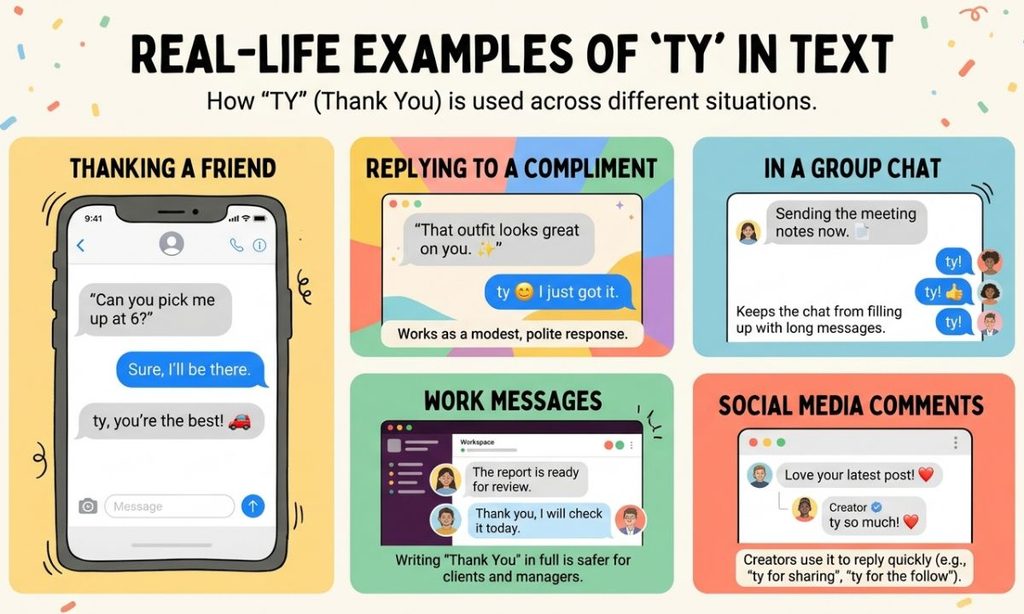
Here are simple examples that show the TY meaning in text across different situations.
Thanking a Friend
Message: “Can you pick me up at 6?” Reply: “Sure, I’ll be there.” Answer: “ty, you’re the best!”
Replying to a Compliment
Message: “That outfit looks great on you.” Reply: “ty 😊 I just got it.”
It works as a modest, polite response.
TY in a Group Chat
Message: “Sending the meeting notes now.” Reply: “ty!”
In a group, one short TY keeps the chat from filling up with long thank-you messages.
TY in a Work Message
Message: “The report is ready for review.” Reply: “Thank you, I will check it today.”
Writing it in full is safer for clients and managers.
TY in Social Media Comments
Comment: “Love your latest post!” Reply: “ty so much! ❤️”
Creators often use TY to reply to many comments quickly. Common phrases include “ty for sharing,” “ty for watching,” and “ty for the follow.”
How to Reply to TY
You do not always need to reply to TY. But a short response feels polite and keeps the chat friendly. Pick the style that matches your relationship.
Casual and Friendly Replies
- “No problem!”
- “Anytime.”
- “Of course.”
- “You’re welcome 😊”
Funny Replies
- “Don’t mention it. Seriously, don’t.”
- “That’ll be $5.”
- “Always here for you.”
Formal Replies
- “You’re very welcome.”
- “Happy to help.”
- “It was my pleasure.”
TY vs THX vs TYSM
These three abbreviations all mean thanks, but they carry different levels of warmth. TY is the standard, THX is the quickest and most casual, and TYSM is the most grateful. Choose based on how much you want to say.
| Abbreviation | Meaning | Tone | Best Use |
| TY | Thank you | Neutral and polite | Everyday chats |
| THX | Thanks | Very casual | Quick replies to friends |
| TYSM | Thank you so much | Warm and grateful | Bigger favors |
| TYVM | Thank you very much | Warm, a bit playful | Friends, social posts |
TY vs Thanks
“Thanks” is a full word and works in almost every setting. TY is shorter and more informal. If you are unsure, write “thanks” or “thank you.”
TY vs TTYL: Common Mix-Up
TTYL means “talk to you later,” and it has nothing to do with gratitude. People confuse them because both contain TY. TTYL ends a chat, while TY thanks someone.
Other Ways to Say TY
There are many other ways to say thanks in text. Some are abbreviations, and some are everyday words. Pick one that fits your tone.
TYVM, TVM, TQ, and 10Q
- TYVM: thank you very much.
- TVM: thanks very much.
- TQ: a short form of “thank you” used in some regions.
- 10Q: a playful spelling that sounds like “thank you” (ten-Q).
Cheers, Appreciate It, and Emojis
You can also write “cheers,” “appreciate it,” or “much appreciated.” Emojis work too, like 🙏, ❤️, or 👍. Use them to match the mood of the chat.
When Should You Use TY?
Use TY when the conversation is casual, quick, and friendly. It is great for friends, family, group chats, social media, and gaming. It also fits when a long thank-you would feel too much.
When Should You Avoid TY?
Avoid TY in formal or high-stakes messages. Examples include job applications, client emails, messages to a senior manager, and official letters. In these cases, write “thank you” in full to sound respectful.
Read Also This Blog BRB Meaning in Chat
Is TY Rude?
No, TY is not rude by itself. It is a polite word in short form. It only feels rude when the setting is formal or the tone around it is cold.
When TY Sounds Dismissive
TY can feel dismissive after a long, thoughtful message. A reply of just “ty.” can seem like the person is brushing you off. Adding a few words, like “ty, this helps a lot,” fixes that.
Does TY Always Mean Thank You?
No. TY mostly means thank you in texting, but not always. It can also be a name (Ty), the word “you” in Russian, Czech, or Polish, or a term for year in tax and finance. Context always decides.
Common Misunderstandings About TY
Some ideas about TY are plain wrong. Here are the most common ones.
TY Means “Talk to You”
This is a mix-up. “Talk to you” is written as TTY or TTYL, depending on the use. TY alone means thank you.
TY Is Only for Teens
Not true. People of all ages use TY, from students to professionals. It is just a habit of fast typing.
TY Is Always Disrespectful
Not true either. Most people use TY to be polite. Disrespect comes from the tone, not the two letters.
Not Everyone Understands TY
Some older readers or people new to English may not know it. If you are not sure, write “thank you.” That keeps your message clear.
Is TY Still Popular in 2026?
Yes, TY is still widely used in 2026. Texting shortcuts change over time, but TY has stayed steady because it is short, clear, and polite. It remains a normal part of casual messaging.
Who Uses TY Most
TY is common among young adults, gamers, social media users, and busy professionals in casual chats. Anyone who types on a phone a lot is likely to use it.
TY on TikTok and Gaming
On TikTok, creators use TY in comments and captions like “ty for 10k.” In gaming, players type TY after a helpful move. Both spaces reward speed, so TY fits.
Pro Tips for Using TY
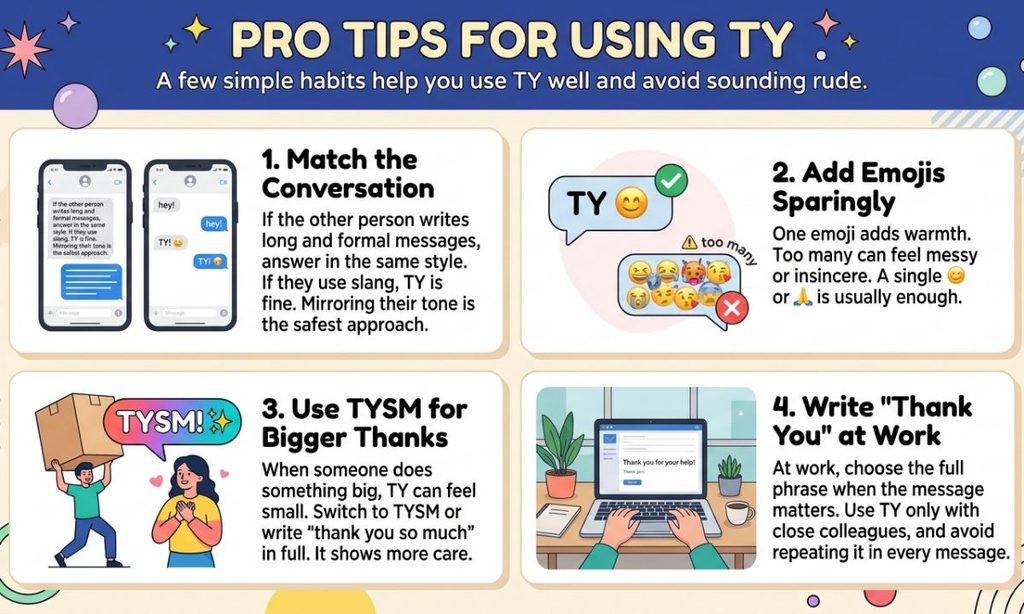
A few simple habits help you use TY well and avoid sounding rude.
Match the Conversation
If the other person writes long and formal messages, answer in the same style. If they use slang, TY is fine. Mirroring their tone is the safest approach.
Add Emojis Sparingly
One emoji adds warmth. Too many can feel messy or insincere. A single 😊 or 🙏 is usually enough.
Use TYSM for Bigger Thanks
When someone does something big, TY can feel small. Switch to TYSM or write “thank you so much” in full. It shows more care.
Write “Thank You” at Work
At work, choose the full phrase when the message matters. Use TY only with close colleagues, and avoid repeating it in every message. This keeps your tone professional.
Quick Facts About TY
Here is the whole TY meaning at a glance.
| Fact | Detail |
| Meaning | Thank you |
| Origin | Early chat rooms, SMS, and T9 phones |
| Tone | Casual and friendly |
| Platforms | WhatsApp, Instagram, Snapchat, Discord, Slack |
| Formality | Informal, avoid in formal writing |
| Other meanings | Name, “you” in Russian, tax year |
Frequently Asked Questions
What does TY mean in text?
TY means thank you. People use it in texts, chats, and social media to show quick gratitude.
Is TY rude?
No. TY is polite in casual settings. It may sound cold in formal messages or after a heated conversation.
What does TY mean from a guy or a girl?
From either, TY means thank you. The tone depends on context, punctuation, and how the person usually texts.
What is the difference between TY and TYSM?
TY is a simple thank you. TYSM means “thank you so much,” so it shows stronger gratitude.
Does TY mean something different in Russian?
Yes. In Russian, “ты” means “you” in the informal form. Czech and Polish use “ty” the same way.
Conclusion
The TY meaning in text is easy to remember: it is a fast way to say thank you. What changes is the tone, the platform, and the person sending it. A quick look at the context will tell you if it is warm, casual, or cold.
Use TY with friends and in casual chats. Choose the full phrase when the message needs respect. And remember that TY can also be a name, a word for “you” in some languages, or a tax year.
