

Japanese last names related to death are rare in real life, but you can still find plenty of dark, haunting options. This guide explores Japanese Last Names Meaning Death and lists 284+ dark picks sorted by theme, each with kanji, meaning, and a clear label. You will also learn why true death-related surnames almost never exist and how to say each name correctly.
Every table uses three labels, so you always know what you are picking:
- Real: A common or well-documented surname used by many families today.
- Rare: A genuine surname, but held by very few people.
- Coined: A name built from real kanji and Japanese words, made for fiction, games, or teams. It is not a standard surname.
Quick answer: No common Japanese surname directly means “death.” The closest real options use kanji associated with death, darkness, graves, or other somber themes. Some names in this guide are creative combinations rather than traditional Japanese family names, so check the labels before choosing one.urial mound (塚), shadow (影), black (黒), or demon (鬼). For anything darker, coin a name from death-related kanji and label it as fiction.
Quick Checklist Before Choosing Japanese Last Names Related to Death
Before you pick one of the Japanese last names related to death in this guide, run through six quick checks. Each takes under a minute and saves you from awkward mistakes later.
- Decide the purpose. A fantasy character, a gaming team, a pen name, and a tattoo all need different levels of accuracy.
- Choose Real, Rare, or Coined. Real names feel authentic. Coined names feel darker but may look odd to Japanese readers.
- Confirm the kanji. One sound can be written with many kanji, and the meaning changes with each one.
- Say it out loud. Give every syllable equal weight, and ask a native speaker to check the reading if you can.
- Skip real tragedies. Do not borrow names tied to recent disasters, crimes, or private grief.
- Search the name. Make sure it does not clash with a brand or a living public figure.
Tip: Japanese puts the family name first. “Kageyama Ren” is the correct order, and “Ren Kageyama” is the Western order.
Why Real Japanese Surnames Rarely Mention Death
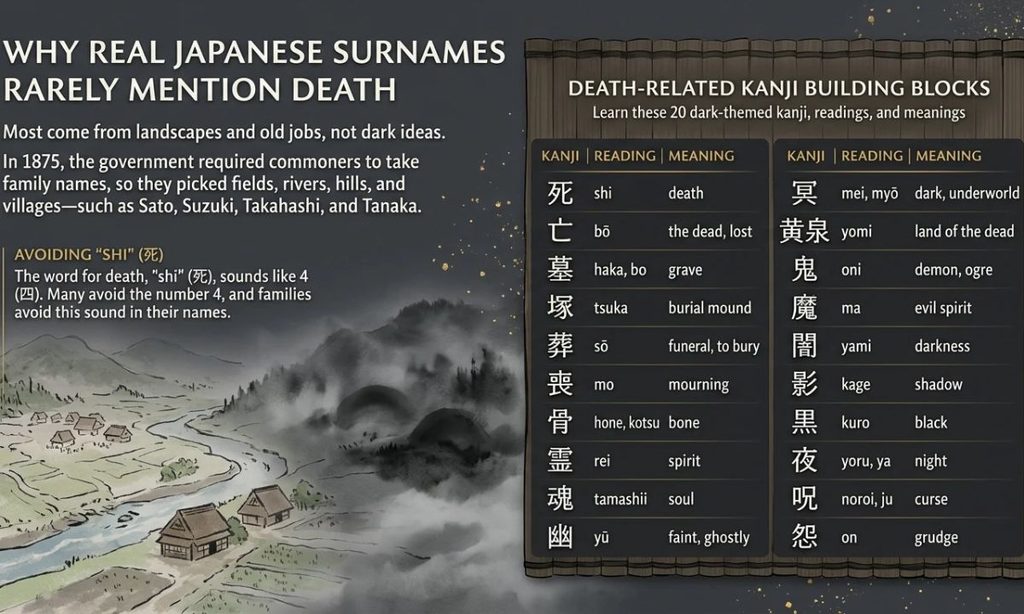
Real Japanese surnames rarely mention death because most of them come from places, landscapes, and old jobs, not from dark ideas. In 1875 the government required commoners to take family names. Many families picked names from the land around them, such as fields, rivers, hills, and villages.
That is why the most common names, like Sato, Suzuki, Takahashi, and Tanaka, sound so ordinary. Japan has well over 100,000 surnames by most estimates, yet very few touch dark themes. When they do, it is almost always through imagery such as mounds, shadows, or demons, not the word death itself.
Culture plays a part too. Japanese has a long habit of avoiding words that bring bad luck, and shi (死), the word for death, sounds exactly like the number four (四). Many hospitals and apartment buildings skip the number 4 for this reason, and few families would want that sound passed down for generations.
Read Also This Blog 110 Baby Names That Mean Strong
Death-Related Kanji Building Blocks
Death-related kanji are the building blocks behind every dark name in this guide. Learn these 20 and you can read, or invent, most dark Japanese surnames.
| Kanji | Reading | Meaning |
| 死 | shi | death |
| 亡 | bō | the dead, lost |
| 墓 | haka, bo | grave |
| 塚 | tsuka | burial mound |
| 葬 | sō, hōmuru | funeral, to bury |
| 喪 | mo | mourning |
| 骨 | hone, kotsu | bone |
| 霊 | rei | spirit |
| 魂 | tamashii, kon | soul |
| 幽 | yū | faint, ghostly |
| 冥 | mei, myō | dark, underworld |
| 黄泉 | yomi | land of the dead |
| 鬼 | oni | demon, ogre |
| 魔 | ma | evil spirit |
| 闇 | yami | darkness |
| 影 | kage | shadow |
| 黒 | kuro | black |
| 夜 | yoru, ya | night |
| 呪 | noroi, ju | curse |
| 怨 | on | grudge |
Key takeaway: The kanji tsuka (塚) is the most useful one. It appears in many real surnames and means a mound where people were buried or remembered.
How to Pronounce Japanese Surnames Correctly
To pronounce Japanese surnames correctly, give each syllable equal weight, use the five pure vowels (a, i, u, e, o), and hold long vowels (ō, ū) a little longer. There is no heavy stress on one syllable like in English.
Sounds also shift inside names. The word tsuka becomes zuka after another word, so 鬼塚 reads as Onizuka. The same kanji can also carry more than one reading, so 鬼塚 is sometimes Onitsuka.
| Name | Say it as | Note |
| Kageyama | ka-ge-ya-ma | All four syllables are even |
| Onizuka | o-ni-zu-ka | Tsuka turns into zuka |
| Tsukamoto | tsu-ka-mo-to | Start with a quick “ts” sound |
| Kurosawa | ku-ro-sa-wa | The “u” is light |
| Hōjō | hoh-joh | Both o sounds are long |
Tip: When a name has several possible readings, check the kanji with a native speaker before you commit to it.
Dark & Creepy Japanese Last Names
Dark and creepy Japanese last names fall into three groups: names about graves and the afterlife, names about shadows and darkness, and names that simply use the color black. The first group is the most chilling, and the second is the easiest to find in real life.
Japanese Last Names That Mean Death or Darkness
These 22 names lean on graves, mounds, the underworld, and funeral words. The first five are real surnames, and the rest are built from real death vocabulary.
| Surname | Kanji | Meaning | Type |
| Tsukahara | 塚原 | burial mound field | Real |
| Tsukada | 塚田 | mound rice field | Real |
| Tsukamoto | 塚本 | base of the mound | Real |
| Onizuka | 鬼塚 | demon mound | Real |
| Kurozuka | 黒塚 | black mound (a Noh play about a demon hag) | Rare |
| Hakamori | 墓守 | grave keeper | Coined |
| Hakaba | 墓場 | graveyard | Coined |
| Meido | 冥土 | land of the dead | Coined |
| Yomi | 黄泉 | land of the dead | Rare |
| Myōga | 冥加 | hidden divine favor | Real |
| Yoruzuka | 夜塚 | night mound | Coined |
| Sotoba | 卒塔婆 | wooden grave marker | Coined |
| Mogari | 殯 | old rite of keeping a body before burial | Coined |
| Honetsuka | 骨塚 | bone mound | Coined |
| Kotsuhara | 骨原 | bone field | Coined |
| Nokotsu | 納骨 | placing ashes in a grave | Coined |
| Kasō | 火葬 | cremation | Coined |
| Sanzu | 三途 | the river of the dead | Coined |
| Yomizuka | 黄泉塚 | mound of the land of the dead | Coined |
| Higan | 彼岸 | the other shore, the afterlife | Coined |
| Tomurai | 弔い | mourning rites | Coined |
| Mofuku | 喪服 | mourning clothes | Coined |
Japanese Last Names With Dark Meanings
Japanese last names with dark meanings are most often built on kage (影, shadow), kuro (黒, black), and yami (闇, darkness). The first twelve below are real surnames you can meet in Japan today.
| Surname | Kanji | Meaning | Type |
| Kageyama | 影山 | shadow mountain | Real |
| Kageura | 影浦 | shadow bay | Rare |
| Kuroda | 黒田 | black rice field | Real |
| Kurokawa | 黒川 | black river | Real |
| Kurosaki | 黒崎 | black cape | Real |
| Kurosawa | 黒沢 | black marsh | Real |
| Kuroki | 黒木 | black tree | Real |
| Kuroiwa | 黒岩 | black rock | Real |
| Kuroshima | 黒島 | black island | Real |
| Kurobe | 黒部 | black section, a gorge name | Real |
| Kurono | 黒野 | black field | Real |
| Kirishima | 霧島 | mist island | Real |
| Kagehara | 影原 | shadow field | Coined |
| Kageshima | 影島 | shadow island | Coined |
| Yamiguchi | 闇口 | mouth of darkness | Coined |
| Yamino | 闇野 | field of darkness | Coined |
| Yamikage | 闇影 | shadow of darkness | Coined |
| Yamizuka | 闇塚 | mound of darkness | Coined |
| Ankoku | 暗黒 | pitch dark | Coined |
| Yoruno | 夜野 | night field | Coined |
| Kokuya | 黒夜 | black night | Coined |
| Kurakage | 暗影 | dim shadow | Coined |
What Are Some Japanese Last Names That Mean “Dark”?
The clearest Japanese last names that mean dark are built on kuro (黒, black), kura (暗, dim), and gen (玄, deep and mysterious). Most of the ones below are real, and the last few are coined for fiction.
| Surname | Kanji | Meaning | Type |
| Kuroyanagi | 黒柳 | black willow | Real |
| Kuroyama | 黒山 | black mountain | Real |
| Kurosu | 黒須 | black, plus a place name ending | Real |
| Kuromatsu | 黒松 | black pine | Real |
| Kurotani | 黒谷 | black valley | Real |
| Kuroi | 黒井 | black well | Real |
| Kuromiya | 黒宮 | black shrine | Rare |
| Kurogane | 黒金 | black metal, iron | Rare |
| Genda | 玄田 | deep, mysterious field | Rare |
| Kurayami | 暗闇 | pitch darkness | Coined |
| Kuraoka | 暗岡 | dark hill | Coined |
| Genkuro | 玄黒 | deep black | Coined |
Read Also This Blog Ladybug Meaning
Japanese Names That Mean Death or Darkness: Surnames vs. Given Names
Japanese names that mean death or darkness are much easier to find as surnames or in fiction than as real given names. Parents choose given names to carry hope, so real ones lean bright, while surnames inherit old place and clan words.
| Feature | Surnames | Given names |
| Where they come from | Places, clans, and old jobs | Parents’ wishes and kanji meaning |
| Dark imagery | Rare, mostly mounds, shadows, and black | Very rare in real life |
| Legal limits | Passed down in the family register | Must use government-approved kanji lists |
| Best use in fiction | Gives a grounded, believable feel | Gives a bold hook for a character |
Tip: If you want a believable dark character, keep the surname real (like Kageyama) and let the given name carry the mood.
Samurai & Historical Names Associated With Death
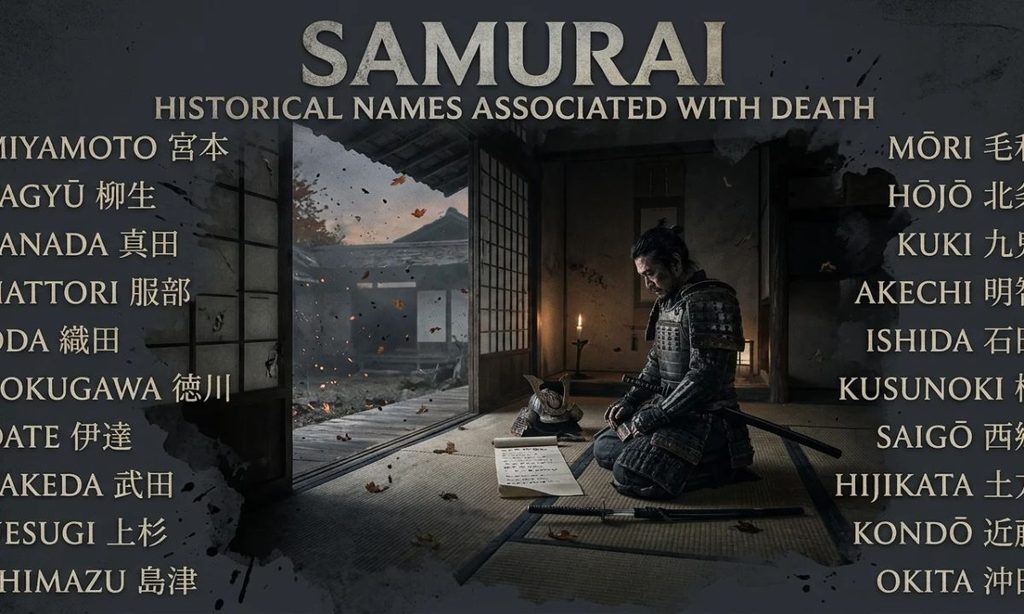
Samurai and historical names associated with death are real clan names tied to famous battles, executions, and last stands. They work well for Japanese last names related to death because the darkness comes from history, not from the kanji. Samurai also wrote jisei (death poems) before dying, which shows how openly the warrior class faced death.
All 22 names below are real surnames.
| Surname | Kanji | Link to death or battle |
| Miyamoto | 宮本 | Musashi, the undefeated duelist who wrote The Book of Five Rings |
| Yagyū | 柳生 | Sword school that served the Tokugawa shoguns |
| Sanada | 真田 | Yukimura died charging at Osaka in 1615 |
| Hattori | 服部 | Hanzō, the Tokugawa warrior tied to ninja legend |
| Oda | 織田 | Nobunaga died at Honnō-ji in 1582 |
| Tokugawa | 徳川 | Clan that ended the warring age and ruled until 1868 |
| Date | 伊達 | Masamune, the “one-eyed dragon” |
| Takeda | 武田 | Shingen, whose death was said to be hidden for years |
| Uesugi | 上杉 | Kenshin, Shingen’s famous rival |
| Shimazu | 島津 | Satsuma lords known for a fierce retreat at Sekigahara |
| Mōri | 毛利 | Powerful western clan on the losing side at Sekigahara |
| Hōjō | 北条 | Ujimasa was ordered to commit seppuku in 1590 |
| Kuki | 九鬼 | “Nine demons,” a clan of sea warriors |
| Akechi | 明智 | Mitsuhide, who killed Nobunaga |
| Ishida | 石田 | Mitsunari, executed after Sekigahara in 1600 |
| Kusunoki | 楠 | Masashige, who died loyal at Minatogawa in 1336 |
| Saigō | 西郷 | Takamori, the “last samurai,” died in 1877 |
| Hijikata | 土方 | Toshizō of the Shinsengumi, killed in 1869 |
| Kondō | 近藤 | Isami, Shinsengumi leader executed in 1868 |
| Okita | 沖田 | Sōji, a young swordsman who died of illness |
| Serizawa | 芹沢 | Kamo, Shinsengumi founder killed by his own side in 1863 |
| Nitta | 新田 | Yoshisada, who died in battle in 1338 |
What Is a Powerful Japanese Surname?
A powerful Japanese surname is one tied to an ancient ruling clan or a shogun family, such as Fujiwara, Minamoto, Taira, and Tachibana. These names carry weight because their owners shaped Japanese politics for centuries. Some also have dark stories behind them, which makes them useful for villains and tragic heroes.
| Surname | Kanji | Why it is powerful |
| Fujiwara | 藤原 | Court regents who dominated the Heian period |
| Minamoto | 源 | Founded the Kamakura shogunate in 1185 |
| Taira | 平 | Rival clan defeated at Dan-no-ura in 1185 |
| Tachibana | 橘 | One of the four great ancient clans |
| Ashikaga | 足利 | Shoguns of the Muromachi era |
| Toyotomi | 豊臣 | The name Hideyoshi used after unifying Japan |
| Sugawara | 菅原 | Michizane, whose angry spirit was blamed for disasters, later worshipped as a god |
| Abe | 安倍 | Seimei, the famous onmyōji and spirit master |
Unique & Rare Death-Themed Japanese Last Names
Unique and rare death-themed Japanese last names are the ones that make readers stop and look twice. Some are real but uncommon, and others are coined from Buddhist and folklore words. Use the Type column to decide how authentic you want to sound.
| Surname | Kanji | Meaning | Type |
| Kuchiki | 朽木 | rotting tree | Rare |
| Kitsunezuka | 狐塚 | fox mound | Rare |
| Onimaru | 鬼丸 | demon circle, also a legendary sword name | Real |
| Kitō | 鬼頭 | demon head | Real |
| Oniki | 鬼木 | demon tree | Rare |
| Ōtsuka | 大塚 | great mound | Real |
| Kozuka | 小塚 | small mound (Edo’s Kozukappara was an execution ground) | Real |
| Karasuma | 烏丸 | crow circle | Real |
| Karasuzuka | 烏塚 | crow mound | Coined |
| Dokuro | 髑髏 | skull | Coined |
| Dokumori | 毒森 | poison forest | Coined |
| Utsuro | 虚 | hollow, empty | Coined |
| Mumei | 無明 | without light, spiritual ignorance | Coined |
| Mujō | 無常 | impermanence of all things | Coined |
| Hakumei | 薄命 | short-lived, ill-fated | Coined |
| Kyomu | 虚無 | nothingness | Coined |
| Shiranui | 不知火 | unknown fire, ghost lights over the sea | Rare |
| Ōma | 逢魔 | meeting with demons (from the dusk hour ōmagatoki) | Coined |
| Tsukumo | 九十九 | ninety-nine, linked to old objects that gain spirits | Rare |
| Hebizuka | 蛇塚 | snake mound | Coined |
| Rokudō | 六道 | the six realms of rebirth | Coined |
| Muen | 無縁 | no ties, the unclaimed dead | Coined |
Read Also This Blog Lygophile Meaning
Japanese Last Names With Meanings: Real Surnames Worth Knowing
The most useful Japanese last names with meanings for a quiet, haunting mood are real surnames built on rain, snow, white, and sacred places. They sound gentle on the surface, but each carries a sad or ritual feel. All 12 are real.
| Surname | Kanji | Meaning and feel |
| Yukimura | 雪村 | snow village, cold and quiet |
| Fuyuki | 冬木 | winter tree, bare and still |
| Amemiya | 雨宮 | rain shrine, a misty and sorrowful mood |
| Amenomori | 雨森 | rain forest, wet and hushed woods |
| Shigure | 時雨 | autumn drizzle, a sad passing rain |
| Tsubaki | 椿 | camellia, whose blossoms drop whole, often linked in folklore to beheading |
| Sakurai | 桜井 | cherry blossom well, fleeting beauty |
| Shirai | 白井 | white well, and white is the color of mourning |
| Shirakawa | 白川 | white river, pale and quiet |
| Sakakibara | 榊原 | sacred sakaki field, a tree used in Shinto rites |
| Terada | 寺田 | temple field, since temples hold funerals and graves |
| Yanagida | 柳田 | willow field, and willows are tied to ghosts in folklore |
Modern & Fictional Use Names
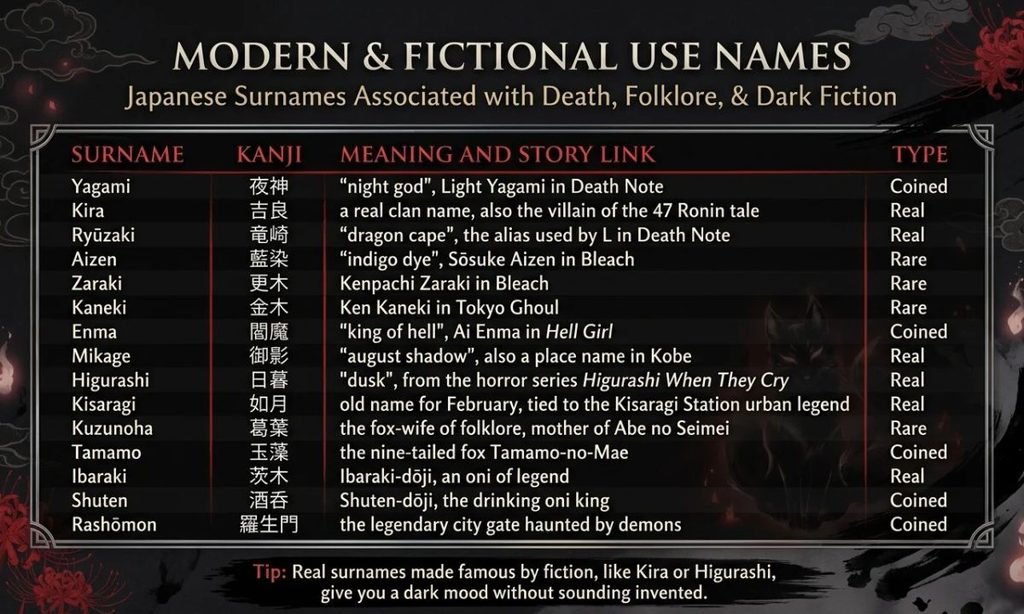
Modern and fictional Japanese last names related to death come from anime, manga, games, and horror stories. Many are real surnames that fiction made famous, so readers feel the mood the moment they see them.
| Surname | Kanji | Meaning and story link | Type |
| Yagami | 夜神 | night god, Light Yagami in Death Note | Coined |
| Kira | 吉良 | a real clan name, also the villain of the 47 Ronin tale | Real |
| Ryūzaki | 竜崎 | dragon cape, the alias used by L in Death Note | Real |
| Aizen | 藍染 | indigo dye, Sōsuke Aizen in Bleach | Rare |
| Zaraki | 更木 | Kenpachi Zaraki in Bleach | Rare |
| Kaneki | 金木 | Ken Kaneki in Tokyo Ghoul | Rare |
| Enma | 閻魔 | king of hell, Ai Enma in Hell Girl | Coined |
| Mikage | 御影 | august shadow, also a place name in Kobe | Real |
| Higurashi | 日暮 | dusk, from the horror series Higurashi When They Cry | Real |
| Kisaragi | 如月 | old name for February, tied to the Kisaragi Station urban legend | Real |
| Kuzunoha | 葛葉 | the fox-wife of folklore, mother of Abe no Seimei | Rare |
| Tamamo | 玉藻 | the nine-tailed fox Tamamo-no-Mae | Coined |
| Ibaraki | 茨木 | Ibaraki-dōji, an oni of legend | Real |
| Shuten | 酒呑 | Shuten-dōji, the drinking oni king | Coined |
| Rashōmon | 羅生門 | the legendary city gate haunted by demons | Coined |
Tip: Real surnames made famous by fiction, like Kira or Higurashi, give you a dark mood without sounding invented.
Ghost & Spirit-Themed Japanese Last Names 👻
Ghost and spirit-themed Japanese last names borrow from yūrei, the pale ghosts of Japanese tradition. Yūrei are usually shown in white burial clothes with long loose hair, and they return because of a grudge or unfinished business. The first four names below come from famous ghost stories.
| Surname | Kanji | Meaning | Type |
| Tamiya | 田宮 | the family of Oiwa in the kabuki ghost play Yotsuya Kaidan | Real |
| Yotsuya | 四谷 | title place of Yotsuya Kaidan, first staged in 1825 | Real |
| Aoyama | 青山 | the household in the Okiku plate ghost tale (Banchō version) | Real |
| Yukishiro | 雪代 | snowmelt, a pale and quiet mood | Rare |
| Hitodama | 人魂 | human soul fireball | Coined |
| Onibi | 鬼火 | demon fire | Coined |
| Kitsunebi | 狐火 | fox fire | Coined |
| Yūrei | 幽霊 | faint spirit, a ghost | Coined |
| Yūki | 幽鬼 | ghostly demon | Coined |
| Bōrei | 亡霊 | spirit of the dead | Coined |
| Goryō | 御霊 | a vengeful spirit that is honored to calm it | Coined |
| Gaki | 餓鬼 | hungry ghost | Coined |
| Kasane | 累 | the vengeful ghost of the Kasane tale | Coined |
| Funayūrei | 船幽霊 | ship ghost | Coined |
| Ubume | 産女 | ghost of a mother who died in childbirth | Coined |
| Shiryō | 死霊 | spirit of the dead | Coined |
| Ikiryō | 生霊 | living spirit, a ghost sent by a living person | Coined |
| Mayoiga | 迷家 | the vanishing ghost house of Tohoku folklore | Coined |
Japanese Last Names Meaning Spirit
Japanese last names meaning spirit use rei (霊), tama (魂 or 玉), or kami (神). The kami names are real and common, while the rei names are better for fiction.
| Surname | Kanji | Meaning | Type |
| Rei | 霊 | spirit | Coined |
| Reiyama | 霊山 | spirit mountain | Coined |
| Mitama | 御魂 | honored soul | Coined |
| Kodama | 木霊 | tree spirit, or an echo | Coined |
| Kotodama | 言霊 | the spirit inside words | Coined |
| Seirei | 精霊 | spirit, such as the souls welcomed at Obon | Coined |
| Kamiyama | 神山 | god mountain | Real |
| Kanzaki | 神崎 | god cape | Real |
| Kamiya | 神谷 | god valley | Real |
| Tamaoki | 玉置 | jewel placement, with a sound close to the word for soul | Real |
Warrior & Battle-Related Death Names ⚔️
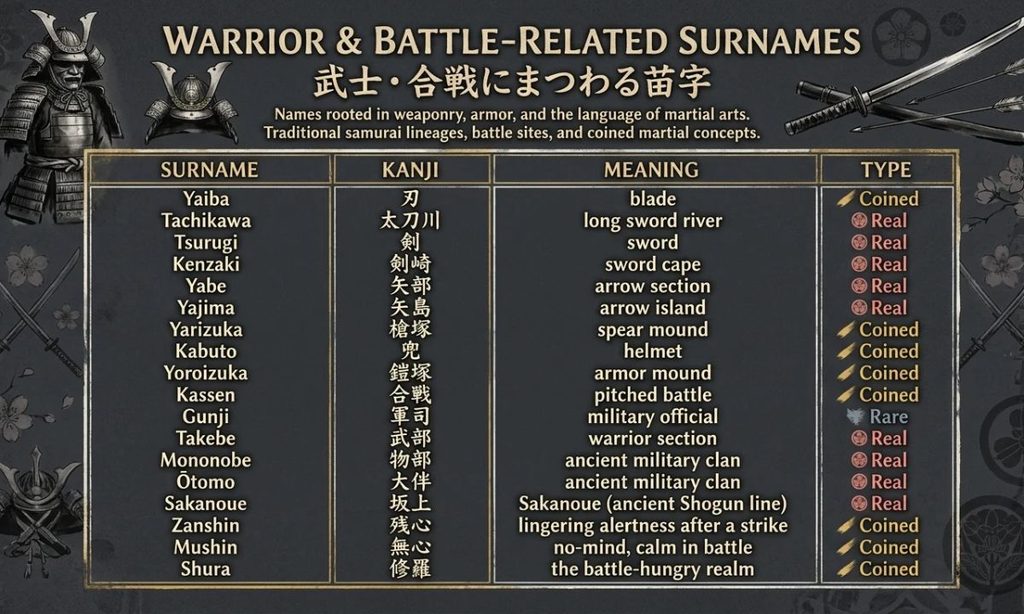
Warrior and battle-related death names use weapons, armor, and the language of martial arts. The real ones come from old military clans and sword-related place names. The coined ones borrow fighting words like zanshin, the lingering alertness after a strike.
| Surname | Kanji | Meaning | Type |
| Yaiba | 刃 | blade | Coined |
| Tachikawa | 太刀川 | long sword river | Real |
| Tsurugi | 剣 | sword | Real |
| Kenzaki | 剣崎 | sword cape | Real |
| Yabe | 矢部 | arrow section | Real |
| Yajima | 矢島 | arrow island | Real |
| Yarizuka | 槍塚 | spear mound | Coined |
| Kabuto | 兜 | helmet | Coined |
| Yoroizuka | 鎧塚 | armor mound | Coined |
| Kassen | 合戦 | pitched battle | Coined |
| Gunji | 軍司 | military official | Rare |
| Takebe | 武部 | warrior section | Real |
| Mononobe | 物部 | ancient military clan | Real |
| Ōtomo | 大伴 | ancient military clan | Real |
| Sakanoue | 坂上 | Tamuramaro, an early shogun, came from this line | Real |
| Zanshin | 残心 | lingering alertness after a strike | Coined |
| Mushin | 無心 | no-mind, calm in battle | Coined |
| Shura | 修羅 | the battle-hungry realm of rebirth | Coined |
Nature & Death Symbolism 🌲
Nature and death symbolism in Japanese names comes from flowers, weather, and seasons. In Japan, white chrysanthemums are linked to funerals, red spider lilies grow near graveyards, and fireflies are often seen as souls. Names built on these images feel quiet and eerie, not violent.
| Surname | Kanji | Meaning | Type |
| Higanbana | 彼岸花 | red spider lily, planted near graves | Coined |
| Shiragiku | 白菊 | white chrysanthemum, a funeral flower | Coined |
| Kikuchi | 菊池 | chrysanthemum pond | Real |
| Yanagisawa | 柳沢 | willow marsh | Real |
| Yūgiri | 夕霧 | evening mist | Coined |
| Shimoyama | 霜山 | frost mountain | Coined |
| Kazama | 風間 | wind gap | Real |
| Matsukaze | 松風 | wind in the pines, a Noh play about ghostly sisters | Rare |
| Hotaruzuka | 蛍塚 | firefly mound | Coined |
| Sakurazuka | 桜塚 | cherry blossom mound | Coined |
| Kasumi | 霞 | haze, mist | Coined |
| Kumoi | 雲井 | cloud well | Real |
| Mizukami | 水上 | upper waters | Real |
| Fukazawa | 深沢 | deep marsh | Real |
| Fukai | 深井 | deep well | Real |
| Okuyama | 奥山 | deep mountain | Real |
| Tsuyu | 露 | dew, a symbol of fleeting life | Coined |
| Ukishima | 浮島 | floating island | Rare |
Read Also This Blog DATY Meaning in Text
Japanese Last Names That Mean Moon
Japanese last names that mean moon begin with tsuki (月). The moon fits dark themes well because it rules the night, and the ukiyo-e artist Tsukioka Yoshitoshi used it in his famous ghostly print series.
| Surname | Kanji | Meaning | Type |
| Tsukishima | 月島 | moon island | Real |
| Tsukioka | 月岡 | moon hill | Real |
| Tsukishiro | 月城 | moon castle | Real |
| Tsukimoto | 月本 | base of the moon | Real |
| Tsukino | 月野 | moon field | Real |
| Tsukuyomi | 月読 | moon reader, the name of the moon god | Rare |
| Yamanashi | 月見里 | written with moon-view-village, but read Yamanashi | Real |
| Tsukikage | 月影 | moonlight and moon shadow | Coined |
| Tsukida | 月田 | moon rice field | Real |
| Tsukiyama | 月山 | moon mountain, as in Gassan, a sacred peak tied to the afterlife | Real |
Occult & Cursed Names 🔮
Occult and cursed names borrow from onmyōdō, the old Japanese art of divination and ritual, and from curse folklore. They suit mystery stories, exorcist characters, and dark fantasy. Only the first two are real surnames, so label the rest as fiction.
| Surname | Kanji | Meaning | Type |
| Busujima | 毒島 | poison island | Real |
| Inugami | 犬神 | dog god, a cursed spirit in folklore | Rare |
| Noroizuka | 呪塚 | curse mound | Coined |
| Tatari | 祟 | the curse of an angry spirit | Coined |
| Onmyō | 陰陽 | yin and yang, Japanese divination | Coined |
| Kekkai | 結界 | a barrier that keeps spirits out | Coined |
| Fūin | 封印 | seal | Coined |
| Ushimitsu | 丑三つ | the dead of night, around 2 AM | Coined |
| Kodoku | 蠱毒 | a curse made with trapped creatures | Coined |
| Shikigami | 式神 | a spirit servant of an onmyōji | Coined |
| Ofuda | 御札 | paper charm | Coined |
| Hitogata | 人形 | paper figure used in purification and curses | Coined |
| Kamikakushi | 神隠し | spirited away | Coined |
| Kuji | 九字 | the nine-syllable protective ritual | Coined |
Japanese Last Names Meaning Demon
Japanese last names meaning demon use oni (鬼), ma (魔), or aku (悪). Real surnames with oni, such as Kitō and Onimaru, appear earlier in this guide. The names below are stronger and better for villains.
| Surname | Kanji | Meaning | Type |
| Akuma | 悪魔 | devil | Coined |
| Maō | 魔王 | demon king | Coined |
| Yasha | 夜叉 | a fierce guardian spirit | Coined |
| Rasetsu | 羅刹 | a flesh-eating demon | Coined |
| Kijin | 鬼神 | demon god | Coined |
| Hannya | 般若 | the jealous demon mask of Noh theater | Coined |
| Tengu | 天狗 | the long-nosed mountain goblin | Coined |
| Onigawara | 鬼瓦 | demon roof tile | Coined |
| Oniyama | 鬼山 | demon mountain | Coined |
| Oniwaka | 鬼若 | young demon, a childhood nickname of the warrior monk Benkei | Coined |
Seasonal & Festival Death Names 🎎
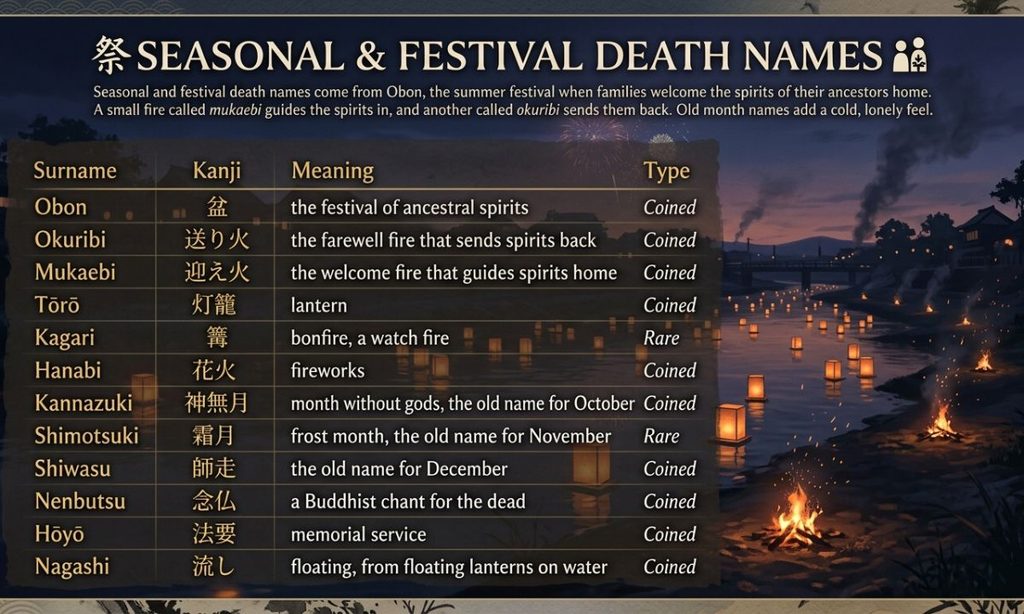
Seasonal and festival death names come from Obon, the summer festival when families welcome the spirits of their ancestors home. A small fire called mukaebi guides the spirits in, and another called okuribi sends them back. Old month names add a cold, lonely feel.
| Surname | Kanji | Meaning | Type |
| Obon | 盆 | the festival of ancestral spirits | Coined |
| Okuribi | 送り火 | the farewell fire that sends spirits back | Coined |
| Mukaebi | 迎え火 | the welcome fire that guides spirits home | Coined |
| Tōrō | 灯籠 | lantern | Coined |
| Kagari | 篝 | bonfire, a watch fire | Rare |
| Hanabi | 花火 | fireworks | Coined |
| Kannazuki | 神無月 | month without gods, the old name for October | Coined |
| Shimotsuki | 霜月 | frost month, the old name for November | Rare |
| Shiwasu | 師走 | the old name for December | Coined |
| Nenbutsu | 念仏 | a Buddhist chant for the dead | Coined |
| Hōyō | 法要 | memorial service | Coined |
| Nagashi | 流し | floating, from floating lanterns on water | Coined |
Read Also This Blog Sapiosexual Meaning
Horror & Fictional Character Names 👹
Horror and fictional character names are where you can be boldest, because no one expects a real family to carry them. These 14 names mix dark kanji such as bones, black, and mounds into short, memorable sounds. Keep them to two to four syllables so readers can say them easily.
| Surname | Kanji | Meaning | Type |
| Kuchiba | 朽葉 | rotted leaves | Rare |
| Kareno | 枯野 | withered field | Coined |
| Kuroyuki | 黒雪 | black snow | Coined |
| Shirozuka | 白塚 | white mound | Coined |
| Akatsuka | 赤塚 | red mound | Real |
| Mukuro | 骸 | remains | Coined |
| Shikabane | 屍 | corpse | Coined |
| Kurotsuki | 黒月 | black moon | Coined |
| Yamizuki | 闇月 | moon of darkness | Coined |
| Yomikage | 黄泉影 | shadow of the underworld | Coined |
| Akeyami | 明闇 | dawn darkness | Coined |
| Hōmuri | 葬 | burial | Coined |
| Nagori | 名残 | a lingering trace | Coined |
| Utakata | 泡沫 | bubbles on water, brief life | Coined |
Sad & Sorrowful Japanese Last Names
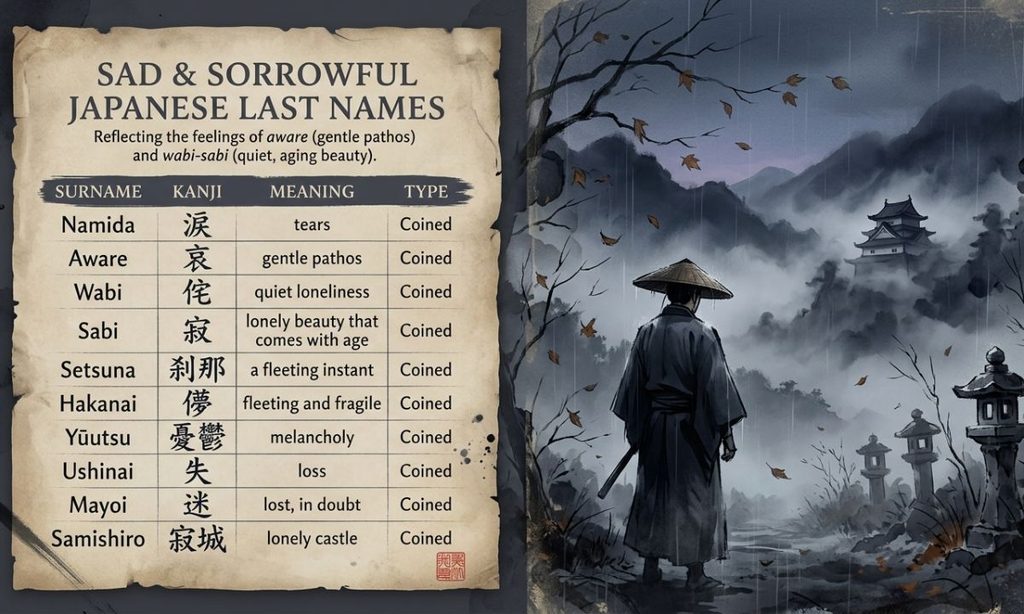
Sad and sorrowful Japanese last names rely on feelings that Japanese art treasures, such as aware (gentle pathos) and wabi-sabi (quiet, aging beauty). These names feel more tender than frightening. They suit tragic heroes and quiet, grieving characters.
| Surname | Kanji | Meaning | Type |
| Namida | 涙 | tears | Coined |
| Aware | 哀 | gentle pathos | Coined |
| Wabi | 侘 | quiet loneliness | Coined |
| Sabi | 寂 | lonely beauty that comes with age | Coined |
| Setsuna | 刹那 | a fleeting instant | Coined |
| Hakanai | 儚 | fleeting and fragile | Coined |
| Yūutsu | 憂鬱 | melancholy | Coined |
| Ushinai | 失 | loss | Coined |
| Mayoi | 迷 | lost, in doubt | Coined |
| Samishiro | 寂城 | lonely castle | Coined |
What Are Some Sad Japanese Surnames?
The best sad Japanese surnames use autumn, cold, rain, and twilight. Two of the six below are real surnames, and the rest are coined from season words.
| Surname | Kanji | Meaning | Type |
| Akiyama | 秋山 | autumn mountain | Real |
| Samukawa | 寒川 | cold river | Real |
| Fuyuno | 冬野 | winter field | Coined |
| Ochiba | 落葉 | fallen leaves | Coined |
| Ukigumo | 浮雲 | drifting cloud | Coined |
| Tasogare | 黄昏 | twilight | Coined |
What Japanese Last Name Means Sorrow?
The Japanese last names that come closest to meaning sorrow are built on ai (哀) and hi (悲), the kanji for grief. None is a common real surname, so treat them as fiction-ready names.
| Surname | Kanji | Meaning | Type |
| Aishū | 哀愁 | sorrow, wistful sadness | Coined |
| Hiai | 悲哀 | pathos, deep grief | Coined |
| Nageki | 嘆き | lament | Coined |
| Yūshū | 憂愁 | melancholy sorrow | Coined |
| Tsuitō | 追悼 | mourning, remembrance of the dead | Coined |
Japanese Last Names Meaning Love: When Love and Loss Meet
Japanese last names meaning love use ai (愛) or koi (恋). They look soft, but some link love and loss, like the old tale behind Koizuka, a mound said to remember a woman who died to save her husband.
| Surname | Kanji | Meaning | Type |
| Aikawa | 愛川 | love river | Real |
| Aikō | 愛甲 | love and armor | Real |
| Atago | 愛宕 | the name of Atago shrine, known as a protector from fire | Real |
| Koizuka | 恋塚 | love mound | Rare |
| Aizen | 愛染 | love dyed, the name of a Buddhist deity of love (different kanji from the Bleach villain) | Rare |
| Chigiri | 契 | a vow or bond | Coined |
Death in Japanese Folklore: Shinigami, Yomi, Oni & Yūrei
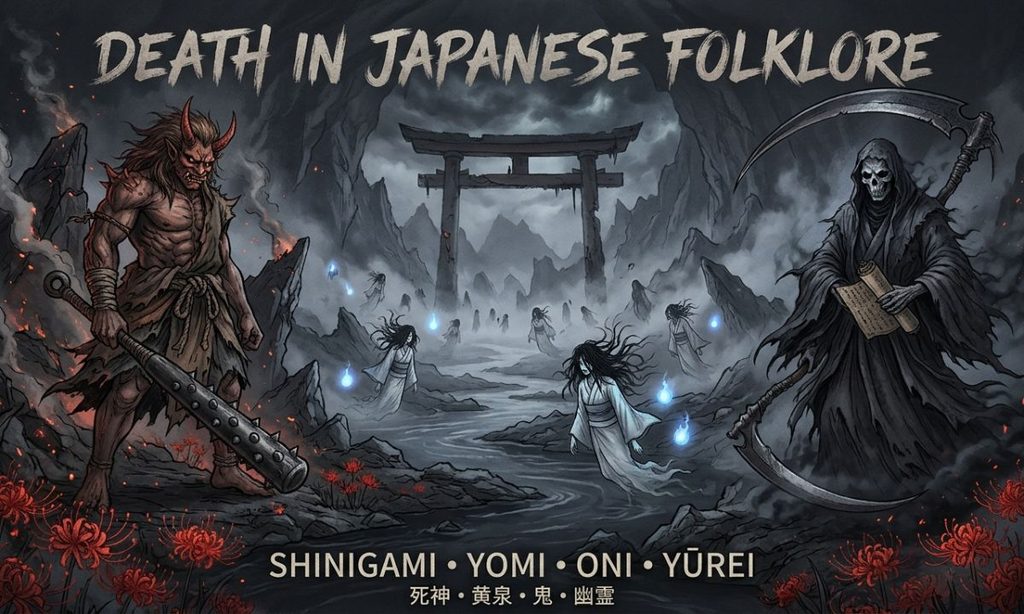
Death in Japanese folklore centers on four ideas: Yomi (the land of the dead), shinigami (death gods), oni (demons), and yūrei (ghosts). Knowing them helps you pick Japanese last names related to death that feel grounded, not random.
| Idea | What it means | Name inspiration |
| Yomi (黄泉) | The land of the dead in early myth, where the goddess Izanami went after she died | Yomi, Yomizuka, Yomikage |
| Shinigami (死神) | Death gods, a later and popular idea, common in modern stories | Shiryō, Bōrei |
| Oni (鬼) | Demons that guard hell and bring misfortune | Onizuka, Onimaru, Kijin |
| Yūrei (幽霊) | Pale ghosts that return with a grudge | Yūrei, Tamiya, Kasane |
| Onryō (怨霊) | Vengeful spirits, such as the angry spirit tied to Sugawara no Michizane | Goryō, Tatari |
| Enma (閻魔) | The king who judges the dead in Buddhist belief | Enma, Sanzu |
Yomi first appears in the Kojiki, Japan’s oldest chronicle, completed in 712. In that story, the god Izanagi followed his dead wife Izanami into Yomi, saw her rotting body, and fled. This is why Yomi is tied to fear, pollution, and the border between worlds.
In Buddhist belief, the dead cross the Sanzu River before Enma judges them. Many names in this guide, like Sanzu and Higan, come from that idea.
Key takeaway: Pick a name from one folklore idea and stay with it. A Yomi name and a yūrei name together can feel confused.
Read Also This Blog FN Meaning in Slang
How We Create Japanese Last Names Related to Death
We create Japanese last names related to death by joining one dark word to one landscape word, the same way real surnames are formed. This keeps the result natural to Japanese eyes and ears. You can use the same method to build your own.
- Pick a dark root. Choose one kanji such as 影 (shadow), 黒 (black), 塚 (mound), or 霊 (spirit).
- Add a landscape word. Common endings are yama (mountain), kawa (river), shima (island), hara (field), and zuka (mound).
- Check the sound. Watch for shifts like tsuka turning into zuka.
- Check the meaning. Confirm that every kanji says what you want, and that no kanji has a hidden second meaning.
- Label the name. Mark it Real, Rare, or Coined, so readers know what it is.
- Avoid real tragedies. Skip names tied to recent disasters or crimes.
| Dark root | Landscape ending | Result |
| 影 kage | 山 yama | Kageyama, shadow mountain |
| 黒 kuro | 塚 zuka | Kurozuka, black mound |
| 霊 rei | 山 yama | Reiyama, spirit mountain |
| 夜 yoru | 野 no | Yoruno, night field |
Tips for Making Your Team or Character Stand Out
To make your team or character stand out with a dark Japanese surname, match the name to the role, keep it short, and pair it with a given name that contrasts in mood. A shadowy surname with a bright first name creates instant personality.
- Match the mood to the role. Use warrior names for fighters, ghost names for mysterious characters, and sad names for tragic heroes.
- Keep it to two to four syllables. Short names are easier to say, spell, and remember.
- Mix real and coined. One real anchor name, like Kageyama, makes the world feel believable.
- Add a small backstory. One line about the meaning gives readers a reason to care.
- Check availability. Search for the name as a username, domain, and brand before you commit.
| Use | Name idea | Why it works |
| Gaming team | Kageyama | Real, short, and shadowy |
| Horror villain | Kurozuka | Linked to a demon hag legend |
| Tragic hero | Kusunoki | A name tied to a loyal death in battle |
| Ghost story | Tamiya | Tied to a famous kabuki ghost tale |
| Quiet detective | Shigure | Soft, rainy, and mysterious |
| Rival fighter | Zaraki | Known from battle anime |
Tip: Pick a name you can explain in one sentence. If you cannot, it may be too complicated for your readers.
Frequently Asked Questions
What is the most common Japanese last name related to death?
The most common Japanese last names related to death are the tsuka (塚) names, such as Tsukamoto, Tsukada, and Ōtsuka. Tsuka means burial mound. None of them mean death directly, but they carry the closest real link to graves.
Is there a real Japanese surname that means death?
No common Japanese surname means death directly. The word shi (死) is avoided because it brings bad luck. The closest real surnames use words for mounds, shadows, black, and demons, such as Tsukahara, Kageyama, Kuroda, and Kitō.
What Japanese last name means demon?
Real Japanese last names that point to demons include Onimaru (鬼丸), Kitō (鬼頭), Oniki (鬼木), and Onizuka (鬼塚). The clan name Kuki (九鬼) is often read as nine demons. For stronger, fiction-only choices, use Akuma, Maō, or Kijin.
Can I use these names for a character, team, or story?
Yes, you can use these names for characters, teams, and stories. Check the Type label first, then say the name aloud and verify the kanji with a native speaker if possible. Avoid names tied to real tragedies, and do not use a real person’s full name without permission.
Why is the number four unlucky in Japan?
The number four is unlucky in Japan because its sound, shi (四), matches the word for death (死). The number nine, ku (九), also sounds like the word for suffering. Even so, real surnames such as Shinomiya (四宮) and Yotsuya (四谷) exist, and families carry them without worry.
Conclusion
Japanese last names related to death are mostly built from imagery, not from the word death itself. Real surnames use burial mounds, shadows, black, and demons, while the darkest picks are coined from kanji for graves, spirits, and curses. With 284+ dark picks, labels, and pronunciation tips, you can now choose a name that feels authentic and fits your story.
Start with one theme, such as samurai, ghosts, or nature. Check the kanji and the sound, label the name honestly, and keep it short. A well-chosen name can set the whole mood of a character or team in one word.
