

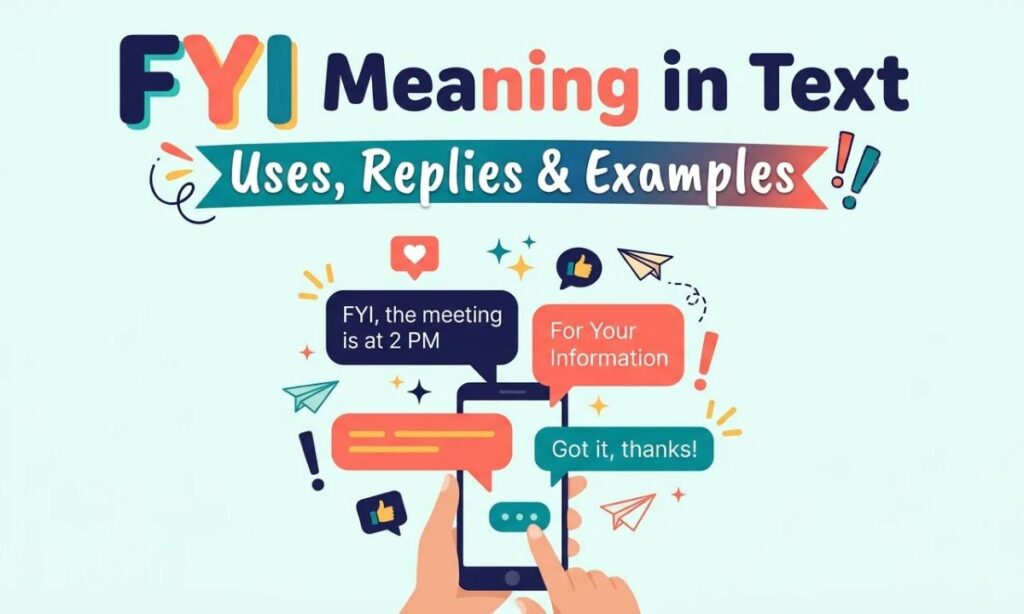
FYI meaning is simple: it stands for “for your information.” People type it in texts, emails, and DMs to share something without asking for anything back. The tone can change a lot though, depending on who sends it and how.
This guide explains the FYI meaning in text, where it came from, how to use it, and how to reply. You will also see how it works on Instagram, Snapchat, TikTok, WhatsApp, and at work.
What Does FYI Mean in Text?
In text, FYI means “for your information.” It tells the reader that the message is a heads-up. The sender wants you to know something, but usually does not expect action or a long answer.
Simple Meaning in Chat
In a chat, FYI is a quick way to say “just so you know.” It adds a small note, a reminder, or a piece of news. Most of the time it is neutral and friendly.
The FYI meaning does not change from app to app. What changes is the tone around it.
Examples
- “FYI, the class starts at 9 now, not 10.”
- “FYI, I left your charger on the kitchen table.”
- “FYI, Mom is coming over on Sunday.”
- “FYI, the store closes early today.”
Key takeaway: FYI means “for your information.” It shares a fact or update and rarely needs a reply.
Where Does FYI Come From?
FYI comes from office and business writing. It started as a short note on memos and letters, used to pass along information without asking the reader to do anything. Records of its use go back to around the 1940s.
As email and then texting became common, people shortened everything. FYI moved from the workplace into everyday chat, and now it is one of the most familiar internet abbreviations.
FYI Meaning at a Glance
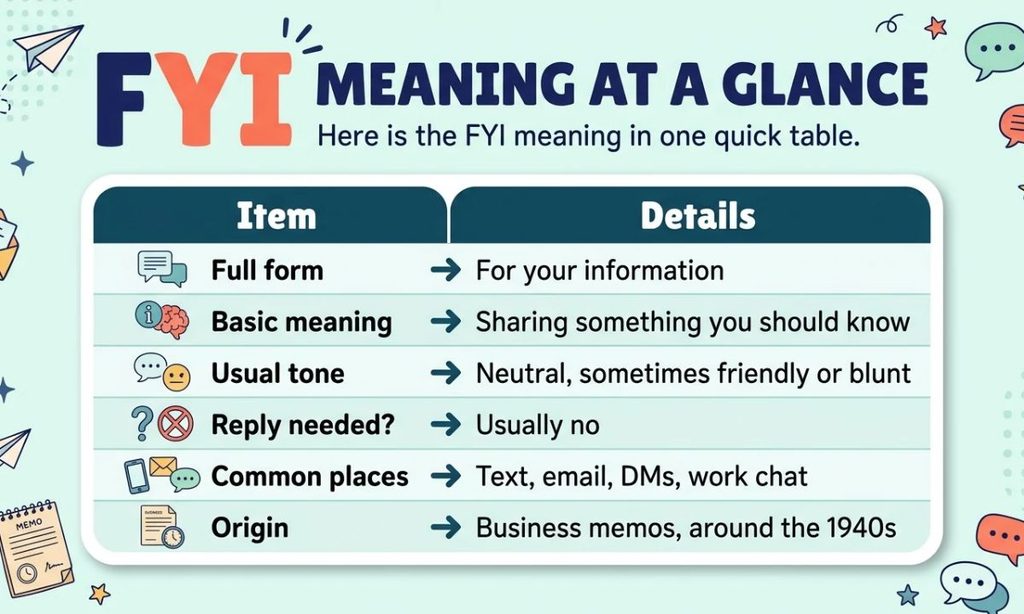
Here is the FYI meaning in one quick table.
| Item | Details |
| Full form | For your information |
| Basic meaning | Sharing something you should know |
| Usual tone | Neutral, sometimes friendly or blunt |
| Reply needed? | Usually no |
| Common places | Text, email, DMs, work chat |
| Origin | Business memos, around the 1940s |
Why Do People Use FYI?
People use FYI because it is short, clear, and low pressure. It lets them pass on information without writing a long message. It also signals that the reader does not have to do anything about it.
Some people also use it to protect themselves. If they warned you, they can say they told you. That is why the FYI meaning can feel helpful in one chat and pointed in another.
FYI Meaning in Text: 11 Key Uses
The FYI meaning in text covers more than one situation. Here are the 11 most common uses.
- Sharing news: “FYI, we got the apartment.”
- Giving a reminder: “FYI, rent is due Friday.”
- Warning someone: “FYI, the road is closed near the mall.”
- Passing on a link or file: “FYI, here is the schedule.”
- Correcting a detail: “FYI, it’s spelled with two Rs.”
- Keeping someone in the loop: “FYI, I told Sam about the plan.”
- Setting a boundary: “FYI, I don’t answer calls after 9.”
- Adding context: “FYI, he was late because of traffic.”
- Showing a bit of attitude: “FYI, I did text you first.”
- Flagging something to read later: “FYI, no rush on this.”
- Making a joke: “FYI, I am the best cook in this house.”
Quick tip: The first eight uses are neutral. Uses nine and eleven depend heavily on tone and your relationship with the sender.
How to Use FYI in a Sentence and in Chat
You can use FYI at the start of a message, in the middle, or as a short standalone note. The key is to follow it with something useful and specific.
How to Use FYI in a Sentence
Put FYI at the start of the sentence and follow it with a comma. You can also place it in the middle, set off by commas.
- “FYI, the meeting moved to Thursday.”
- “The meeting, FYI, moved to Thursday.”
- “Just FYI, parking is free on weekends.”
The first version is the clearest and the most common.
How to Use FYI in Chat
In chat, keep it light and short. Add the fact right after FYI, and do not stack several unrelated updates in one message.
- Use it for small updates, not big emotional topics.
- Add a friendly word if the news could sound cold (“FYI, no pressure!”).
- Skip it when you actually need a decision or an answer.
FYI Meaning on Instagram
On Instagram, FYI means the same thing: “for your information.” The context is just more casual and more public, so the tone matters even more.
FYI in Instagram DMs
In DMs, FYI usually introduces a quick update or a link. A friend might send “FYI, the party is at 8” with a meme or a post attached. It is a casual heads-up.
FYI in Instagram Comments
In comments, FYI is often used to correct or add information. For example, “FYI, this cafe moved last year.” Because others can see it, it can come across as corrective or even snarky, so be careful.
FYI in Instagram Stories
In Stories, people add FYI as text over a photo to share a quick note, like “FYI, I’m taking a break from posting.” It works as a short announcement for followers.
FYI Meaning on Snapchat, TikTok, WhatsApp, and Other Apps
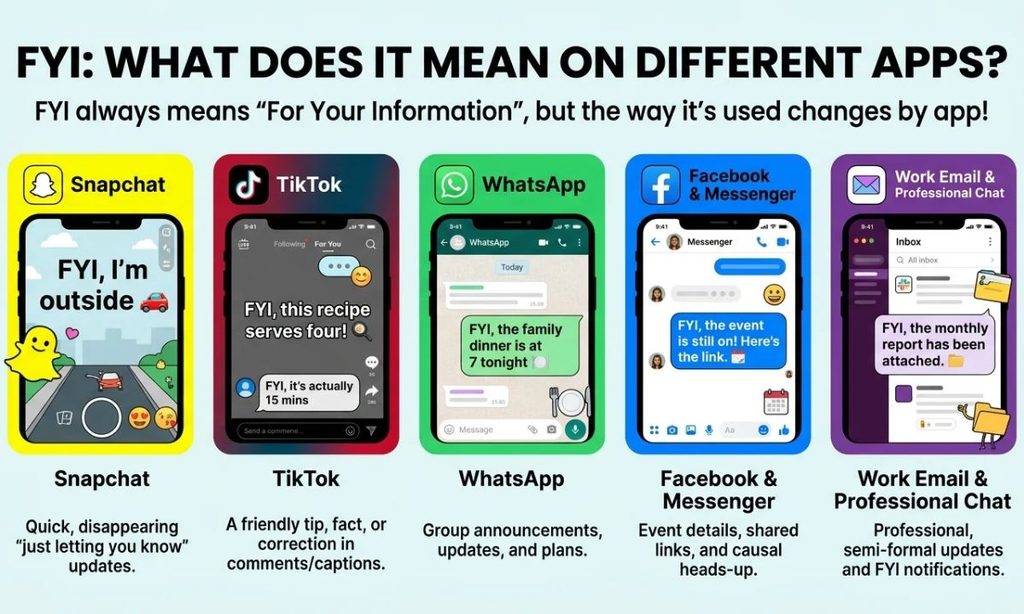
The FYI meaning stays the same on every app. Only the style around it changes.
FYI Meaning on Snapchat
On Snapchat, FYI shows up in quick text snaps and chats. It usually means “just letting you know,” such as “FYI, I’m outside.” Messages disappear fast, so people keep it short.
FYI Meaning on TikTok
On TikTok, FYI appears in captions, comments, and on-screen text. Creators use it to add a fact or clarify a point, like “FYI, this recipe serves four.” In comments, it can also be a gentle correction.
FYI Meaning in WhatsApp
In WhatsApp, FYI is common in group chats for announcements and updates. “FYI, the family dinner is at 7” tells everyone the plan without needing replies.
FYI Meaning in Facebook and Messenger
On Facebook and Messenger, FYI works as a casual or semi-formal heads-up. People use it for event details, shared links, and reminders. In public posts, it can read as a broad announcement.
Work Emails and Professional Chat
In Slack, Teams, and work email, FYI means “no action needed, just be aware.” It is standard and polite in this setting, especially when you forward a message or a file.
What Does FYI Mean in Email?
In email, FYI means the message is shared for awareness only. Many people write “FYI” in the subject line or at the top of a forwarded email. It tells the reader they do not need to reply or act.
Examples:
- Subject: “FYI: Updated Q3 schedule”
- “FYI, see the note below from the client.”
Tip: If you do need a reply, do not use FYI. Say what you need, like “Please confirm by Friday.”
FYI Meaning in Work
At work, FYI means “for your awareness.” Managers and coworkers use it to keep people informed without adding to anyone’s to-do list. It is useful for updates, copied emails, and shared documents.
It can also create a paper trail. By sending an FYI, someone shows that you were informed. That is normal in a professional setting, but a long chain of FYI emails can feel like noise.
What Does FYI Mean From a Guy?
From a guy, FYI usually means he is sharing information plainly. Most guys use it as a short, no-frills heads-up. But the meaning depends on the situation, the tone, and your relationship.
Possible Intentions
- Simple heads-up: He wants you to know something.
- Keeping it casual: He is avoiding a long message.
- Mild defensiveness: He is making a point, like “FYI, I did call.”
- Playful teasing: He is joking, especially with an emoji.
- Making an excuse: He is explaining something without apologizing.
Examples of Replies
| His message | Possible reply |
| “FYI, I’ll be late.” | “Thanks for telling me!” |
| “FYI, I did call you.” | “Oh, my bad, I missed it.” |
| “FYI, you looked great tonight.” | “Aw, thank you!” |
What Does FYI Mean From a Girl?
From a girl, FYI also means “for your information,” and the same rules apply. Tone, timing, and context tell you whether it is friendly, informational, or a bit sharp.
Possible Intentions
- Helpful update: She is keeping you in the loop.
- Gentle hint: She is nudging you about something, like “FYI, her birthday is Friday.”
- Clarifying: She is correcting a misunderstanding.
- Showing mild annoyance: She is pointing out something she feels was missed.
- Flirty or playful: She is teasing you, usually with emojis.
Examples of Replies
| Her message | Possible reply |
| “FYI, I’m free Saturday.” | “Great, let’s do something!” |
| “FYI, I already told you that.” | “You’re right, sorry about that.” |
| “FYI, I love that song.” | “Good to know, I’ll play it.” |
Key takeaway: Gender does not change the FYI meaning. Read the tone, emojis, and past conversation instead.
How to Respond to FYI
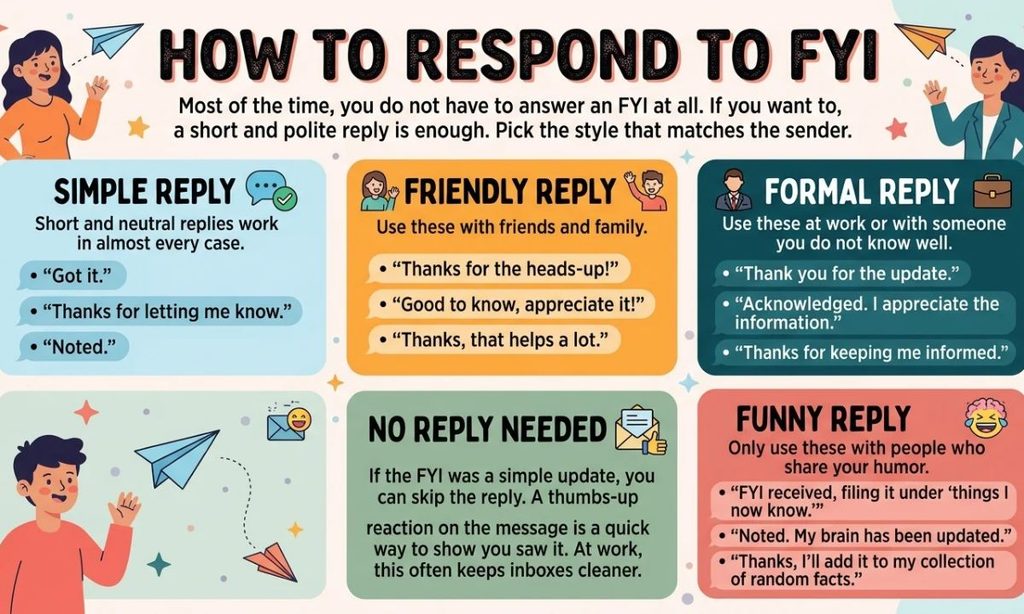
Most of the time, you do not have to answer an FYI at all. If you want to, a short and polite reply is enough. Pick the style that matches the sender.
Simple Reply
Short and neutral replies work in almost every case.
- “Got it.”
- “Thanks for letting me know.”
- “Noted.”
Friendly Reply
Use these with friends and family.
- “Thanks for the heads-up!”
- “Good to know, appreciate it!”
- “Thanks, that helps a lot.”
Formal Reply
Use these at work or with someone you do not know well.
- “Thank you for the update.”
- “Acknowledged. I appreciate the information.”
- “Thanks for keeping me informed.”
No Reply Needed
If the FYI was a simple update, you can skip the reply. A thumbs-up reaction on the message is a quick way to show you saw it. At work, this often keeps inboxes cleaner.
Funny Reply
Only use these with people who share your humor.
- “FYI received, filing it under ‘things I now know.'”
- “Noted. My brain has been updated.”
- “Thanks, I’ll add it to my collection of random facts.”
Is FYI Rude or Polite?
FYI is neither rude nor polite by itself. It is a neutral abbreviation. The tone comes from the context, the relationship, and how it is written.
It Is Polite When
- You are sharing helpful news or a useful link.
- The message is friendly and specific.
- You add a kind word, like “FYI, no rush!”
- It is standard practice in a work setting.
It May Feel Rude When
- It follows an argument or a missed message.
- It corrects someone in public.
- It is used to point out a mistake without softening.
- It replaces a conversation that needed more care.
How Capitalization and Punctuation Change the Tone
Small details change how FYI lands.
| Style | Likely tone |
| “fyi” | Casual, relaxed |
| “FYI” | Neutral, standard |
| “FYI.” | Firm, a bit cold |
| “FYI!!” | Urgent or irritated |
| “FYI :)” | Friendly, soft |
| “F.Y.I.” | Formal or old-fashioned |
Can You Say “FYI Please”?
Yes, but it is unusual and can sound odd. FYI already means you are sharing information, not asking for something. If you want to be polite, try “Just so you know” or “For your awareness, thanks!” instead.
When Does FYI Sound Passive-Aggressive?
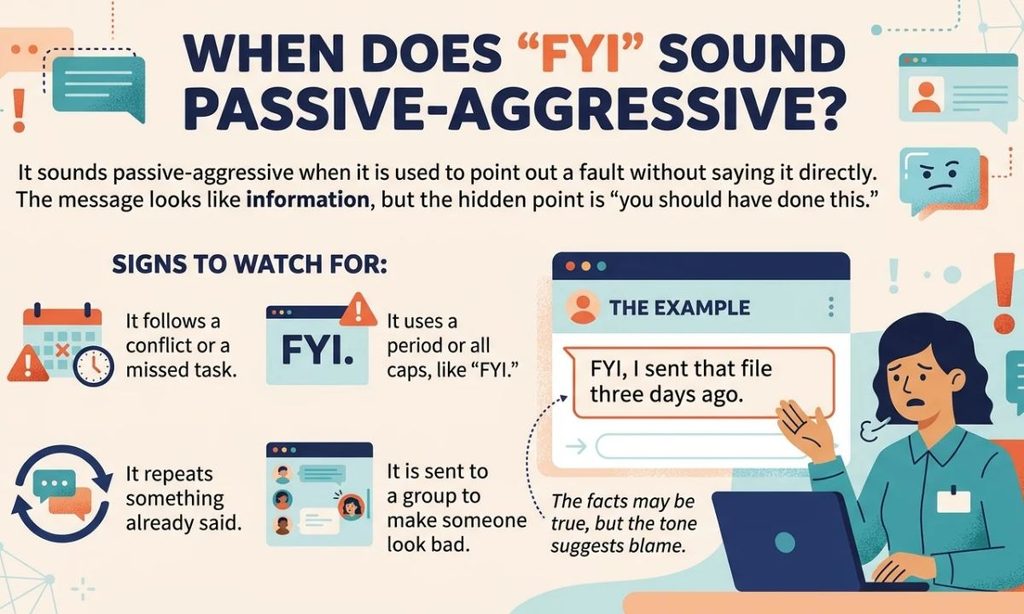
FYI sounds passive-aggressive when it is used to point out a fault without saying it directly. The message looks like information, but the hidden point is “you should have done this.”
Signs to watch for:
- It follows a conflict or a missed task.
- It uses a period or all caps, like “FYI.”
- It repeats something already said.
- It is sent to a group to make someone look bad.
Example: “FYI, I sent that file three days ago.” The facts may be true, but the tone suggests blame.
Tip: Ask yourself if you would say it the same way in person. If not, rewrite it.
When Should You Avoid Using FYI?
Avoid FYI when you need action, when emotions are high, or when the topic is sensitive. It can make serious messages feel cold or dismissive.
Skip it in these cases:
- You need a reply or a decision.
- You are delivering bad news.
- You are in the middle of a disagreement.
- You are writing to someone senior and want a warm tone.
Better Alternatives to FYI
| Instead of FYI | Try this |
| Friendly chat | “Just so you know” |
| Work update | “For your awareness” |
| Gentle reminder | “Quick reminder” |
| Needing action | “Please review and confirm” |
| Soft heads-up | “Heads up” |
| Sharing a link | “Thought you might like this” |
Common Mistakes People Make With FYI
These are the mistakes that cause the most confusion with the FYI meaning.
- Using it when you need action. The reader may ignore the message.
- Sounding blunt by accident. A bare “FYI.” can feel sharp.
- Overusing it. Too many FYIs feel like noise.
- Using it for sensitive topics. Personal news needs a warmer tone.
- Mixing it up with other terms. FYI is not the same as FYR or FWIW.
- Burying the point. Put the useful detail right after FYI.
FYI vs Similar Slang Terms
Several abbreviations sound alike but carry different shades of meaning.
| Term | Meaning | Tone and use |
| FYI | For your information | Neutral heads-up |
| FYR | For your reference | Sharing material to keep for later |
| FWIW | For what it’s worth | Offering an opinion softly |
| IMO | In my opinion | Sharing a personal view |
| BTW | By the way | Adding a side note |
| TBH | To be honest | Being candid |
| HTH | Hope this helps | Closing a helpful message |
The main difference: FYI shares facts, while FWIW and IMO share opinions.
Real Chat Examples Using FYI
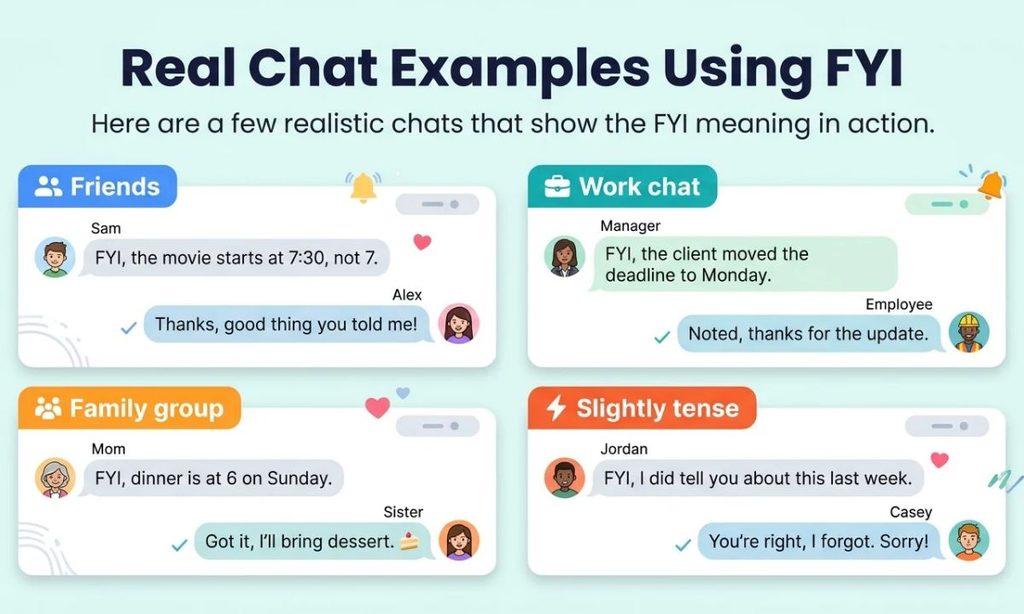
Here are a few realistic chats that show the FYI meaning in action.
Friends
- Sam: “FYI, the movie starts at 7:30, not 7.”
- Alex: “Thanks, good thing you told me!”
Work chat
- Manager: “FYI, the client moved the deadline to Monday.”
- Employee: “Noted, thanks for the update.”
Family group
- Mom: “FYI, dinner is at 6 on Sunday.”
- Sister: “Got it, I’ll bring dessert.”
Slightly tense
- Jordan: “FYI, I did tell you about this last week.”
- Casey: “You’re right, I forgot. Sorry!”
In the last chat, the FYI adds tension. A softer version would be “Quick reminder, I mentioned this last week.”
Safety Tip: Understanding FYI in Messages
An FYI message is normally harmless, but be careful with unknown senders. Scammers sometimes use phrases like “FYI, see attached” or “FYI, check this link” to get you to click.
- Do not open links or files from people you do not know.
- Be careful if the message creates fake urgency.
- Check the sender’s email address, not just the name.
- When in doubt, ask the person through another channel.
Safety rule: An FYI from someone you trust is just information. An FYI with an odd link from a stranger deserves a second look.
Frequently Asked Questions
What does FYI mean in text?
FYI means “for your information.” It is used to share a fact or update, usually without needing a reply.
Is FYI rude?
Not by itself. The FYI meaning is neutral, but a cold tone, a period at the end, or the wrong moment can make it feel rude or passive-aggressive.
Do I need to reply to FYI?
Usually no. A short “Thanks” or “Got it” is polite, and a thumbs-up reaction works well in chats and at work.
What is the difference between FYI and FYR?
FYI shares information you should be aware of. FYR means “for your reference” and points to material you may want to keep and use later.
Can I use FYI in formal emails?
Yes. FYI is common in professional email, especially for forwarded messages and updates. Keep the tone polite and add context so the reader knows why you sent it.
Conclusion
The FYI meaning is easy to remember: it is a quick way to share information without asking for action. The real skill is reading the tone, since a small change in punctuation or timing can turn a helpful note into a sharp one.
Use FYI for clear, useful updates, and pick a friendlier phrase when the topic is sensitive. When you receive one, a short “Thanks” is almost always enough.
