

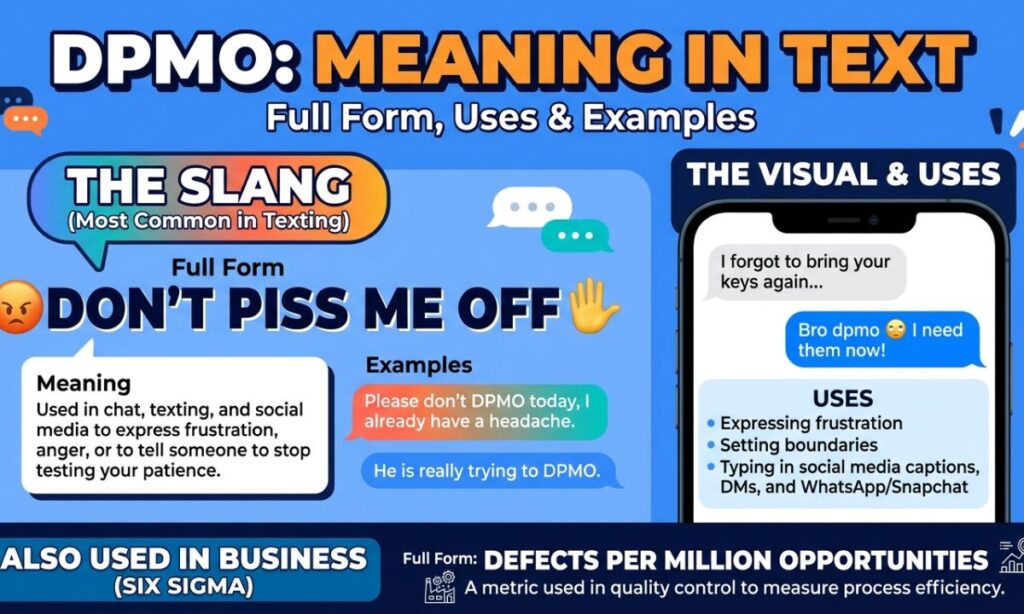
You open a chat and a friend sends one word: DPMO. Is it a joke, a warning, or a real insult? The DPMO meaning in text is simple, but the tone behind it changes everything.
This guide explains what DPMO stands for, where people use it, and how to reply. You will also see real-life examples, platform differences, and the business meaning of DPMO that has nothing to do with texting.
Quick answer: In texting and slang, DPMO means “Don’t Piss Me Off.” It is a warning to stop annoying, teasing, or pushing the sender. In business, DPMO means Defects Per Million Opportunities.
What Does DPMO Mean in Text?
DPMO meaning in text is “Don’t Piss Me Off.” People send it when they feel irritated, want someone to back off, or want to joke about being annoyed. It is informal slang, so you will see it mostly in casual chats between friends, partners, and online communities.
The abbreviation works as a short warning. It tells the other person that the sender’s patience is running low. Whether it is serious or playful depends on the people involved and the words around it.
Short Meaning: DPMO Meaning in Text in Plain English
In plain English, DPMO meaning in text is “leave me alone, I am annoyed.” It can also be a light joke like “careful, I am in a mood today.”
- Literal meaning: Don’t Piss Me Off
- Common feeling behind it: irritation, frustration, or teasing
- Typical use: a warning or a dramatic joke
- Where it fits: casual texts, memes, comments, and group chats
DPMO Full Form
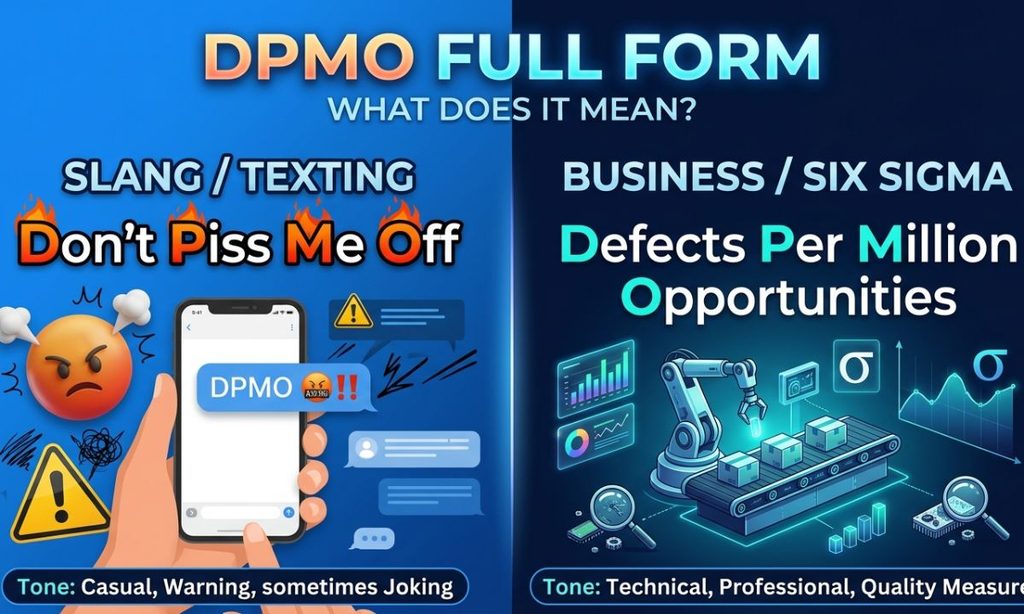
The DPMO full form in slang is Don’t Piss Me Off. Each letter stands for one word: D for Don’t, P for Piss, M for Me, and O for Off.
Outside slang, the DPMO full form is Defects Per Million Opportunities. This is a quality measure used in manufacturing and Six Sigma. The meaning you need depends on where you saw the term.
| Context | DPMO Full Form | Tone |
| Texting and slang | Don’t Piss Me Off | Casual, warning, sometimes joking |
| Business and Six Sigma | Defects Per Million Opportunities | Technical, professional |
DPMO Slang Meaning: What Does DPMO Mean in Slang?
The DPMO slang meaning is a blunt way to say “stop bothering me.” It sits in the same family as other short warning abbreviations that people use when they are tired, stressed, or fed up.
Slang use is often exaggerated on purpose. A friend might text “DPMO, I have not had coffee” and mean nothing harsh at all. Real anger usually comes with more detail, a colder tone, or no emoji.
Where Did DPMO Come From?
DPMO grew out of texting and chat culture, where people shorten common phrases to type faster. Abbreviations like this spread through early messaging apps, forums, and gaming chats, then moved to social media. There is no single known inventor or exact date for the slang version.
Its business sibling is much older. Defects Per Million Opportunities became a standard metric as quality programs like Six Sigma spread through factories and service companies. The two meanings share letters by coincidence, not by any link.
DPMO Meaning on Urban Dictionary
On Urban Dictionary, a site where users submit slang definitions, DPMO is generally listed as “Don’t Piss Me Off.” Entries tend to describe it as a warning or a way to show annoyance.
Keep in mind that Urban Dictionary is user-written, so tone and extra details can vary from entry to entry. Treat it as a guide to how people use the word, not as an official dictionary. Real context in your own chat is always the better clue.
How Is DPMO Used in Real Conversations?
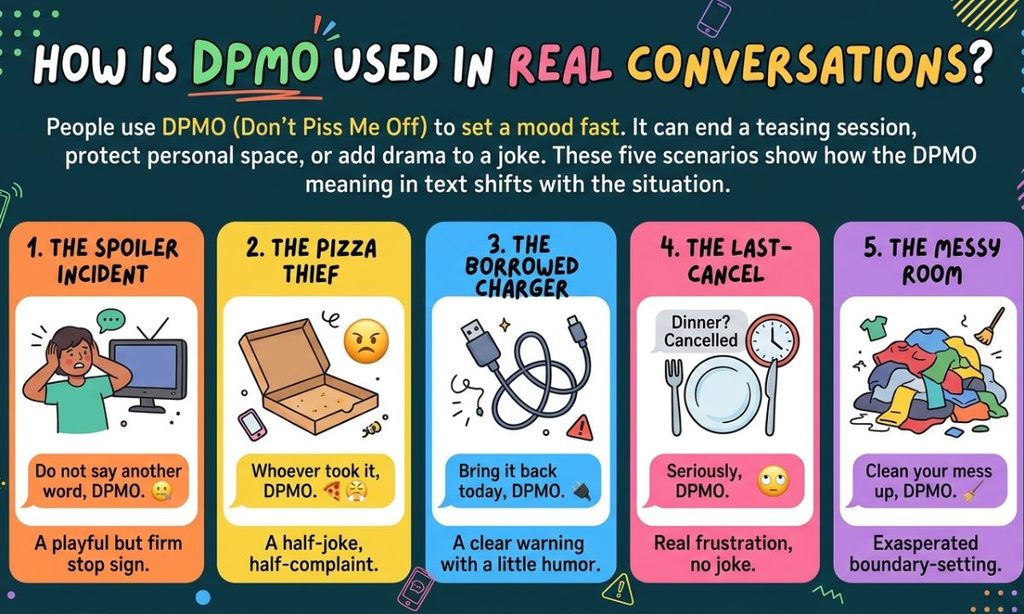
People use DPMO to set a mood fast. It can end a teasing session, protect personal space, or add drama to a joke. These five scenarios show how the DPMO meaning in text shifts with the situation.
Example 1: The Spoiler Incident
Your friend starts talking about the finale of a show you are halfway through. You type, “Do not say another word, DPMO.” Here, the abbreviation is a playful but firm stop sign.
Example 2: The Pizza Thief
Someone ate your leftover pizza from the shared fridge. You text the group, “Whoever took it, DPMO.” It is a half-joke, half-complaint about a small betrayal.
Example 3: The Borrowed Charger
A roommate keeps borrowing your phone charger and never returns it. You send, “Bring it back today, DPMO.” The message is a clear warning with a little humor to soften it.
Example 4: The Last-Minute Cancel
A friend cancels plans five minutes before dinner for the third time. You reply, “Seriously, DPMO.” This one carries real frustration and no joke.
Example 5: The Messy Room
Your sibling walks into your clean room and starts moving things around. You say, “Out. DPMO.” It is a quick, family-style warning that rarely means anything dramatic.
How to Read the Tone Behind DPMO
The tone behind DPMO depends on clues around the message. Look at emojis, punctuation, timing, and your history with the sender. The same four letters can be a laugh or a real warning.
| Clue | Likely Tone |
| Laughing emoji or “lol” | Playful |
| Short reply, no emoji, full stop | Serious or cold |
| Capital letters and exclamation marks | Frustrated or dramatic |
| Sent after a long argument | Real anger |
| Sent during banter | Joking |
Tip: When in doubt, ask. A quick “Are you joking or actually upset?” saves a lot of confusion.
What Does DPMO Mean in Text From a Girl or a Guy?
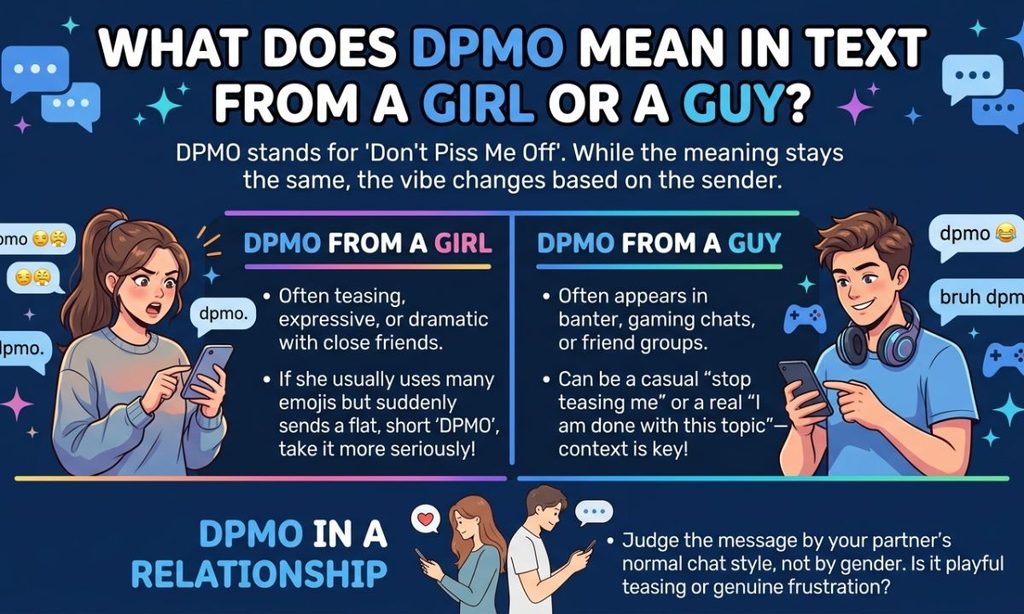
The DPMO meaning in text stays the same no matter who sends it. What changes is the relationship, the mood, and the way each person usually talks. Judge the message by the sender’s normal style, not by gender.
DPMO From a Girl
When a girl sends DPMO, it usually matches her usual chat style. With close friends it is often teasing or dramatic. If she normally uses many emojis and suddenly sends a flat, short DPMO, take it more seriously.
DPMO From a Guy
When a guy sends DPMO, it often shows up in banter, gaming chats, or friend groups. It can be a casual “stop teasing me” or a real “I am done with this topic.” Again, the surrounding words tell you which one it is.
DPMO in a Relationship
In a relationship, DPMO can be a small playful warning during a joke fight. It can also signal real stress, especially after an argument. Do not ignore it. Check in kindly and give the person space if they ask for it.
DPMO Meaning on WhatsApp
On WhatsApp, DPMO means “Don’t Piss Me Off” and mostly appears in private chats and family or friend groups. Because WhatsApp messages feel personal, a lone DPMO can come across as sharper than it was meant to.
Voice notes and emojis often follow it to clarify the mood. If someone sends DPMO in a group chat, they are usually reacting to teasing, not attacking anyone.
DPMO Meaning on Instagram
On Instagram, DPMO shows up in DMs, replies to stories, and comments. It usually carries the same “Don’t Piss Me Off” meaning, often as a joke attached to a meme or a funny story reply.
A public comment saying DPMO is typically playful or dramatic. A private DM with no emoji is more likely to be serious.
DPMO Meaning on TikTok
On TikTok, DPMO appears in comments and captions, often as a joke about a bad mood or a relatable situation. Creators may write it over videos about annoying coworkers, siblings, or bad days.
The tone is mostly humorous. Treat it as part of internet drama culture, not a personal threat.
DPMO Meaning on Snapchat
On Snapchat, DPMO is used in quick chats and captions on snaps. Since messages disappear fast, people use it casually and without much thought.
A snap with a funny face and DPMO is almost always a joke. A plain text chat with no visuals can feel more serious.
DPMO Meaning on Twitter (X) and Discord
On Twitter (X) and Discord, DPMO still means “Don’t Piss Me Off.” On X it appears in short posts about being annoyed, and on Discord it is common in gaming and community servers.
In gaming chats it is often banter after a loss or a teasing moment. Server moderators may still treat repeated use as hostile, so know the rules of the space.
Is DPMO Always Rude?
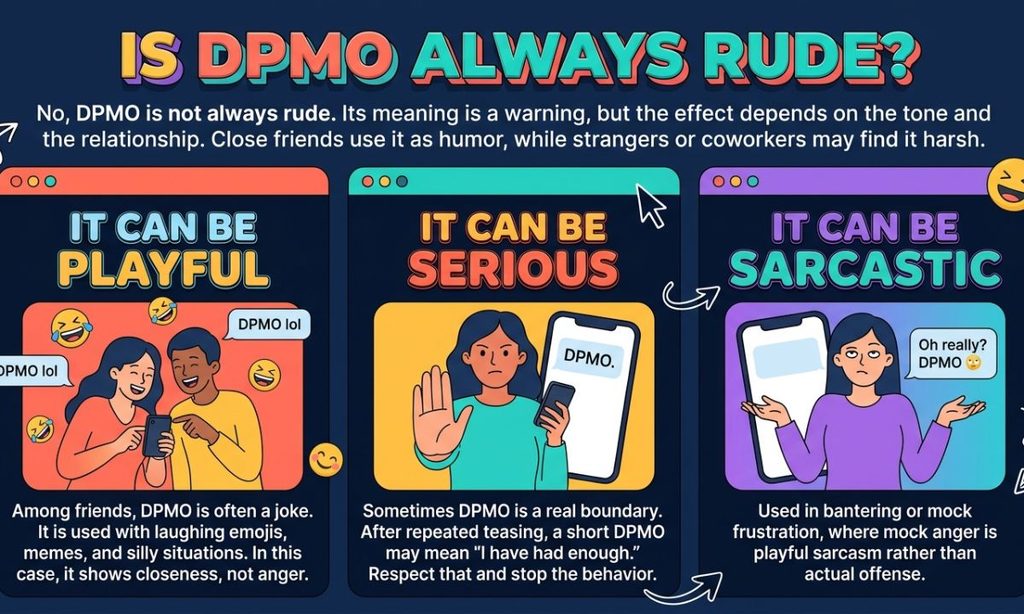
No, DPMO is not always rude. Its meaning is a warning, but the effect depends on the tone and the relationship. Close friends use it as humor, while strangers or coworkers may find it harsh.
It Can Be Playful
Among friends, DPMO is often a joke. It is used with laughing emojis, memes, and silly situations. In this case, it shows closeness, not anger.
It Can Be Serious
Sometimes DPMO is a real boundary. After repeated teasing, a short DPMO may mean “I have had enough.” Respect that and stop the behavior.
It Can Be Sarcastic
Sarcasm is common too. Someone might say “Oh sure, keep going, DPMO” while clearly not meaning it as a threat. Read the whole sentence, not just the abbreviation.
What DPMO Does NOT Mean
DPMO does not mean a literal threat of violence. It also does not mean “Don’t Put Me Off,” “Display Picture My Own,” or any romantic code.
In text, it is a mild, informal expression of annoyance. If a message includes real threats or harassment, that is a separate issue and should be reported or blocked.
Common Confusions About DPMO
People mix up DPMO with other short abbreviations because letters look alike. Some confuse it with PMO, DP, or with unrelated business terms.
The quick fix is to look at where you saw it. In a chat with a friend, it is slang. In a report about quality control, it is the Six Sigma metric.
What About DPWM?
DPWM is not a widely recognized slang term. It is usually a typing mistake for DPMO, or a personal abbreviation inside one friend group. If you see it, check the surrounding message and ask the sender what they meant.
DP Meaning in Text: Not the Same as DPMO
DP in text most commonly means display picture, meaning a profile photo on apps like WhatsApp and Instagram. It has nothing to do with the DPMO meaning in text.
So “Nice DP” is a compliment on a profile photo. “DPMO” is a warning to stop annoying someone. The extra letters change the entire meaning.
DPMO in Business: The Six Sigma Meaning
In business, DPMO stands for Defects Per Million Opportunities. It measures how many defects occur for every one million chances a product or process has to go wrong. Quality teams use it to compare performance and track improvement.
The formula is simple:
DPMO = (Number of Defects / (Number of Units x Opportunities per Unit)) x 1,000,000
For example, if a factory checks 1,000 units with 5 chances for error each and finds 25 defects, the DPMO is (25 / 5,000) x 1,000,000 = 5,000. A lower number means better quality.
DPMO vs PMO: PMO Meaning in Slang
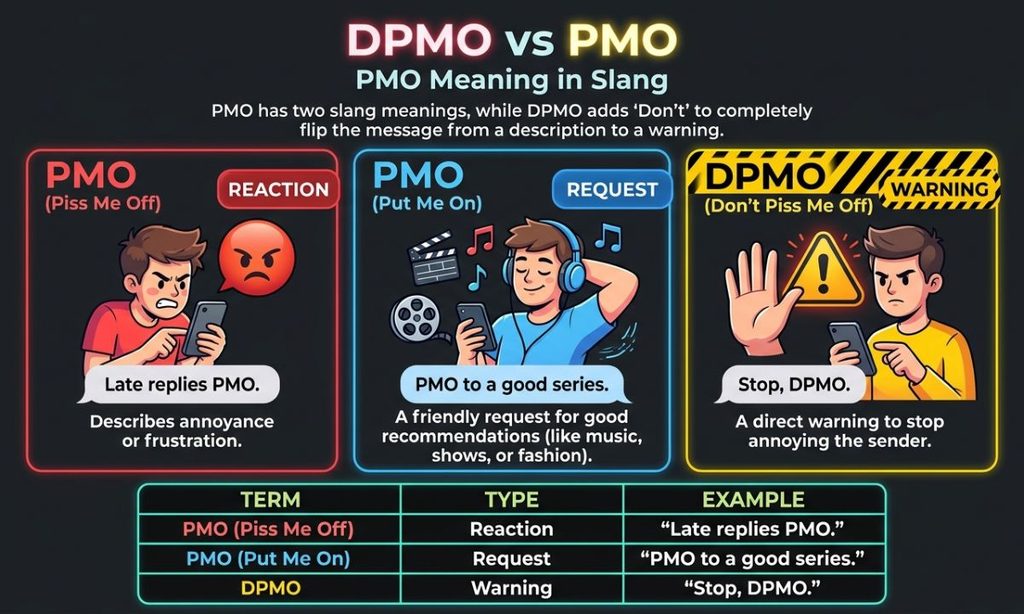
PMO in slang can mean two things: “Piss Me Off” or “Put Me On.” The second one means “introduce me to something good,” like a song or a show. DPMO always adds a “Don’t” to the first meaning.
That single letter D flips the message from a description to a warning.
Piss Me Off vs Put Me On
- Piss Me Off: “That noise really PMO.” It describes annoyance.
- Put Me On: “PMO to some good music.” It is a friendly request for recommendations.
- Don’t Piss Me Off (DPMO): a direct warning to stop annoying the sender.
Reaction vs Warning
| Term | Type | Example |
| PMO (Piss Me Off) | Reaction | “Late replies PMO.” |
| PMO (Put Me On) | Request | “PMO to a good series.” |
| DPMO | Warning | “Stop, DPMO.” |
DPMO vs Other Similar Slang
DPMO sits close to other “back off” expressions like “leave me alone,” “not today,” or “I am not in the mood.” What sets DPMO apart is its blunt, slightly dramatic edge.
Some slang is softer, while DPMO tends to sound stronger. That is why tone clues matter so much.
DPMO vs WYLL: They Are Completely Different
DPMO and WYLL are not related. DPMO is a clear warning abbreviation. WYLL is a far less standard abbreviation whose meaning depends on the group using it.
If you see WYLL, do not guess. Check the conversation or ask the sender, because a wrong guess can cause an awkward reply.
Quick Comparison
| Feature | DPMO | WYLL |
| Standard meaning | Don’t Piss Me Off | Varies by group |
| Common tone | Warning or joke | Depends on context |
| Recognized widely | Yes, in casual slang | No |
Why People Mix Them Up
Both are four-letter abbreviations ending in similar-looking letters, and both appear in fast chats. When people skim messages, short acronyms blur together. Slowing down and reading the full message solves most mix-ups.
Similar Slang Terms and Alternatives
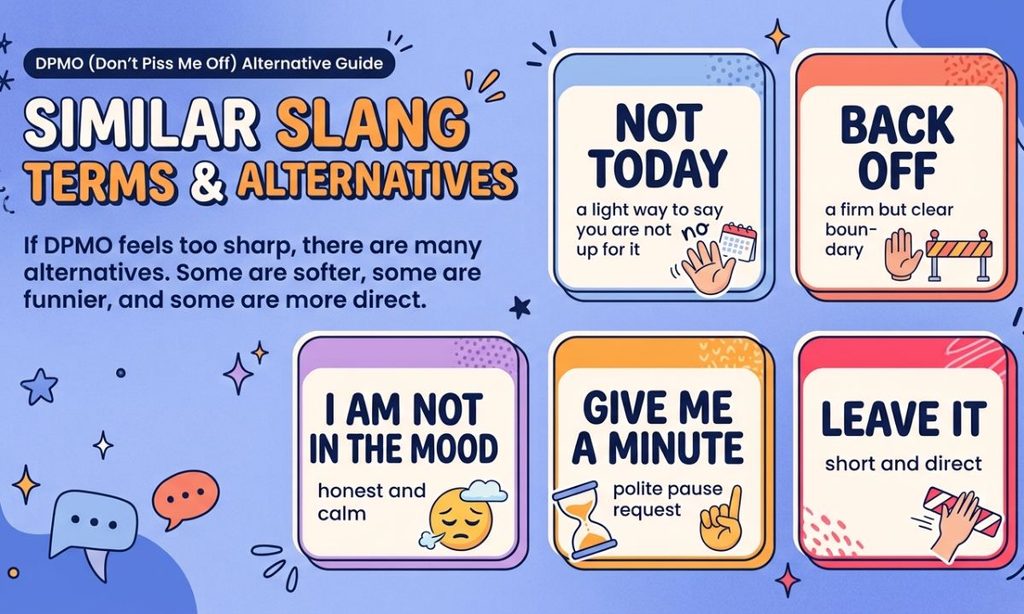
If DPMO feels too sharp, there are many alternatives. Some are softer, some are funnier, and some are more direct.
- Not today: a light way to say you are not up for it
- Back off: a firm but clear boundary
- I am not in the mood: honest and calm
- Give me a minute: polite pause request
- Leave it: short and direct
Cleaner Ways to Say It
If you want the same message without the harsh tone, try these:
- “I am a bit annoyed right now, can we talk later?”
- “Please stop, it is bothering me.”
- “I need some space for a bit.”
- “Not the best time for jokes today.”
How to Reply When Someone Says DPMO
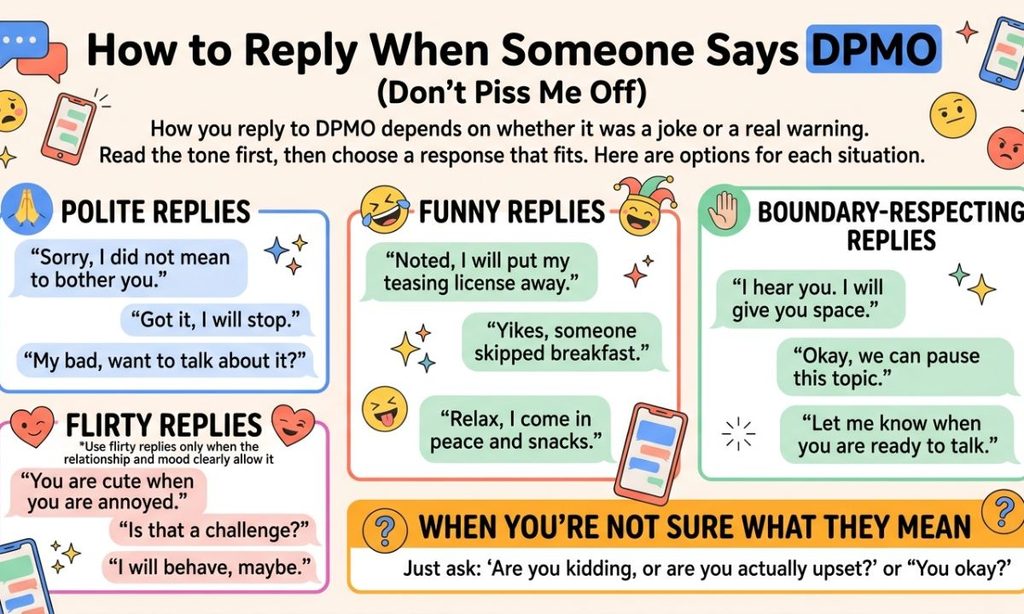
How you reply to DPMO depends on whether it was a joke or a real warning. Read the tone first, then choose a response that fits. Here are options for each situation.
Polite Replies
- “Sorry, I did not mean to bother you.”
- “Got it, I will stop.”
- “My bad, want to talk about it?”
Funny Replies
- “Noted, I will put my teasing license away.”
- “Yikes, someone skipped breakfast.”
- “Relax, I come in peace and snacks.”
Flirty Replies
- “You are cute when you are annoyed.”
- “Is that a challenge?”
- “I will behave, maybe.”
Use flirty replies only when the relationship and mood clearly allow it.
Boundary-Respecting Replies
- “I hear you. I will give you space.”
- “Okay, we can pause this topic.”
- “Let me know when you are ready to talk.”
When You’re Not Sure What They Mean
If you cannot tell the tone, ask directly. Try: “Are you joking, or did I actually upset you?” A calm question shows respect and clears up confusion fast.
Is DPMO Still Popular?
Yes, DPMO is still used, but it is not as trendy as newer slang. It remains a handy shortcut in casual chats, and it shows up in memes, comments, and group conversations.
Its popularity is steady rather than viral. Younger users sometimes prefer fresher phrases, but the DPMO meaning in text is still widely understood.
DPMO and Gen-Z Slang Culture
Gen-Z slang loves short, dramatic expressions, and DPMO fits right in. It matches the culture of exaggerated reactions, memes, and quick emotional shorthand.
At the same time, Gen-Z also values clear boundaries. Many young people use DPMO as a fast way to say “I need space” without writing a long explanation.
Tips for Using DPMO Correctly
Using DPMO well comes down to audience and tone. Follow these simple tips to avoid misunderstandings.
Key takeaways:
- Use it with close friends, not bosses or strangers.
- Add an emoji or a joke if you mean it playfully.
- Skip it in professional chats and school emails.
- Respect it when someone sends it to you.
- Remember the business meaning in work reports.
When you truly need a boundary, a clear sentence is often better than a blunt abbreviation.
Frequently Asked Questions
What does DPMO mean in text?
In text, DPMO means “Don’t Piss Me Off.” It is a casual warning to stop annoying the sender. It can be serious or playful depending on tone.
What is the DPMO full form in business?
In business and Six Sigma, the DPMO full form is Defects Per Million Opportunities. It measures defects in relation to the number of chances for error in a process. Lower numbers mean better quality.
Is DPMO rude to send?
It can be, depending on who receives it. Among close friends it is often a joke, but with strangers, coworkers, or elders it may sound disrespectful. Think about the audience before you send it.
What is the difference between DPMO and PMO?
PMO can mean “Piss Me Off” or “Put Me On.” DPMO adds “Don’t” and always means “Don’t Piss Me Off.” So PMO describes a feeling or request, while DPMO is a warning.
How should I reply if someone texts me DPMO?
First read the tone. If it looks playful, you can reply with humor. If it looks serious, apologize, stop the behavior, and give them space.
Conclusion
The DPMO meaning in text is a short warning that says “Don’t Piss Me Off.” Depending on tone, it can be a joke, a boundary, or a sign of real frustration. Outside chats, DPMO is a Six Sigma term for Defects Per Million Opportunities.
The safest habit is to read the context before you react. Check the emojis, the relationship, and the timing. When you are unsure, ask kindly and respect the answer.
