

You open a chat and see “idgaf” at the end of a message. Is it a joke, an insult, or just a shrug? The IDGAF meaning is simple on paper, but the tone behind it changes with every sender.
This guide explains the IDGAF meaning in text, where it came from, how people use it, and how to reply. You will also find examples, platform tips, and look-alike terms so you never misread it again.
IDGAF Meaning in Text
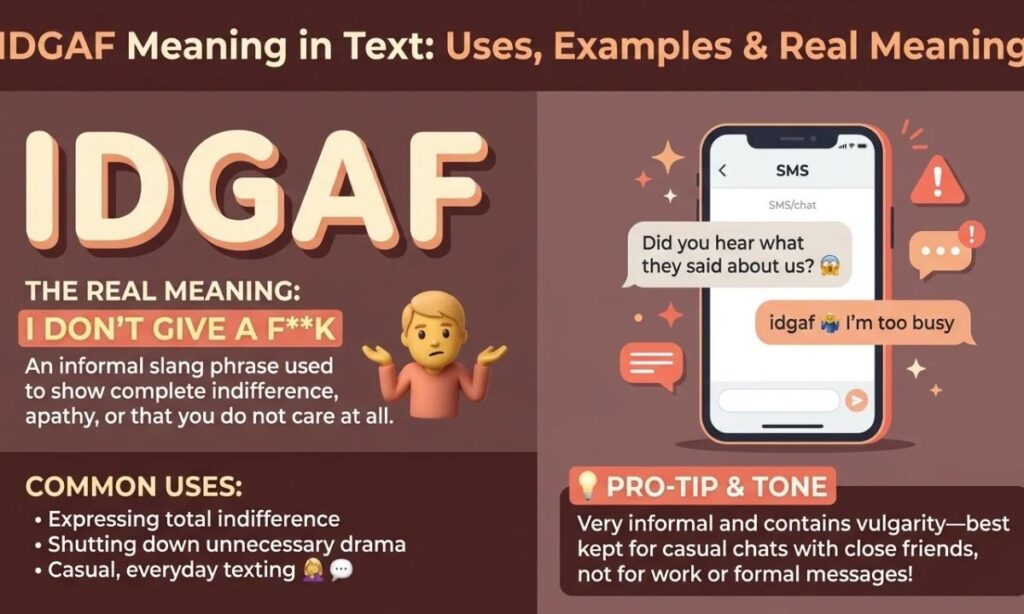
IDGAF stands for “I don’t give a f***.” It is a blunt slang acronym that tells the reader the writer does not care about something. In text messages and chats, the IDGAF meaning is about showing total indifference, strong confidence, or open frustration.
The phrase is crude, so it fits casual talk best. Its exact feeling depends on who sends it and how.
Quick Summary
| Detail | Answer |
| Full form | I don’t give a f*** |
| Core IDGAF meaning | I do not care at all |
| Tone | Casual, blunt, sometimes rude |
| Common in | Texts, DMs, captions, gaming chat |
| Best avoided in | Work emails, school, formal talk |
| Safe alternative | “I don’t mind” or “It doesn’t matter to me” |
Key takeaway: The IDGAF meaning is “I really don’t care,” but the mood can be playful, proud, or angry depending on context.
Background and Origin
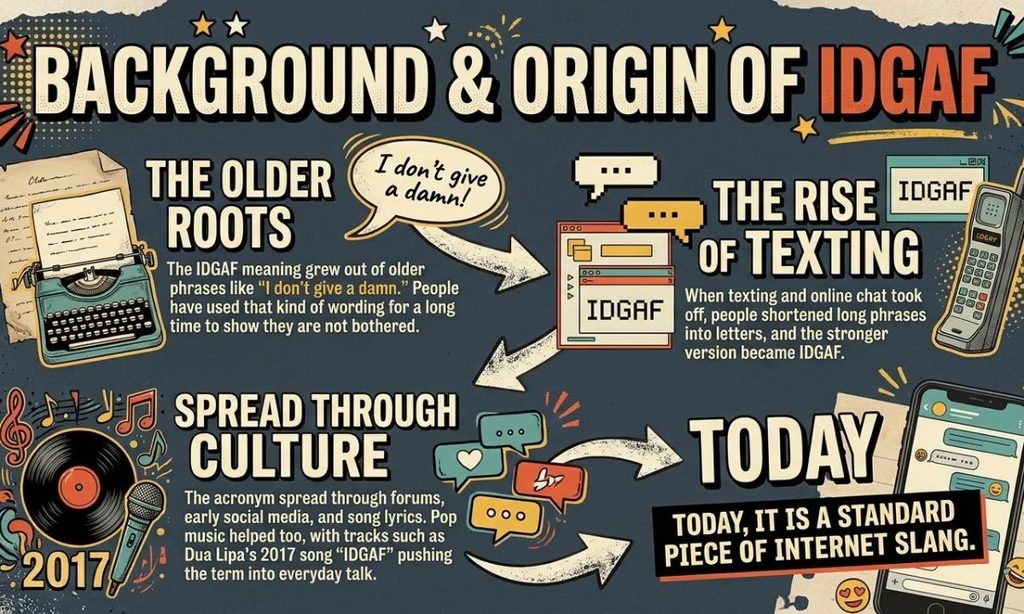
The IDGAF meaning grew out of older phrases like “I don’t give a damn.” People have used that kind of wording for a long time to show they are not bothered. When texting and online chat took off, people shortened long phrases into letters, and the stronger version became IDGAF.
The acronym spread through forums, early social media, and song lyrics. Pop music helped too, with tracks such as Dua Lipa’s 2017 song “IDGAF” pushing the term into everyday talk. Today it is a standard piece of internet slang.
IDGAF Meaning in Gen Z Slang
In Gen Z slang, the IDGAF meaning leans toward self-confidence and emotional freedom. Younger users often say it to show they will not chase approval, drama, or people who waste their time.
It also shows up as a joke. A friend might type “idgaf what we eat, just feed me” and mean nothing harsh at all. The word is less angry than it looks.
9 Bold Meanings of IDGAF in Text
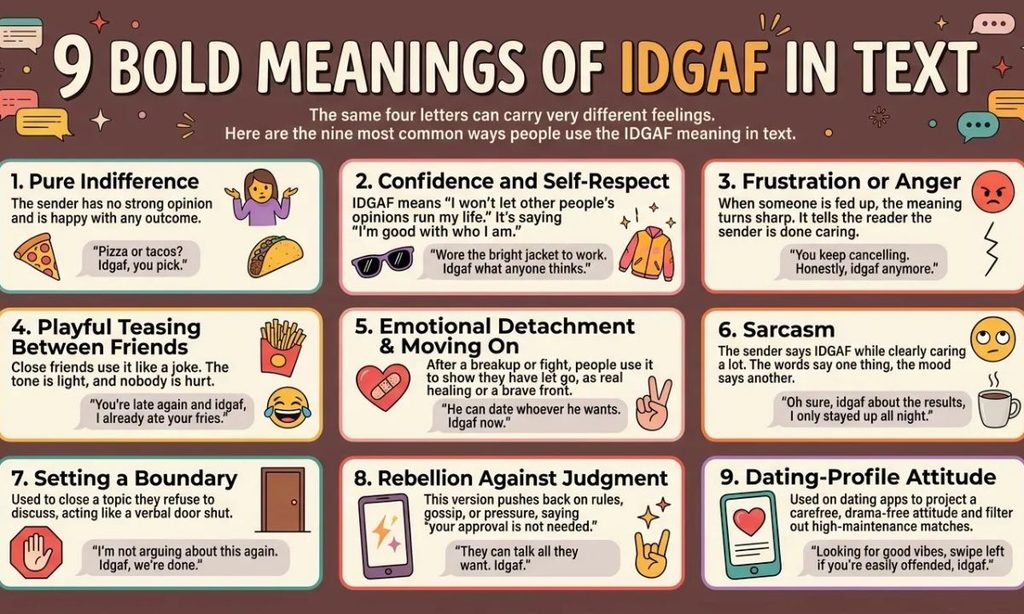
The same four letters can carry very different feelings. Here are the nine most common ways people use the IDGAF meaning in text.
1. Pure Indifference
This is the plainest use. The sender has no strong opinion and is happy with any outcome.
Example: “Pizza or tacos? Idgaf, you pick.”
2. Confidence and Self-Respect
Here, IDGAF means “I won’t let other people’s opinions run my life.” It is a way to say “I’m good with who I am.”
Example: “Wore the bright jacket to work. Idgaf what anyone thinks.”
3. Frustration or Anger
When someone is fed up, the IDGAF meaning turns sharp. It tells the reader the sender is done caring about a person or problem.
Example: “You keep cancelling. Honestly, idgaf anymore.”
4. Playful Teasing Between Friends
Close friends use it like a joke. The tone is light, and nobody is hurt.
Example: “You’re late again and idgaf, I already ate your fries.”
5. Emotional Detachment and Moving On
After a breakup or fight, people use IDGAF to show they have let go. It can be real healing or a brave front.
Example: “He can date whoever he wants. Idgaf now.”
6. Sarcasm
Sometimes the sender says IDGAF while clearly caring a lot. The words say one thing and the mood says another.
Example: “Oh sure, idgaf about the results, I only stayed up all night.”
7. Setting a Boundary or Ending an Argument
People use the IDGAF meaning to close a topic they refuse to discuss. It works like a verbal door shut.
Example: “I’m not arguing about this again. Idgaf, we’re done.”
8. Rebellion Against Judgment
This version pushes back on rules, gossip, or pressure. It says “your approval is not needed.”
Example: “They can talk all they want. Idgaf.”
9. Dating-Profile Attitude
On dating apps, some people add IDGAF to a bio to look relaxed and bold. It signals a laid-back, no-drama style, though it can also come across as cold.
Example: “Love hiking, bad jokes, and idgaf energy.”
Tip: Always read the sentence around IDGAF. Emojis, punctuation, and the relationship between you and the sender tell you which of the nine meanings applies.
How to Use IDGAF Naturally in a Sentence
Use IDGAF as a standalone reply or as a short clause inside a longer message. Keep it casual, and use it only with people who understand your humor.
Here are simple patterns that sound natural:
- As a reply: “Which movie?” “Idgaf, anything works.”
- With a topic: “Idgaf about the score, I just like the snacks.”
- For emphasis: “Honestly, idgaf what time we leave.”
- As a joke: “Idgaf, I’m in a good mood today.”
A good rule is to use it when you are relaxed, not when you want to be taken seriously.
Usage in Different Contexts
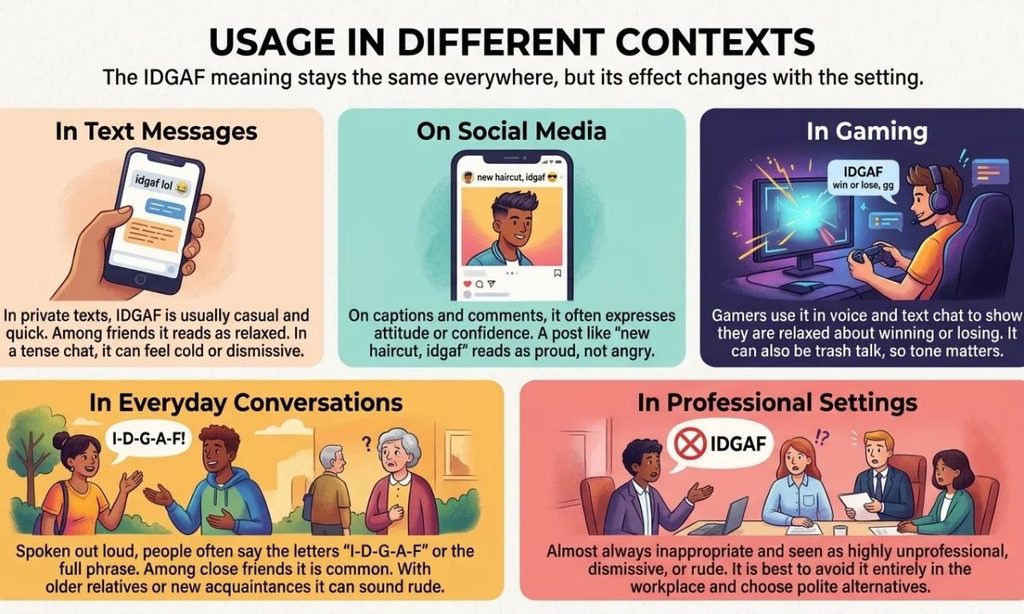
The IDGAF meaning stays the same everywhere, but its effect changes with the setting.
In Text Messages
In private texts, IDGAF is usually casual and quick. Among friends it reads as relaxed. In a tense chat, it can feel cold or dismissive.
On Social Media
On captions and comments, it often expresses attitude or confidence. A post like “new haircut, idgaf” reads as proud, not angry.
In Gaming
Gamers use it in voice and text chat to show they are relaxed about winning or losing. It can also be trash talk, so tone matters.
In Everyday Conversations
Spoken out loud, people often say the letters “I-D-G-A-F” or the full phrase. Among close friends it is common. With older relatives or new acquaintances it can sound rude.
In Professional Settings
Avoid it at work. The IDGAF meaning is crude and can look unprofessional in emails, meetings, and team chats. Use “I have no strong preference” or “I’m flexible” instead.
Key takeaway: Fine with friends, risky with bosses, teachers, and strangers.
Meaning Across Different Platforms
The IDGAF meaning is the same on every app, but each platform has its own style.
On WhatsApp, IDGAF shows up in personal chats and group banter. It usually signals indifference or a joke between friends and family-friendly groups may find it too strong.
On Instagram, it appears in captions, stories, and DMs. People use it to show confidence or to add an edgy vibe to a photo.
TikTok
On TikTok, IDGAF is common in comments, captions, and trending sounds. It often points to attitude, humor, or “I do what I want” energy.
Snapchat
On Snapchat, messages vanish fast, so people type more freely. IDGAF is usually a quick, casual way to say “whatever works.”
X (Twitter)
On X, the IDGAF meaning often appears in opinions and replies. It can show strong stance or open frustration, and it sometimes sparks arguments.
| Platform | Typical IDGAF tone |
| Casual, friendly, or annoyed | |
| Confident, stylish | |
| TikTok | Humorous, bold |
| Snapchat | Relaxed, quick |
| X (Twitter) | Opinionated, sharp |
Does IDGAF Mean Anything in Other Fields?
In almost every field, IDGAF has no official meaning outside slang. Medicine, law, business, and science do not use it as a formal term.
You may still see the letters as a song title, a brand slogan, a hashtag, or a username. In those cases, the creator is borrowing the same “I don’t care” attitude. If you see it somewhere unexpected, treat it as slang first.
Common Misconceptions and Mistakes
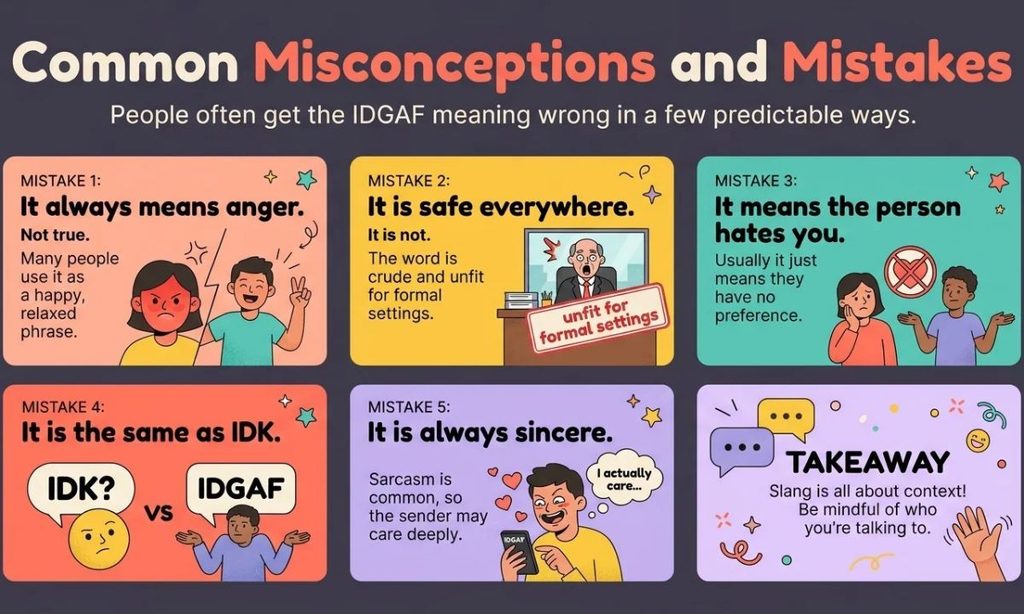
People often get the IDGAF meaning wrong in a few predictable ways.
- Mistake 1: It always means anger. Not true. Many people use it as a happy, relaxed phrase.
- Mistake 2: It is safe everywhere. It is not. The word is crude and unfit for formal settings.
- Mistake 3: It means the person hates you. Usually it just means they have no preference.
- Mistake 4: It is the same as IDK. IDK means “I don’t know.” IDGAF means “I don’t care.”
- Mistake 5: It is always sincere. Sarcasm is common, so the sender may care deeply.
Similar Terms and Alternatives
If you want a milder way to say the same thing, you have plenty of choices. Each one softens the IDGAF meaning in a different way.
- “I don’t mind.”
- “Whatever works for me.”
- “It’s all good.”
- “I’m easy.”
- “I couldn’t care less.”
IDC Meaning in English
IDC means “I don’t care.” It is the clean, milder cousin of IDGAF. It carries the same message without the crude word, so it works better with a wider audience.
IGAF, IDGAC, IDGAS & Other IDGAF Look-Alikes
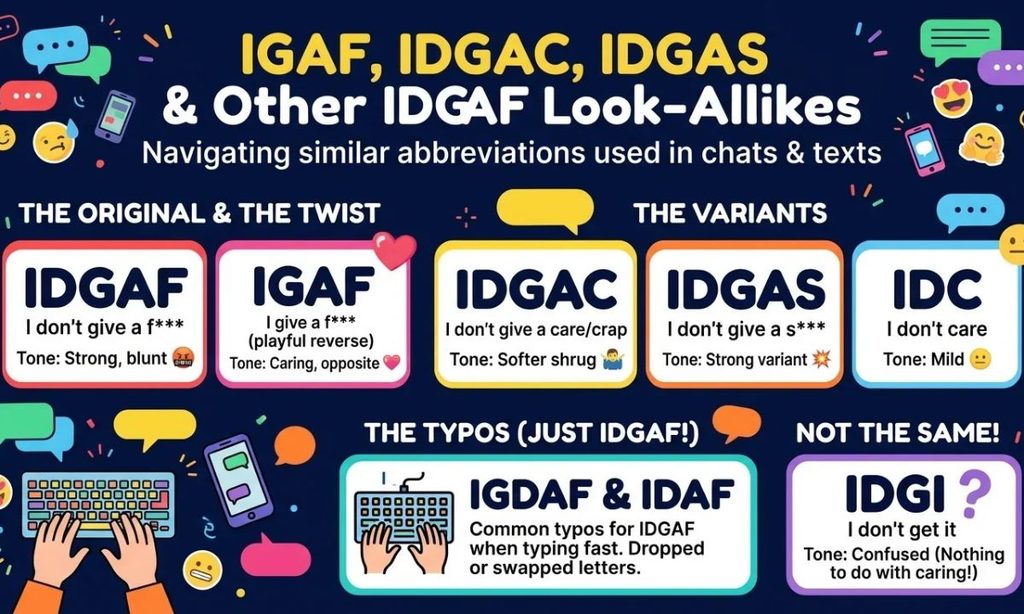
Several similar abbreviations float around chats. Some mean the opposite, and some are typos.
IGAF Meaning in Chat
IGAF means “I give a f***.” It is the reverse of the IDGAF meaning. People use it to say they care a lot, often as a playful twist.
IDGAC Meaning in Text
IDGAC means “I don’t give a care” or “I don’t give a crap.” It is a softer version of IDGAF with the same message.
IDGAS Meaning
IDGAS means “I don’t give a s***.” It is another blunt variant, close to IDGAF in strength.
IGDAF and IDAF (Common Typos)
IGDAF and IDAF are usually typing mistakes for IDGAF. People drop or swap letters when typing fast. Context almost always shows that the sender meant IDGAF.
IDGI Meaning (Not the Same Thing)
IDGI means “I don’t get it.” It has nothing to do with caring. It shows confusion, not indifference.
| Term | Meaning | Tone |
| IDGAF | I don’t give a f*** | Strong, blunt |
| IDC | I don’t care | Mild |
| IGAF | I give a f*** | Opposite, caring |
| IDGAC | I don’t give a care/crap | Softer |
| IDGAS | I don’t give a s*** | Strong |
| IDGI | I don’t get it | Confused |
IDGAF vs Similar Expressions
The IDGAF meaning overlaps with several phrases, but the strength differs.
| Expression | Strength | Best use |
| IDGAF | Very strong | Close friends, venting |
| IDC | Medium | General casual chat |
| Whatever | Medium, can sound dismissive | Quick shrug |
| I couldn’t care less | Strong but polite | Formal or written |
| I don’t mind | Soft | Any setting |
Pick IDGAF when you want force, and pick IDC or “I don’t mind” when you want to stay polite.
How to Respond to IDGAF
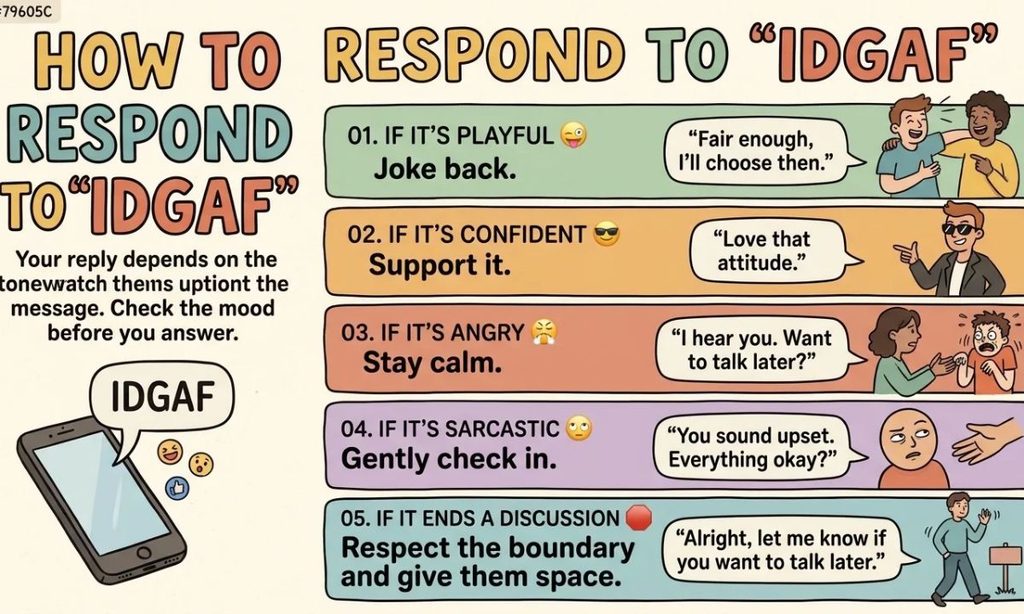
Your reply depends on the tone behind the message. Check the mood before you answer.
- If it is playful: Joke back. “Fair enough, I’ll choose then.”
- If it is confident: Support it. “Love that attitude.”
- If it is angry: Stay calm. “I hear you. Want to talk later?”
- If it is sarcastic: Gently check in. “You sound upset. Everything okay?”
- If it ends a discussion: Respect the boundary and give space.
Tip: If you are unsure, ask a short question like “Do you mean that or are you joking?” A quick check prevents big misunderstandings.
Relevance in Online Conversations and Dating Apps
Online, the IDGAF meaning helps people sound relaxed and real. It shows up in chats, memes, and comment sections where short, bold language is normal.
On dating apps, it can work as a confidence signal in a bio or opener. Used lightly, it suggests a fun, easygoing person. Used too much, it may suggest the person is emotionally closed off.
A good balance helps. Pair it with warmth, humor, or real details so you do not look uninterested in everyone.
Popularity and Trends Over Time
The IDGAF meaning has stayed popular because the feeling behind it never goes out of style. People always want a quick way to say “I won’t stress about this.”
Social media, music, and memes keep it alive. It has also moved from edgy slang to a normal part of casual online talk, and many people now use it without much thought. Newer slang may replace it in some groups, but the term remains widely recognized.
What Does IDGAF Say About the Speaker’s Tone?
IDGAF shows a direct, unfiltered, and informal tone. The speaker is skipping politeness to be honest or bold.
The exact mood can be:
- Relaxed: “I’m fine with anything.”
- Proud: “I’m not changing for anyone.”
- Hurt: “I’m acting like I don’t care.”
- Angry: “I’m done with this.”
To read it right, look at the emojis, the timing, and your history with the sender.
Frequently Asked Questions
What is the IDGAF meaning in text?
The IDGAF meaning in text is “I don’t give a f***.” It tells the reader the sender does not care about a topic, person, or outcome. The tone can be playful, confident, or angry.
Is IDGAF rude?
It can be. The phrase contains a swear word, so it may offend people in formal or mixed company. With close friends, it is usually seen as casual.
What is the difference between IDGAF and IDC?
IDGAF is stronger and cruder than IDC. Both mean the sender does not care, but IDC (“I don’t care”) is mild and safe for most chats.
Can I use IDGAF at work or school?
It is best to avoid it. The word is unprofessional in emails, meetings, and class discussions. Choose “I’m flexible” or “I have no preference” instead.
What does IGAF mean compared to IDGAF?
IGAF means “I give a f***,” the opposite of IDGAF. It shows the person cares. Make sure you read the letters carefully, because one missing “D” flips the meaning.
Conclusion
The IDGAF meaning is easy to learn but easy to misread. At its heart, it says “I don’t care,” yet the mood can swing from joyful freedom to cold anger.
To use it well, match it to your audience, keep it out of formal places, and watch the tone around it. When you receive it, read the context before you reply.
Now that you know the IDGAF meaning in text, you can type it, read it, and answer it with confidence.
