


Ever called something “trite and true” and gotten it completely backwards? You’re not alone. Millions confuse this phrase every single day.
Tried and True Meaning actually points to something tested, proven, and dependable not clichéd or overused. It’s the compliment you give when something has earned your trust through real experience, whether that’s a recipe, a friend, or a business strategy. Understanding this idiom correctly could change how confidently you write and speak.
Tried and True Meaning in English
The Tried and True Meaning describes anything proven to work well after repeated use or testing. When someone says a method is tried-and-true meaning it, they’re confirming the Tried and True Meaning — that it has earned trust through real experience, not guesswork. It’s one of the most widely used positive phrases in everyday English.
Simple Definition
In plain terms, the tried and true definition is: something tested over time and shown to work. Think of it as the opposite of “new and unproven.”
- Tested through real use, not theory
- Proven to work consistently
- Trusted because of past results
Part of Speech & Pronunciation
Tried-and-true functions as an adjective. It’s pronounced tryd-and-troo (rhymes with “cried and blue”) and usually sits before or after a noun to describe reliability.
- Part of speech: Adjective
- Pronunciation: /traɪd ən(d) truː/
- Common form: hyphenated compound adjective
Origin of Tried and True Phrase

The origin behind Tried and True Meaning traces back centuries, combining two words that individually meant “tested” and “faithful.” Together, they created one of English’s most trusted compliments, giving us the phrase we know today.
Tried and true origin
The word “tried” originally meant tested or examined, while “true” meant faithful and dependable. English speakers began pairing them to describe reliable people and things, and the phrase stuck because it captured trust built through experience a piece of word history still relevant today.
First Known Use Timeline (1792)
| Period | Milestone |
| Middle English period | “Tried” and “true” used separately for testing and loyalty |
| 1792 | First recorded use of “tried-and-true” as a paired phrase |
| Today | One of the most common idioms for reliability in English |
This historical meaning of tried and true explains why the phrase still feels timeless rather than trendy.
Tried Meaning
On its own, “tried” means tested, examined, or attempted through direct experience — a core part of the Tried and True Meaning. It comes from the verb “try,” meaning to test something’s quality.
- Tried = tested, attempted, examined
- Used alone: “I tried the new recipe.”
- Paired with “true,” it signals proven reliability not just a single attempt
Is Tried and True a Compliment?

Yes — Tried and True Meaning confirms it’s almost always a compliment. Calling someone or something tried and true praises their reliability, dependability, and consistency. It’s also a genuine idiom, not just a casual phrase, and understanding the Tried and True Meaning shows it can absolutely describe a person as easily as a method.
Examples
- “She’s a tried-and-true friend I can always count on.”
- “This is a tried-and-true recipe passed down for generations.”
- “He’s a tried-and-true employee who never misses a deadline.”
Tried-and-True in a Sentence
Learning how to use tried and true correctly comes down to one grammar rule: hyphenation. The phrase changes form depending on where it sits in a sentence.
Before a Noun (Hyphenated)
As a hyphenated adjective, it directly modifies the noun that follows.
- A tried-and-true method
- A tried-and-true strategy
- A tried-and-true solution
After a Verb (No Hyphen)
After a linking verb like “is” or “remains,” drop the hyphens.
- This method is tried and true.
- Their approach remains tried and true.
More Sentence Examples
- We rely on a tried-and-true process for quality checks.
- This tried-and-true budgeting system has worked for years.
- Their tried-and-true teaching method keeps students engaged.
Tried and True or Tried and Tested
People often ask: tried and true or tried and tested — what’s the difference between tried and tested and Tried and True Meaning? Both are correct, but the focus shifts slightly depending on whether you’re emphasizing trust or verification.
Key Difference at a Glance
| Phrase | Main Focus | Example |
| Tried and True | Trust and reliability | A tried-and-true friend |
| Tried and Tested | Verification through testing | A tried-and-tested safety procedure |
In most everyday writing, both phrases work interchangeably without confusing readers.
Also Read This Blog Ghetto Slang
Tried and True Method
A tried and true method is a way of doing something that has consistently worked in the past in cooking, teaching, fitness, or daily routines.
- A tried-and-true teaching method for beginners
- A tried-and-true morning routine that boosts energy
- A tried-and-true remedy for common colds
Tried and True Person Meaning
The tried and true person meaning refers to someone who has proven their loyalty and dependability over time through consistent actions, not promises.
- A tried-and-true friend who shows up when it matters
- A tried-and-true partner who stays reliable through challenges
- A tried-and-true employee trusted with important tasks
Tried and True in Business & Marketing

In professional settings, Tried and True Meaning signals proven success rather than experimental risk. Brands lean on this idiom to build instant trust with customers, showing their methods have already delivered consistent, reliable results over time.
Business vs Marketing Examples
| Context | Example |
| Business | A tried-and-true sales funnel that consistently converts leads |
| Marketing | Email marketing remains a tried-and-true marketing method |
| Business | A tried-and-true business strategy used by established brands |
| Marketing | Word-of-mouth is still a tried-and-true, trusted approach |
Tried and True Meaning Synonym
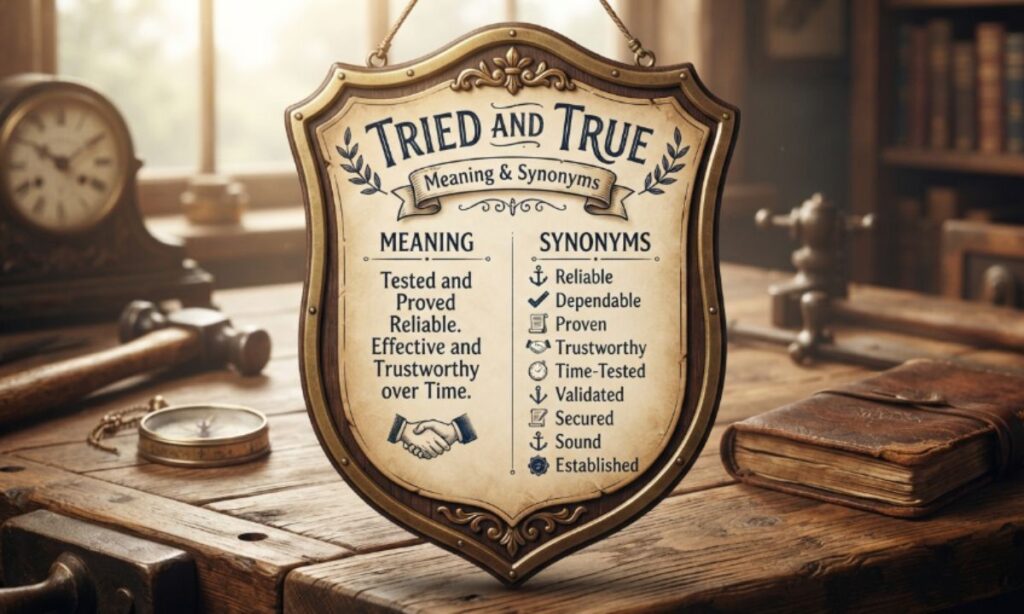
Looking for a tried and true meaning synonym? English offers plenty of reliable alternatives depending on tone.
Word Synonyms List
Proven, reliable, trustworthy, dependable, effective, established, time-tested, successful, confirmed, consistent all describe something tested and reliable.
Similar Phrases & Expressions
- Tried and tested
- Proven method
- Time-tested solution
- Trusted approach
- Established practice
- Reliable strategy
- Safe bet
Related Collocations (Go-To, Sure Bet)
Native speakers often pair the idea with casual expressions like these:
- Go-to (a go-to remedy)
- Sure bet
- Works like a dream
- Works wonders
Trite and True A Common Mistake
A frequent slip-up is writing “trite and true” instead of “tried and true.” The two phrases mean almost opposite things.
- Trite = overused, clichéd, stale
- Tried = tested, proven, dependable
- Wrong: “Our safety checks are trite and true.”
- Right: “Our safety checks are tried and true.”
If your sentence means “proven,” always choose tried, never trite.
Tried and True vs Proven Methods
Comparing tried and true vs proven method comes down to emphasis. Both describe things that work, but the tone differs.
| Expression | Main Focus |
| Tried and True | Reliability and trust built over time |
| Proven Method | Demonstrated effectiveness, often measured by results |
Tried and true feels warmer and more personal; proven method feels more formal.
Tried and True in Everyday Conversation

People use this phrase constantly when recommending something they trust.
- “That’s my tried-and-true coffee recipe every morning.”
- “We always pick a tried-and-true vacation spot.”
- “This cleaning trick is tried and true.”
When to Use Tried and True in Writing
Use the phrase to highlight consistency, dependability, or long-term effectiveness not something new or unproven.
Good for:
- Blog posts and product reviews
- Business reports and marketing content
- Everyday conversation and casual writing
Avoid it for anything untested the phrase implies an established track record.
Tried and True in Media & Pop Culture
Magazines and lifestyle sites frequently use the Tried and True Meaning to describe trusted routines readers can count on.
- Fashion writers call classic wardrobe staples “tried-and-true style picks”
- Beauty articles recommend “tried-and-true skincare routines” rooted in the same Tried and True Meaning of consistency
- Lifestyle publications praise “tried-and-true travel destinations” that reflect the true Tried and True Meaning of dependability
Frequently Asked Questions
What does the phrase tried and true mean?
Tried and True Meaning refers to something tested repeatedly and proven reliable, effective, or trustworthy over time through real experience and consistent results.
What is another way to say “tried and true”?
The Tried and True Meaning can be expressed as proven, reliable, dependable, established, or time-tested all describing something trusted through experience.
How to use “tried and true” in a sentence?
Apply the Tried and True Meaning by hyphenating before nouns: “a tried-and-true method,” or without hyphens after verbs: “this method is tried and true.”
Is it tride and true or tried and true?
The correct spelling reflecting Tried and True Meaning is “tried and true,” not “tride and true,” which is simply a common typing error.
What does “tried” mean?
Within the Tried and True Meaning, “tried” means tested, examined, or attempted through direct experience, showing something has proven its reliability over time.
How do you say “tried and true” professionally?
In formal writing, the Tried and True Meaning translates to “proven,” “time-tested,” or “well-established,” which sound more polished than the conversational original idiom.
Is tried and true formal?
Tried and True Meaning fits casual and workplace writing well, but formal or academic contexts prefer alternatives like “proven” or “time-tested” instead.
What are 5 strong synonyms?
Five strong synonyms capturing the Tried and True Meaning are proven, reliable, dependable, established, and time-tested each highlighting consistent, trustworthy performance.
What can I say instead of “tried”?
Instead of “tried,” within the Tried and True Meaning context, use tested, attempted, verified, or examined to convey the same proven, experience-based reliability.
Conclusion
Tried and True Meaning describes anything tested repeatedly and proven reliable, effective, or trustworthy through real experience not guesswork or trends. The phrase traces back to 1792, pairing “tried” (tested) with “true” (dependable) into one of English’s most trusted idioms. It works as a hyphenated adjective before nouns (“a tried-and-true method”) and without hyphens after verbs (“this method is tried and true”). People, recipes, business strategies, and daily routines all qualify when they’ve consistently delivered results over time.
The common confusion with “trite and true” flips the meaning entirely trite means clichéd, while tried means proven. Understanding Tried and True Meaning helps writers, marketers, and everyday speakers communicate reliability with precision and confidence.
