

TW meaning in text is almost always trigger warning. People type it before a message, post, or story to say, “Heads up, the next part may be upsetting.” It gives the reader a moment to decide whether they are ready to continue.
This guide explains what TW stands for, the other meanings you might run into, and how to use it in real chats. You will also find reply examples, a TW vs. CW comparison, and tips for TikTok, Snapchat, WhatsApp, Reddit, Discord, dating apps and the workplace.
Quick answer: TW means trigger warning. Use it before sensitive content such as violence, grief, abuse, or health struggles so the reader can prepare or skip it.
Definition & Meaning
TW meaning in text: TW is short for trigger warning. It is a short label that warns someone that a message, image, video, or story contains sensitive material.
The label usually sits at the very start of the message, like “TW: loss of a parent.” The reader then chooses to read on, wait, or skip it.
Full Form and Meaning
The full form of TW is trigger warning. A “trigger” is something that can bring back a painful memory or strong emotional reaction, often linked to trauma, anxiety, or grief. A “warning” is simply the heads up that comes first.
So the TW meaning in text is a polite signal: “This topic could be hard for some people.”
Quick Example
Here is how TW looks in a normal message:
TW: hospital stay. I had a rough week and I need to vent. Is now a good time?
The sender names the topic (a hospital stay) and checks in before sharing details. That is the whole idea behind TW.
Defining the Term and Its Core Purpose
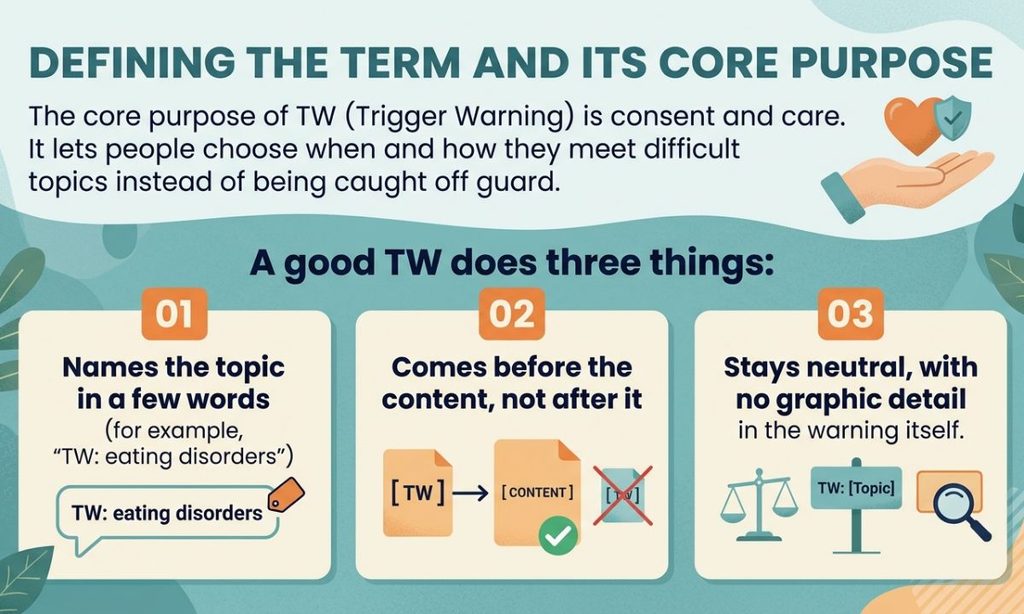
The core purpose of TW is consent and care. It lets people choose when and how they meet difficult topics instead of being caught off guard.
A good TW does three things:
- Names the topic in a few words (for example, “TW: eating disorders”).
- Comes before the content, not after it.
- Stays neutral, with no graphic detail in the warning itself.
Think of it as a small courtesy, like telling a friend a movie is very loud before they sit down.
Other Meanings of TW: When It Doesn’t Mean Trigger Warning
TW can mean other things depending on the app, the person, and the topic. Trigger warning is by far the most common, but context matters.
| Meaning | Where you may see it | Example |
| Trigger warning | Texts, social posts, forums | “TW: self-harm mention” |
| Trans woman | LGBTQ+ communities, dating profiles | “TW looking for friends” |
| Older posts and bios (now called X) | “Follow me on TW” | |
| Tap water | Clinical shorthand in some notes | “TW rinse” |
| Teaching week or term week | Some school and college timetables | “Exam in TW 9” |
If the meaning is unclear, look at the words around it. A topic after a colon, like “TW: injury,” points to trigger warning.
TW Meaning in Gender and Identity Contexts
In gender and identity spaces, TW can stand for trans woman. You may see it in bios, support groups, and community posts, usually written as a plain label such as “TW, she/her.”
The topic after the letters usually tells you which meaning is intended. Avoid guessing someone’s identity from two letters. If you are not sure, ask politely or read their profile.
TW Meaning in College and Medical Settings
In colleges, TW may refer to a teaching week or term week in a timetable, depending on the school. In medical or lab notes, some people use it as shorthand such as “tap water,” but this is not a universal standard.
Because these uses are local, always check the document’s key or ask the institution. Never assume a medical abbreviation without confirming it.
The Evolution and History of the Concept
The idea of a trigger warning began in online forums and feminist blogs in the early 2000s. Writers used it to flag posts about sexual violence and trauma so survivors could choose whether to read them.
The habit spread across blogging platforms and social networks over the following years. Tumblr, Reddit, and fan fiction sites made labels like TW and CW normal. Today it has moved into everyday texting, classrooms, streaming platforms, and workplaces.
The word “trigger” itself comes from psychology, where it describes a cue linked to a past traumatic event. In daily chat, it now covers a much wider range of upsetting topics.
Usage in Various Contexts and Daily Interaction
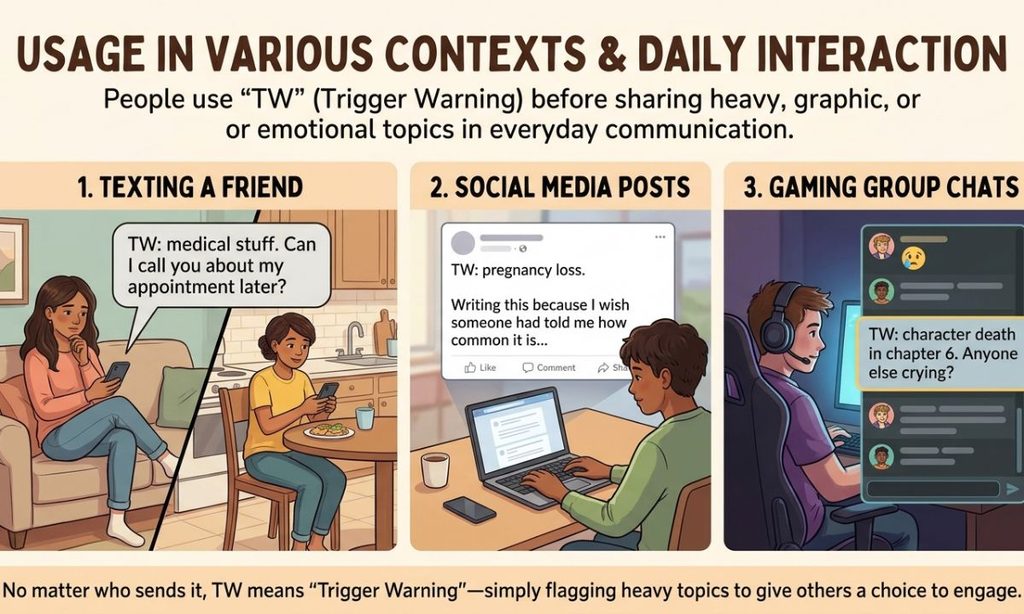
People use TW in text whenever they are about to share something heavy, graphic, or emotional. It works in private chats, public posts, group conversations, and even jokes.
These scenarios show the TW meaning in text in action. Each one has a different tone and purpose.
Scenario 1: Texting a Friend After a Rough Day
Say you had a stressful medical appointment and want to talk about it. You might text:
TW: medical stuff. Can I call you about my appointment later?
The TW gives your friend room to say “yes, now” or “I’m drained, can we do tonight?” You get support, and they keep their own boundaries.
Scenario 2: Posting Your Story on Social Media
When you share a personal story online, a TW at the top protects readers scrolling past. For example:
TW: pregnancy loss. Writing this because I wish someone had told me how common it is.
Many people also add a few blank lines or a line break after the warning. That way the sensitive part does not appear in the preview.
Scenario 3: Gaming Group Chats
In gaming chats, players use TW for spoilers about dark story moments or for content like blood and death. A message might read:
TW: character death in chapter 6. Anyone else crying?
This keeps the chat friendly for people who have not reached that point yet. It also helps players who prefer to avoid certain themes.
What Does TW Mean From a Girl or Guy in a Text?
When a girl or a guy sends TW in a text, it means the same thing: trigger warning. Gender does not change the meaning. The sender is simply flagging that the message includes a heavy topic.
It is not flirting or a hidden code. If the rest of the message does not make sense, ask, “TW for what?” and they will usually clarify.
Notice How in Each of These Examples
In every example, the writer names the topic briefly and puts it first. They also invite the reader to respond on their own terms.
That pattern is what makes a TW work. It is short, specific, and kind.
Addressing Misconceptions and Clarifications
The biggest misconception about TW is that it is a way to avoid hard conversations. In practice, it is a way to start hard conversations more gently.
Another myth is that only people with trauma use or need it. Many people use TW simply to be considerate, the same way they would say “sorry to bring this up.”
TW vs. Spoiler Alert
A spoiler alert warns about plot details, while a TW warns about upsetting subject matter. One protects your enjoyment of a story, and the other protects your emotional comfort.
They can appear together. For example: “Spoiler and TW: major character dies in the finale.”
Do Trigger Warnings Actually Work?
The research is mixed. Several studies suggest that trigger warnings do not significantly reduce distress for most readers, and some found they may slightly raise anxiety before reading. Other studies and many personal accounts say they help people feel respected and prepared.
The practical takeaway is simple. A TW is a courtesy and a communication tool, not a medical treatment. If someone is struggling with trauma, professional support is the right resource.
Key takeaway: Use TW to show care, not to promise protection. It signals respect, but it does not replace real support.
Similar Terms and Alternatives
The closest alternatives to TW are CW (content warning), NSFW (not safe for work), spoiler tags, and sensitive content screens. Each one warns about something slightly different.
- CW: a broader warning for any heavy or uncomfortable content.
- NSFW: flags adult or explicit material.
- Spoiler tag: hides plot details.
- Sensitive content screen: an app feature that blurs media until you tap it.
TW vs. CW: The Quick Comparison Table
TW is specifically about content that may trigger a trauma response, while CW covers a wider range of content. In daily use, many people treat them as nearly interchangeable.
| Feature | TW (trigger warning) | CW (content warning) |
| Meaning | Warns about content that may trigger trauma | Warns about any sensitive or heavy content |
| Scope | Narrower, trauma focused | Broader, includes gore, spoilers, and more |
| Common topics | Abuse, self-harm, assault, grief | Violence, blood, flashing lights, death |
| Tone | Personal and protective | General and informational |
| Example | “TW: panic attacks” | “CW: graphic injury” |
If you are unsure which to choose, CW is the safer, wider label. Either one is understood in most chats.
How to Write a Good TW (With Examples)
To write a good TW, put it first, name the topic in a few words, and keep the warning itself free of detail. Then leave a gap before the content.
Follow these steps:
- Type “TW” followed by a colon.
- Name the topic simply (for example, “bullying”).
- Add a line break before the content.
- Offer an easy exit when it makes sense, such as “skip if you need to.”
Here are a few examples:
| Situation | Good TW example |
| Venting to a friend | “TW: family argument. Need to talk when you have a minute.” |
| Sharing news | “TW: illness. Sharing an update on my dad.” |
| Group chat | “TW: spoilers and character death.” |
| Social post | “TW: disordered eating. Long post about my recovery.” |
Tip: Be specific but gentle. “TW: assault” is clearer than “TW: bad stuff,” and it does not describe anything graphic.
Responding to a Trigger Warning
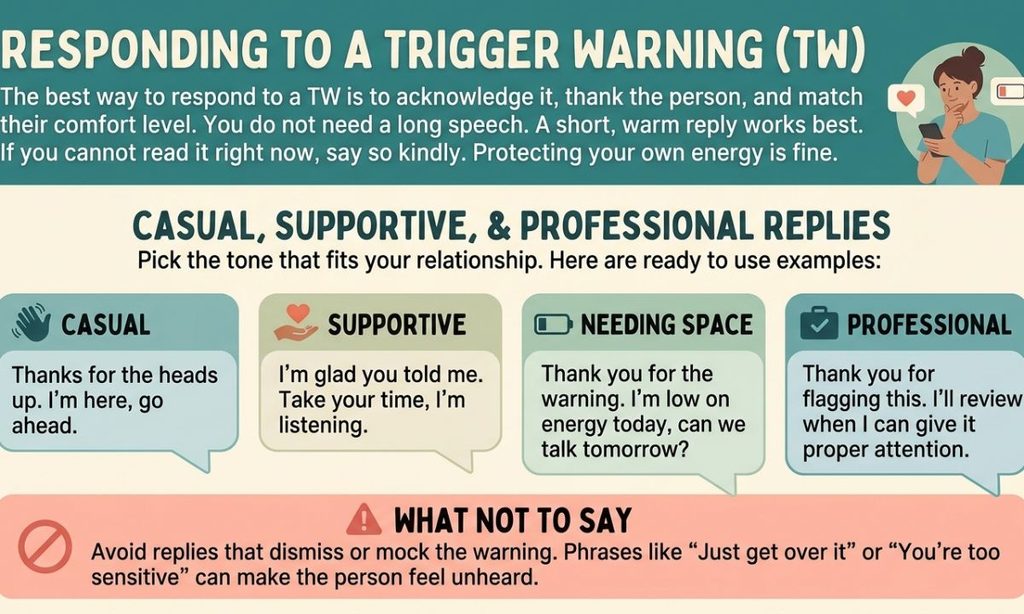
The best way to respond to a TW is to acknowledge it, thank the person, and match their comfort level. You do not need a long speech. A short, warm reply works best.
If you cannot read it right now, say so kindly. Protecting your own energy is fine.
Casual, Supportive, and Professional Replies
Pick the tone that fits your relationship. Here are ready to use examples:
| Tone | Reply |
| Casual | “Thanks for the heads up. I’m here, go ahead.” |
| Supportive | “I’m glad you told me. Take your time, I’m listening.” |
| Needing space | “Thank you for the warning. I’m low on energy today, can we talk tomorrow?” |
| Professional | “Thank you for flagging this. I’ll review it when I can give it proper attention.” |
What Not to Say
Avoid replies that dismiss or mock the warning. Phrases like “Just get over it” or “You’re too sensitive” can make the person feel unheard.
Also avoid asking for graphic details. Let the person share only what they want to share.
Quick rule: Thank them, listen, and never pressure them for more.
Regional and Cultural Differences
The TW meaning in text is the same around the world, but how often people use it and what topics they flag varies by culture. English-speaking online communities use it most. In other regions, people may rely on local phrases or skip warnings entirely.
People who chat in more than one language often mix English and their own language. TW is one of the English shortcuts that travels easily.
TW Meaning in Urdu and Roman Urdu Chats
In Urdu and Roman Urdu chats, people usually write TW in English letters and carry on in Urdu. There is no single standard Urdu form, but some people write words like “ehtiyat” (caution) or “intibah” (warning) to say the same thing.
For example: “TW: maut ka zikar. Mujhe aaj dil halka karna hai.” This means the message mentions death and the sender wants to open up. The meaning stays the same: be careful, this is a heavy topic.
Usage in Online Communities and Dating Apps
Each platform has its own habits for TW. The meaning stays the same, but the style changes based on the format, from captions to bios to threads.
TW Meaning in Text on TikTok and Instagram
On TikTok and Instagram, TW appears in captions, on-screen text, and comments before sensitive videos or posts. Creators often add it in the first second so viewers can swipe away.
Instagram also offers sensitive content screens on some media. Many creators still add a TW in the caption as a personal touch.
TW Meaning on Snapchat
On Snapchat, TW is added as text over a snap or story before a heavy update. Because snaps disappear fast, people place it at the start so viewers see it first.
In private snaps, it is often casual, like “TW: rant.”
TW Meaning on WhatsApp
On WhatsApp, TW goes at the start of a message, a voice note description, or a status update. In group chats, people use it to protect members who joined for different reasons.
If a family group is sharing sad news, a short “TW: bad news” is a considerate opening.
TW on Reddit, X, and Discord
On Reddit, TW usually sits in the post title or first line, often alongside tags like NSFW or spoiler. On X (formerly Twitter), people add TW or CW at the top of a post and sometimes mark media as sensitive. On Discord, users write TW in a channel or use spoiler formatting to hide the content until someone clicks.
Many servers have rules on warnings, so check the channel guidelines first.
Dating Apps and Bios
On dating apps, TW can appear in bios as a joke or a real notice. Some people write “TW: I talk about my dog nonstop” for humor. Others use it for serious topics they want matches to know up front.
In some LGBTQ+ spaces, TW in a bio may also mean trans woman. Read the full bio before you decide.
Hidden Meanings and Tone Matters
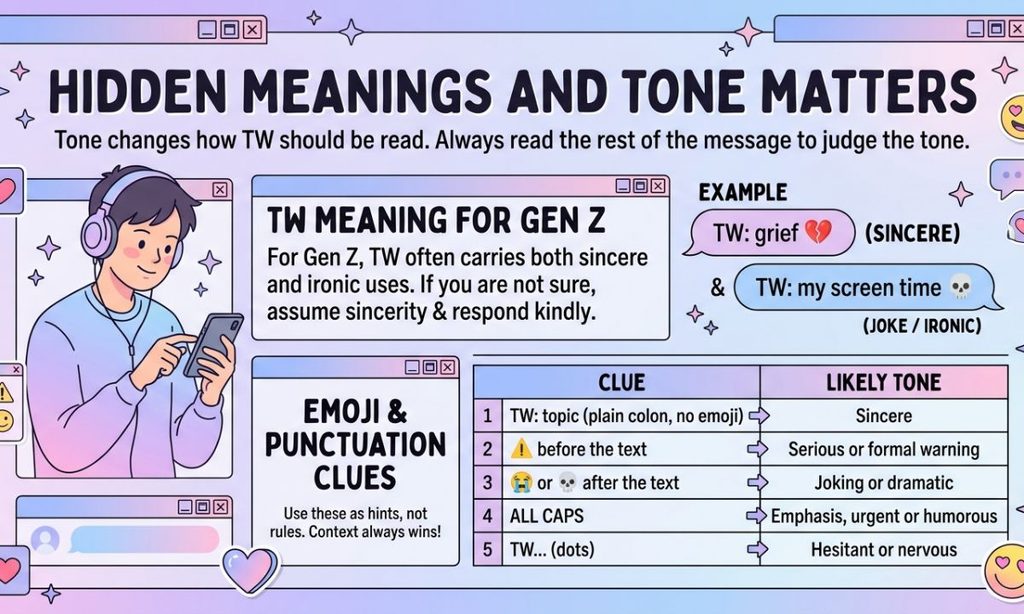
Tone changes how TW should be read. A serious TW before a grief story is sincere, while TW before a silly confession is a joke. Always read the rest of the message to judge the tone.
Punctuation, emojis, and timing all give clues about what the sender really means.
TW Meaning for Gen Z
For Gen Z, TW often carries both sincere and ironic uses. Someone might write “TW: my screen time” as a funny self-callout, or “TW: heavy thoughts” as a real signal.
The humor works because everyone understands the original meaning. If you are not sure, assume sincerity and respond kindly.
Emoji and Punctuation Clues
Emojis and punctuation help reveal tone. Here is a quick guide:
| Clue | Likely tone |
| TW: topic (plain colon, no emoji) | Sincere |
| ⚠️ before the text | Serious or formal warning |
| 😭 or 💀 after the text | Joking or dramatic |
| ALL CAPS | Emphasis, urgent or humorous |
| TW… (dots) | Hesitant or nervous |
Use these as hints, not rules. People write differently, so context always wins.
Professional Communication and Workplace Etiquette
In the workplace, a TW is best used sparingly and with clear, neutral wording. Use it before sharing content such as incident reports, harassment cases, or sensitive customer stories.
For example: “Content note: this report discusses a workplace injury.” Many offices prefer the words “content note” or “sensitive topic” over the abbreviation TW, because they feel more formal.
Here are good habits for the office:
- Be specific about the topic without describing details.
- Give people a choice to read later or skip.
- Avoid jokes about TW in formal channels.
- Follow company policy on sensitive communications.
Frequently Asked Questions
What does TW mean in text?
TW most commonly means trigger warning. It tells the reader that the message contains a sensitive topic. Depending on context, it can also mean trans woman, Twitter, or a local abbreviation.
Is TW the same as CW?
They are close but not identical. TW focuses on content that may trigger a trauma response, and CW (content warning) covers a broader range of heavy content. Most people use them interchangeably in casual chats.
How do I reply when someone sends a TW?
Thank them, acknowledge the warning, and say whether you are ready to read it. A simple “Thanks for the heads up, I’m here” works well. Never press for graphic details.
Should I use TW in a work message?
Yes, but keep it professional. Phrases like “content note” or “sensitive topic” often fit better in formal settings. Name the topic briefly and give readers a choice.
Do trigger warnings really help?
The evidence is mixed. Some studies show little effect on distress, while many people say warnings make them feel respected and prepared. Treat a TW as a thoughtful courtesy, not a treatment.
Conclusion
Now you know the TW meaning in text: it is a quick, caring label that flags sensitive content before someone reads it. Most of the time it means trigger warning, though context can point to other meanings such as trans woman or Twitter.
Use it first, keep it short, and name the topic without detail. When you receive one, reply with kindness and let the sender share at their own pace. A few careful words can make online and offline conversations feel safer for everyone.
