

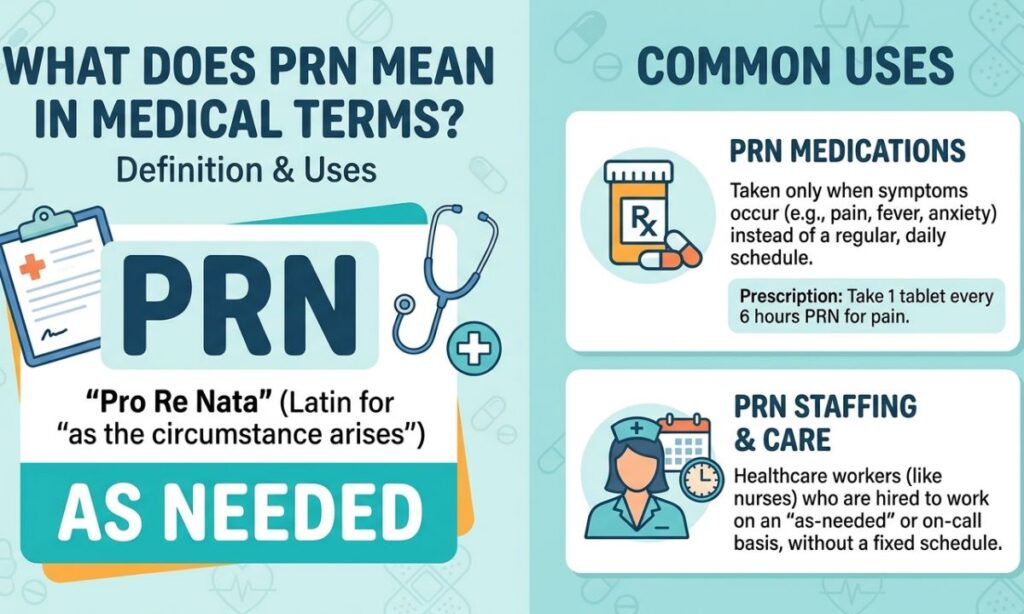
You may have spotted “PRN” on a prescription label, a hospital chart, or a nursing job ad and wondered what it really says. So, what does PRN mean in medical terms? It means “as needed,” and it tells you a medicine or treatment should be used only when a certain symptom shows up.
This guide explains the meaning, the Latin origin, how nurses and pharmacists use PRN, and how it differs from scheduled dosing. You will also find safety rules, common myths, and how PRN is used in different countries.
What Does PRN Mean in Medical Terms?
In medical terms, PRN means “as needed.” It comes from the Latin phrase pro re nata. A PRN order lets a patient take or receive a medicine only when a specific need appears, such as pain, nausea, or wheezing.
The word “needed” does not mean “whenever you feel like it.” A PRN order still has limits, such as the reason for use, the dose, and the shortest gap between doses.
What is PRN mean
PRN means a medicine or treatment is given only when a symptom or situation calls for it, instead of at set times. The prescriber names the symptom (for example, “for headache”) so the patient knows when the order applies.
Think of it as a safety net. The medicine waits in the cabinet until the symptom appears, then you use it within the dose limits on the label.
Simple PRN Examples on Prescriptions
These short examples show how what does PRN mean in medical terms looks in real life. They are made-up samples for learning, not medical advice.
| Sample prescription line | Plain English meaning |
| Ibuprofen 400 mg every 6 hours PRN pain | Take it only when you have pain, and wait at least 6 hours between doses |
| Ondansetron 4 mg every 8 hours PRN nausea | Take it only when you feel sick to your stomach |
| Albuterol inhaler 2 puffs every 4 hours PRN wheeze | Use it only when you wheeze or feel short of breath |
| Cetirizine 10 mg once daily PRN allergy | Take it only on days when allergy symptoms bother you |
Key takeaway: Every good PRN order has three parts: the reason, the dose, and the minimum time between doses.
PRN Origin and Latin Background
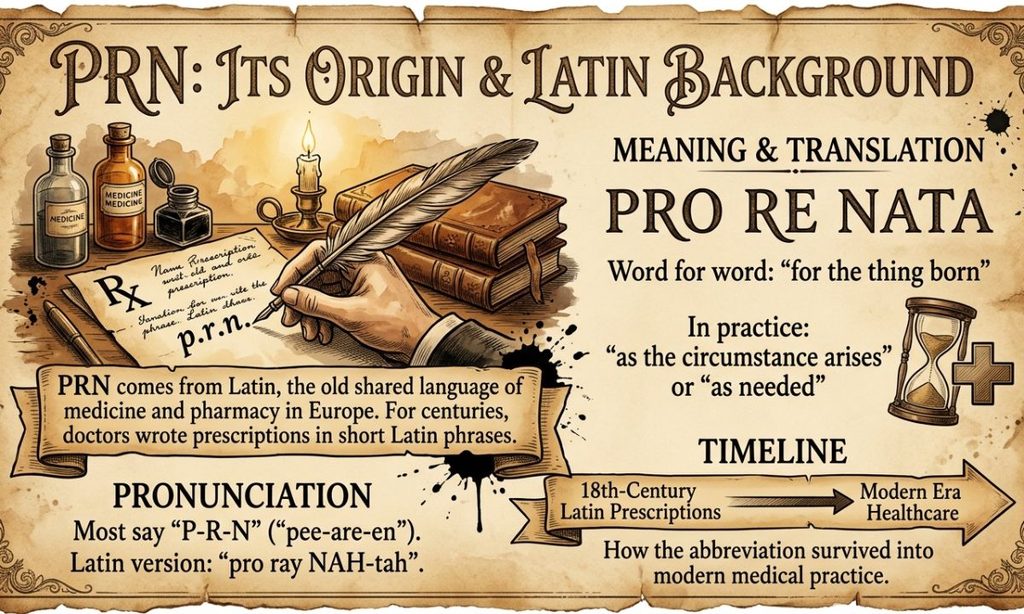
PRN comes from Latin, the old shared language of medicine and pharmacy in Europe. Doctors wrote prescriptions in short Latin phrases for centuries. Many of those abbreviations, including PRN, survived into modern English-language healthcare.
What is the full meaning of PRN
The full form of PRN is “pro re nata.” Word for word, it roughly means “for the thing born,” and in practice it means “as the circumstance arises” or “as needed.”
So the phrase is really about circumstances. When the circumstance (a symptom) appears, the order applies.
PRN Medical abbreviation pronunciation
Most people say PRN as three letters: “pee, are, en.” Healthcare workers almost never say the full Latin phrase out loud.
If you want the Latin version, it is commonly said as “pro ray NAH-tah.” Pronunciation of Latin varies, so you may hear small differences.
Timeline: How PRN Entered Medicine
PRN grew out of the long tradition of writing prescriptions in Latin shorthand. Exact first-use dates are hard to confirm, so this timeline is described by era rather than by specific years.
| Era | What happened |
| Early centuries of European medicine | Latin became the common written language for physicians and apothecaries |
| Handwritten prescription era | Short Latin abbreviations saved time and became standard on prescriptions |
| 20th century | English-language healthcare kept many Latin terms, including PRN, on charts and labels |
| Modern electronic records | PRN stays in wide use, while some regions prefer plain wording like “when required” |
PRN Meaning Nursing
In nursing, PRN means a nurse may give a medication or treatment when the patient’s condition meets the order’s criteria. The nurse checks the patient first, decides whether the need is real, and then documents what was given and why.
The phrase “PRN meaning nursing” also has a second use in staffing. You will see it explained below.
Read Also This Blog BFF Meaning
PRN Orders in Hospital Settings
In a hospital, a PRN order is written by a prescriber and carried out by a nurse when the patient shows the listed symptom. Typical examples include pain relief, anti-nausea medicine, and sleep aids.
The nurse assesses the patient, gives the dose, and returns later to check if it worked. That follow-up note is a normal part of PRN care.
PRN Orders in Long-Term and Hospice Care
In long-term and hospice care, PRN orders help staff respond quickly to changing symptoms without calling a doctor every time. Comfort is the main goal.
Common hospice PRN needs include pain, breathlessness, restlessness, and constipation. Orders are usually clear about dose limits so caregivers can act safely, even at night.
What Is a PRN Nurse?
A PRN nurse is a nurse who works on an as-needed basis instead of a fixed weekly schedule. Facilities call them in when patient numbers rise or regular staff are away.
This role is often similar to a per diem nurse. PRN nurses usually have flexible hours, though benefits and guaranteed shifts differ by employer.
What is PRN in medication
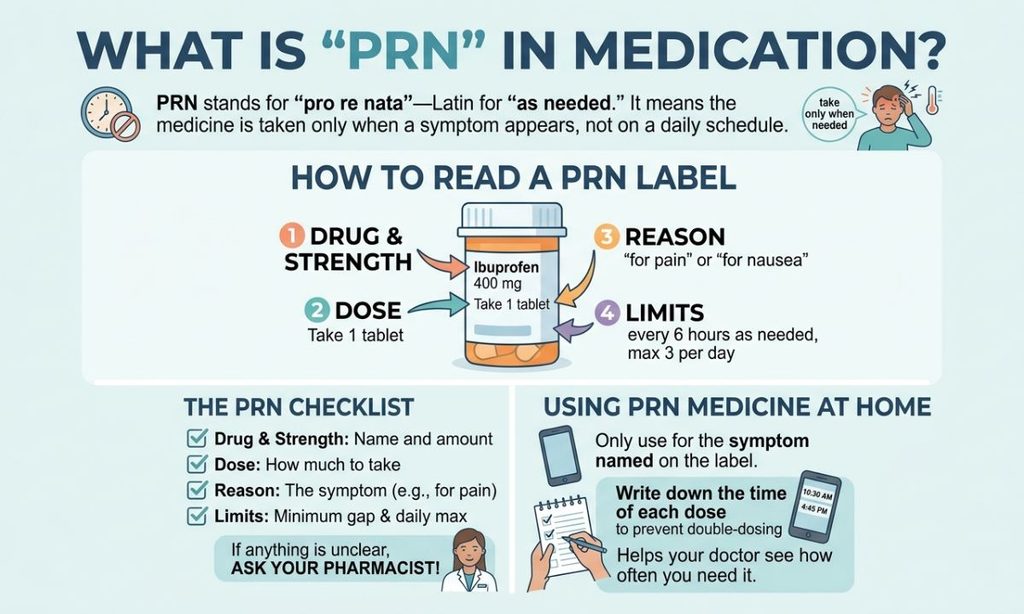
In medication, PRN means the drug is taken only when a symptom appears, not on a daily clock. The label should tell you the symptom, the dose, and the minimum gap between doses.
How to Read a PRN Label
To read a PRN label, look for four things: the drug, the dose, the symptom, and the limits. Here is a quick checklist.
- Drug and strength: the name and amount per tablet or puff.
- Dose: how much to take each time.
- Reason: the symptom, such as “for pain” or “for nausea”.
- Limits: the shortest time between doses and the daily maximum.
If any of these four items is missing or unclear, ask your pharmacist before you take the medicine.
Using PRN Medicine at Home
At home, use PRN medicine only for the symptom named on the label, and follow the dose gap exactly. Write down the time of each dose so you do not lose track.
Keeping a simple note on your phone or on paper helps prevent accidental double dosing. It also gives your doctor a clear picture of how often you need the medicine.
PRN Use in Mental Health Care
In mental health care, PRN medicines are used for sudden symptoms such as severe anxiety, agitation, or trouble sleeping. They are meant for short-term relief while the main treatment plan does the long-term work.
Because some of these medicines can cause sleepiness or dependence, clinicians watch PRN use closely. If you need a PRN dose often, tell your care team so the main plan can be adjusted.
Read Also This Blog KMT Meaning
PRN medication examples
Common PRN medications include pain relievers, anti-nausea drugs, rescue inhalers, and allergy medicines. The right choice depends on your symptom and health history, so these are examples only.
Common PRN Drugs by Symptom
| Symptom | Example drug class | Why PRN |
| Mild to moderate pain | Acetaminophen (paracetamol), NSAIDs | Pain comes and goes, so constant dosing is not needed |
| Nausea | Antiemetics | Nausea is often short-lived and unpredictable |
| Wheezing or shortness of breath | Rescue inhalers (bronchodilators) | Symptoms appear suddenly and need fast relief |
| Allergy flare | Antihistamines | Needed mainly on high-exposure days |
| Constipation | Laxatives | Used only when bowel habits slow down |
| Anxiety or panic | Short-acting anti-anxiety medicines | Reserved for sudden, severe episodes |
| Chest pain from angina | Nitroglycerin under the tongue | Taken when an episode begins |
PRN medical condition
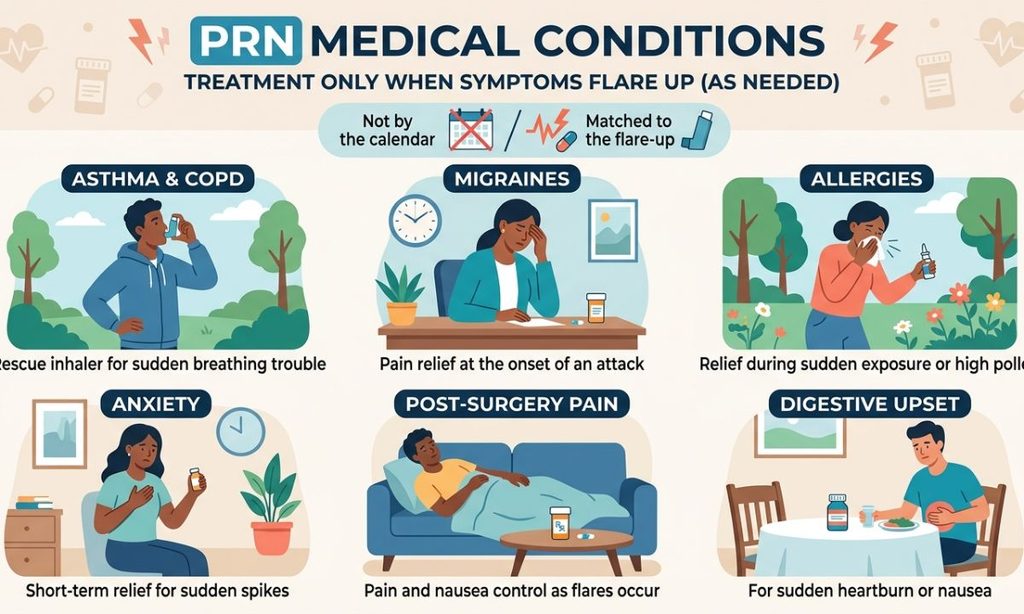
A PRN medical condition is any health problem where symptoms flare up now and then, so treatment is used only during the flare. The treatment is matched to the episode, not to the calendar.
Conditions Where PRN Is Commonly Used
PRN orders are common in conditions with unpredictable or short-lived symptoms. Examples include:
- Asthma and COPD (rescue inhaler for sudden breathing trouble)
- Migraine and tension headache (pain relief when an attack starts)
- Angina (quick relief during chest pain)
- Allergies (relief during exposure or high pollen days)
- Post-surgery recovery (pain and nausea control)
- Anxiety disorders (short-term relief for sudden spikes)
- Digestive upset (heartburn, nausea, constipation)
Chest pain, severe breathlessness, or a sudden change in symptoms can be an emergency. Do not treat these at home with PRN medicine alone.
PRN vs Scheduled Dosing Table
PRN dosing is based on symptoms, while scheduled dosing is based on the clock. Here is how what does PRN mean in medical terms compares with a fixed schedule.
| Feature | PRN | Scheduled |
| Timing | Only when needed | At set times each day |
| Trigger | A symptom or event | The clock or a routine |
| Purpose | Relieve flare-ups | Keep steady levels in the body or prevent problems |
| Example | Pain tablet for a headache | Blood pressure tablet every morning |
Key Insight: Symptom, Not Clock
The key idea is that PRN follows your symptom, not the time on the clock. If the symptom is gone, you do not take the dose. If it returns, you can take the next dose once the minimum gap has passed.
Remember: Some medicines work only when taken regularly, such as blood pressure or antibiotic courses. Never switch a scheduled medicine to PRN on your own.
PRN vs SOS
PRN and SOS both mean “as needed,” but SOS is more common in South Asia and comes from the Latin “si opus sit,” meaning “if necessary.” In many cases, they are used the same way on a prescription.
SOS here has nothing to do with the emergency distress signal. It simply tells the patient to use the medicine if the symptom appears.
Read Also This Blog What Does SU Mean
PRN vs STAT vs Per Diem
These three terms look alike but mean very different things. STAT means “immediately,” PRN means “as needed,” and per diem is mostly about work shifts.
| Term | Full form | Meaning | Where used |
| PRN | Pro re nata | As needed | Medication orders, nursing care, staffing |
| STAT | Statim | Immediately | Urgent tests and medicines in hospitals |
| Per diem | Per diem | By the day | Staffing and daily-rate work |
PRN vs “When Required” in the UK
In the UK, “when required” is the plain-English version of PRN. Prescribers and pharmacists often write “when required” on labels, though PRN still appears on hospital drug charts.
Both mean the same thing. The aim of the plain wording is to reduce confusion for patients who do not know Latin abbreviations.
Types of PRN Orders and Uses
PRN is used in three main ways: medication orders, treatments and nursing actions, and staffing. The meaning is always the same idea of “as needed,” but the setting changes.
PRN Medication Orders
A PRN medication order is a prescriber’s instruction to give a drug only when a named symptom appears. It includes the drug, dose, route, reason, and minimum time between doses.
Many orders also list a daily maximum. For example, a nurse may be allowed to give a pain medicine up to four times in 24 hours, and no more.
PRN Treatments and Nursing Interventions
PRN is not limited to pills. It can also apply to treatments and nursing actions. Examples include oxygen for low oxygen levels, a nebulizer for wheezing, a repositioning routine for comfort, or a dressing change when a wound leaks.
The order explains the trigger, so staff know exactly when to act.
PRN Staffing and Per Diem Jobs
In work settings, PRN describes a job where you are called in as needed, not scheduled every week. Hospitals, clinics, and care homes use PRN staff to cover busy periods, sick leave, and holidays.
PRN workers often earn a higher hourly rate than regular staff, but may get fewer benefits. Always ask about hours, pay, and benefits before accepting a PRN position.
PRN Safety Rules to Follow
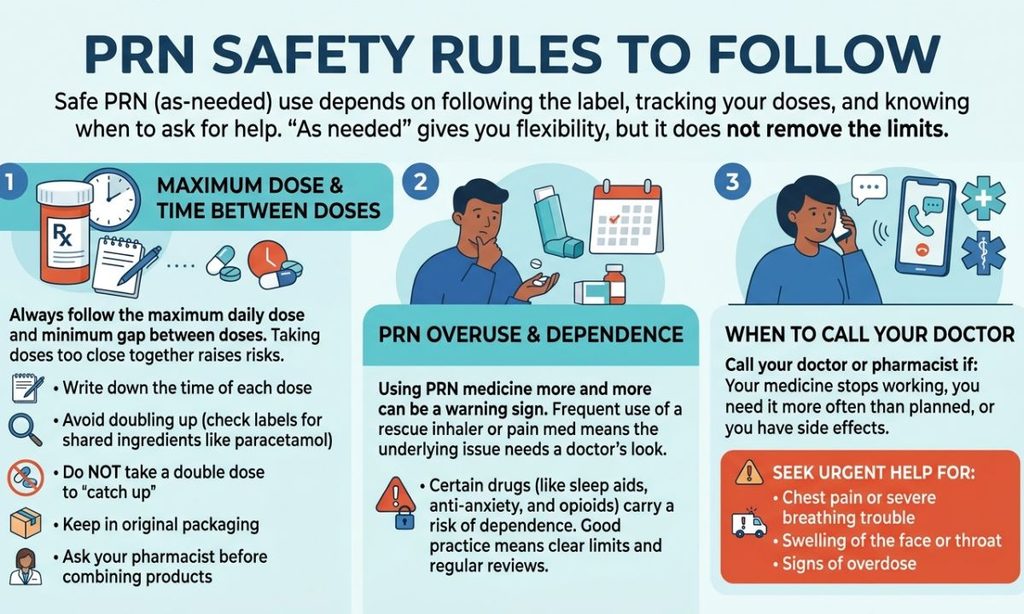
Safe PRN use depends on following the label, tracking your doses, and knowing when to ask for help. “As needed” gives you flexibility, but it does not remove the limits.
Maximum Dose and Time Between Doses
Always follow the maximum daily dose and the minimum gap between doses printed on your label. Taking doses too close together can raise the risk of side effects and overdose.
Safety tip: Many products share the same active ingredient. Cold and flu remedies, for example, may also contain paracetamol (acetaminophen), so check labels to avoid doubling up.
- Write down the time of each dose.
- Do not take a double dose to “catch up.”
- Keep medicines in their original packaging.
- Ask your pharmacist before combining two products.
PRN Overuse and Dependence Concerns
Using a PRN medicine more and more often can be a warning sign, not just a habit. Frequent use of a rescue inhaler may mean asthma is poorly controlled. Frequent use of pain medicine may mean the cause of the pain needs a closer look.
Some PRN drugs, such as certain sleep aids, anti-anxiety medicines, and opioid pain relievers, carry a risk of dependence. There is also a debate in healthcare about how much freedom PRN orders give staff, especially in mental health units. Good practice means clear criteria, careful documentation, and regular review.
Read Also This Blog LYT Meaning in Text
When to Call Your Doctor
Call your doctor or pharmacist if a PRN medicine stops working, if you need it more often than planned, or if you have side effects. Seek urgent medical help for chest pain, severe breathing trouble, swelling of the face or throat, or signs of overdose.
- You reach the daily maximum on several days in a row.
- The symptom is getting worse or changing.
- You feel drowsy, dizzy, or confused after a dose.
- You are unsure whether a new medicine is safe with your PRN drug.
Common PRN Myths and Facts
Most PRN confusion comes from reading “as needed” too loosely. The four myths below clear up the most common mistakes.
Myth: PRN Means Once Daily
Fact: PRN does not mean once daily. It means “as needed,” and the label may allow several doses in a day, with a minimum gap and a daily maximum. Some PRN items are used a few times a month, others several times a day.
Myth: PRN Allows Unlimited Doses
Fact: PRN never means unlimited. Every PRN order has a limit, even if the limit is short. Going beyond it can cause harm, so treat the maximum as a firm line.
Myth: PRN Means Optional, Unimportant
Fact: PRN medicines can be critical. A rescue inhaler or an emergency angina tablet may protect your life. “As needed” describes the timing, not how important the medicine is.
Myth: Feeling Better Means Stop Everything
Fact: this is true for PRN medicine, but not for scheduled medicine. Once your symptom has gone, you can stop the PRN dose. Your regular medicines, such as antibiotics or blood pressure tablets, must be continued as prescribed unless your doctor tells you otherwise.
PRN Usage Across Countries
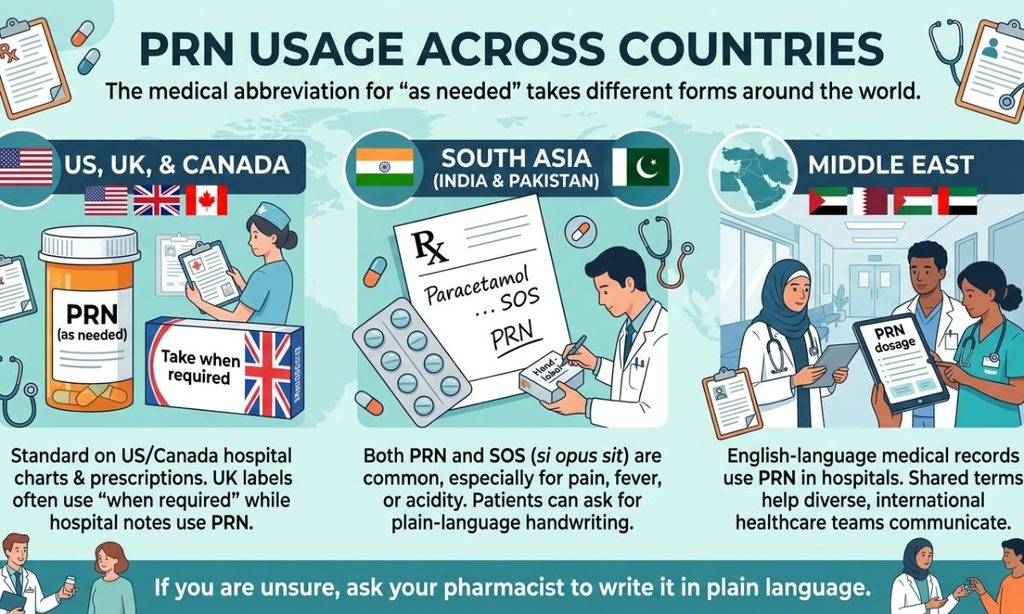
PRN is understood in many countries, but local habits and plain-language wording differ. English-language healthcare tends to use PRN, while some regions prefer other terms.
PRN in US, UK, and Canada
In the US and Canada, PRN is standard on prescriptions, hospital charts, and staffing contracts. In the UK, “when required” is often used on pharmacy labels, while PRN is still common in hospitals and nursing notes.
Across all three, the idea is the same: use only when needed, within safe limits.
PRN and SOS in South Asia
In South Asia, you may see both PRN and SOS on prescriptions. SOS is especially familiar to patients in countries such as India and Pakistan, where it often appears next to medicines for pain, fever, or acidity.
If you are unsure which one applies to you, ask the pharmacist to write it in plain language on the packet.
PRN Use in Middle Eastern Hospitals
In many Middle Eastern hospitals, English-language medical records use PRN in the same way as in Western hospitals. Healthcare teams are often international, so shared abbreviations help staff communicate.
Patient-facing labels may add instructions in Arabic or another local language. Always ask for a translated explanation if the English wording is unclear.
Read Also This Blog WTV Meaning in Text
Questions to Ask Your Pharmacist
Before you start any PRN medicine, ask your pharmacist a few simple questions to make sure you use it safely. A short conversation can prevent common mistakes.
- What symptom is this medicine meant for?
- How much can I take each time?
- How long should I wait between doses?
- What is the most I can take in 24 hours?
- Is it safe with my other medicines or health conditions?
- What side effects should I watch for?
- When should I stop and call my doctor?
Frequently Asked Questions
What does PRN stand for in medical terms?
PRN stands for “pro re nata,” a Latin phrase meaning “as needed.” In medical terms, it tells you a medicine or treatment is used only when a specific symptom appears.
Does PRN mean daily?
No. PRN does not mean daily. It means the medicine is used only when needed. You might take it several times in one day or not at all for weeks, depending on your symptoms and the label limits.
Can you take PRN medication every day?
Yes, you can, if you truly need it and stay within the label limits. However, needing a PRN medicine every day is a good reason to talk to your doctor, since the main treatment plan may need to change.
Is PRN the same as optional?
No. PRN is not the same as optional. It means the timing depends on your symptoms. The medicine itself may still be very important.
What is a PRN nurse?
A PRN nurse is a nurse who works as needed, usually covering extra shifts and absences. The schedule is flexible, and the work is similar to per diem nursing.
Why do doctors prescribe PRN?
Doctors prescribe PRN medicine when symptoms come and go, so constant dosing is not needed. It also lets patients treat flare-ups quickly without waiting for a new prescription or a visit.
Is PRN safe?
PRN is safe when you follow the dose, the minimum gap, and the daily maximum. Problems usually start when people take too much, combine similar products, or use PRN medicine for symptoms the label does not cover.
Conclusion
So, what does PRN mean in medical terms? It means “as needed,” from the Latin “pro re nata,” and it links a medicine or treatment to a symptom instead of a schedule. Patients, nurses, and pharmacists all rely on it, but the idea always comes with clear limits.
Read the label, track your doses, and ask questions when anything feels unclear. If you find yourself using a PRN medicine more often than planned, speak with your doctor. That conversation can keep you safe and help your treatment work better.
